Free template
Free Debit Note Template, Format & Examples
A seller’s debit note records an additional charge against an invoice already issued. A simple debit note format still identifies the original invoice, the reason for the change and the amount being adjusted. A buyer’s debit note can instead record a credit requested from a supplier, such as for returned goods. Start by identifying who is issuing the note and which invoice it concerns. Download the free PDF, Word or Excel template below, then follow the examples and the country guidance for your situation.
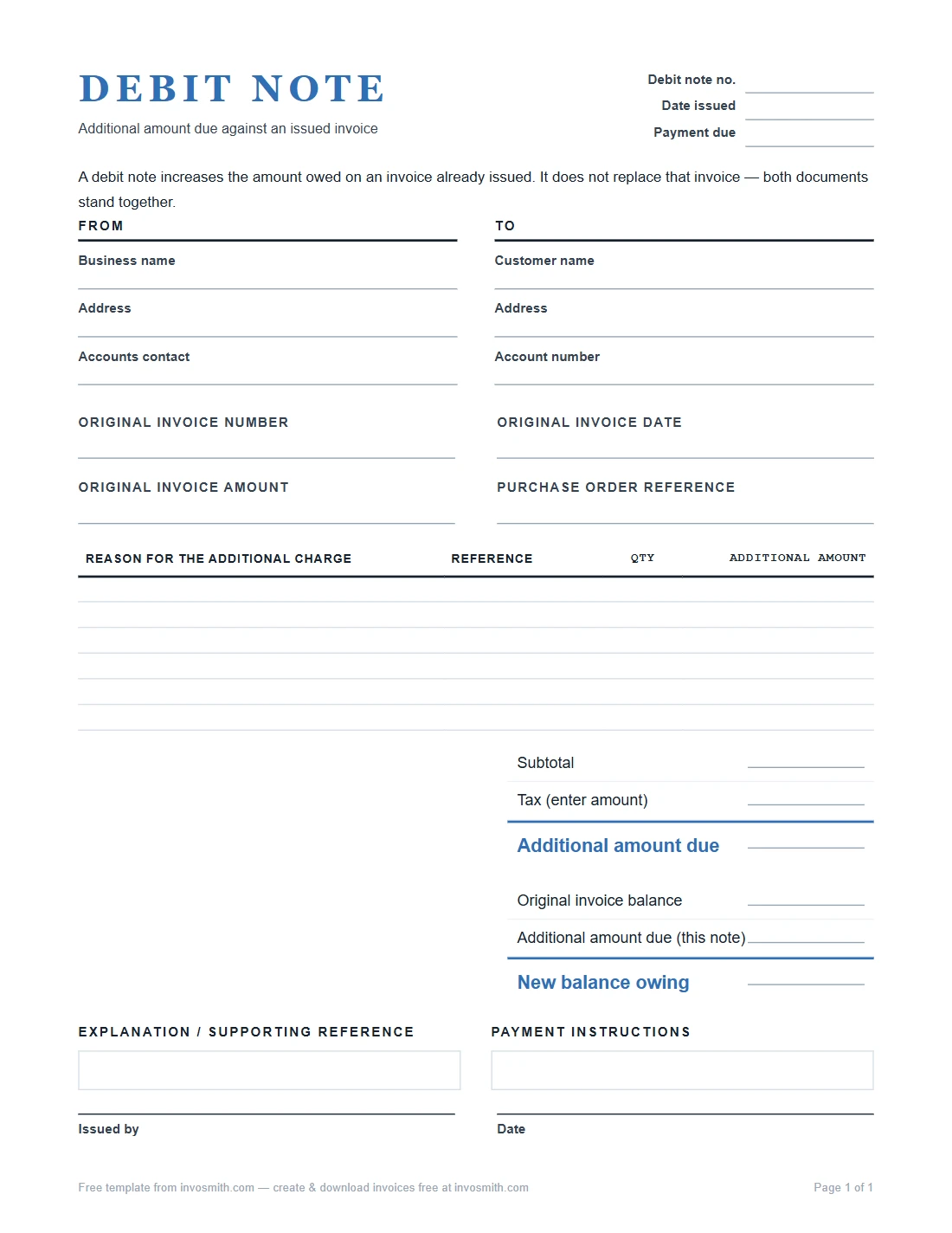
These downloads are seller-style templates for additional amounts due, not approved local tax forms or an e-invoice submission service. No sign-up is needed to download them. For a buyer return, adapt the editable Word document so its labels describe a credit request rather than an extra charge.
Samples
Debit note samples and examples
Sample 1: seller corrects an omitted freight charge
Invoice INV-0913, dated July 21, billed Kessler Fabrication $2,400.00 for machinery. An agreed $180.00 freight charge was omitted. The invoice is still wholly unpaid, and this illustration adds no tax. The seller issues DN-0914 on July 30. The new money requested is $180.00; $2,580.00 is the resulting unpaid balance. “Omitted from invoice INV-0913” lets the customer compare the note with the invoice and the delivery terms instead of guessing what the extra charge covers.
Sample 2: buyer requests credit for returned goods
Fictional buyer Alder Workshop returns three damaged brackets to supplier Northbridge Parts. The supplier invoice NP-6208 charged $50.00 per bracket and has an unpaid balance of $1,000.00. The buyer sends debit note BDN-0026 requesting $150.00 credit, with return reference RET-104 and photographs. Tax adjustments are outside this illustration. This is a request to reduce what the buyer owes, not a seller’s demand for an extra $150.00. The $850.00 figure is conditional on the supplier accepting and documenting the credit. Relabel the Word template’s additional-charge and balance wording accordingly; do not use the seller-style Excel addition formula unchanged for a return.
Sample 3: additional charge on a Malaysian e-Invoice
Fictional supplier Meranti Office Fitouts omitted an agreed RM300.00 installation charge from an RM5,000.00 invoice to Bayu Studio. Both amounts below are before tax. This is a conceptual Debit Note e-Invoice example, not a completed submission or a validated document. MyInvois uses Debit Note for additional charges on a previous e-Invoice. Its adjustment reference is the original document’s IRBM unique identifier, not only an internal invoice number. Use the actual validated identifier in the applicable system. The files provide an editable document outside MyInvois. [Document types](https://sdk.myinvois.hasil.gov.my/types/); [IRBM guideline, Appendix 1, field 21](https://www.hasil.gov.my/wp-content/uploads/IRBM-e-Invoice-Guideline.pdf).
Download the debit note template
Debit Note Template (PDF / Word / Excel)
All three formats include the issuer and customer, note number and dates, original invoice reference, additional-charge lines, tax entry and balance reconciliation. Print the PDF to complete by hand, or edit the Word document. In Excel, enter each line amount yourself: formulas total the lines, add the manually entered tax amount and calculate the new balance from the original balance you enter. Excel does not multiply quantity by a unit price or choose a tax rate.
The files include an Issued by and Date area, an original invoice date field, a purchase order reference and space for supporting explanations. Keep the original invoice alongside the completed note.
The blank template is not automatically a Philippine BIR-authorized form, an Indian GST debit note or a validated Malaysian e-Invoice. Use the country sections below to identify additional requirements before issuing it.
Simple debit note format and fields
Make the document traceable to an existing invoice and an agreed reason for changing it. These nine field jobs describe a seller-issued note; the buyer-specific changes follow below. For a reduction instead of an added charge, use the credit memo template.
- Debit note number and date. Use a unique reference such as DN-0001 and the issue date. A separate DN- sequence is a useful way to distinguish corrections from original invoices; apply any local numbering rules.
- Reference to the original invoice. Enter its number and date, not just the customer’s name. This is expressly required for the UK and Indian cases described below; the EU rule instead requires a specific, unambiguous reference and an amendment.
- Customer details. Match the original customer’s name and billing address. Complete your own business details too, so the recipient can identify both parties.
- Reason for the debit, line by line. Give each additional charge a specific explanation and supporting reference: “freight omitted from INV-0913” is more useful than “adjustment”. Attach the agreed quote, change approval or other support where needed.
- Amount per line. Enter only the extra amount for that line, not the original invoice total again. In this Excel file, line amounts are manual entries.
- Total additional amount due. Reconcile the extra line amounts and any applicable tax. Label this as the amount added by this note, not the whole account balance.
- Tax, if any. The template’s tax field is manual. Enter a verified amount where applicable; it does not calculate tax or establish an exemption. Add any tax-rate or registration details required locally.
- New balance and payment terms. Start with the actual unpaid balance, add this note and account for any other verified payments or credits. State when the additional amount is due under the agreement; do not treat the original invoice amount as unpaid if it has already been paid.
- Issued by, with signature where needed. Complete the Issued by and Date area. Add the issuer’s signature or authorized approval where your agreement or applicable rules require it; the downloadable form does not include a separate field labelled Signature.
Three debit note examples
These samples use fictional businesses and illustrative amounts. They show document wording and arithmetic. The first preserves the original INV-0913 example; the second changes the issuer and direction of the adjustment; the third explains an e-invoice scenario without claiming the download can submit it.
Sample 1: seller corrects an omitted freight charge
Invoice INV-0913, dated July 21, billed Kessler Fabrication $2,400.00 for machinery. An agreed $180.00 freight charge was omitted. The invoice is still wholly unpaid, and this illustration adds no tax. The seller issues DN-0914 on July 30.
| Entry | Reason or reference | Amount |
|---|---|---|
| Debit Note DN-0914 | July 30; INV-0913 dated July 21; Kessler Fabrication | |
| Original unpaid balance | Invoice INV-0913 | $2,400.00 |
| Freight — palletized delivery, dock to dock | Agreed freight omitted from INV-0913 | $180.00 |
| Tax (if applicable) | — | |
| Total additional amount due | This debit note only | $180.00 |
| New balance on account | $2,400.00 + $180.00 | $2,580.00 |
The new money requested is $180.00; $2,580.00 is the resulting unpaid balance. “Omitted from invoice INV-0913” lets the customer compare the note with the invoice and the delivery terms instead of guessing what the extra charge covers.
Sample 2: buyer requests credit for returned goods
Fictional buyer Alder Workshop returns three damaged brackets to supplier Northbridge Parts. The supplier invoice NP-6208 charged $50.00 per bracket and has an unpaid balance of $1,000.00. The buyer sends debit note BDN-0026 requesting $150.00 credit, with return reference RET-104 and photographs. Tax adjustments are outside this illustration.
| Field | Sample entry |
|---|---|
| Issuer / recipient | Alder Workshop (buyer) → Northbridge Parts (supplier) |
| Buyer debit note | BDN-0026; August 6 |
| Original invoice | NP-6208, dated August 1 |
| Reason / support | Three damaged brackets returned; RET-104; photographs attached |
| Credit requested | 3 × $50.00 = $150.00 |
| Unpaid balance before request | $1,000.00 |
| Balance if the credit is accepted | $1,000.00 − $150.00 = $850.00 |
| Status / next document | Credit requested; await supplier confirmation and the relevant credit document |
This is a request to reduce what the buyer owes, not a seller’s demand for an extra $150.00. The $850.00 figure is conditional on the supplier accepting and documenting the credit. Relabel the Word template’s additional-charge and balance wording accordingly; do not use the seller-style Excel addition formula unchanged for a return.
Sample 3: additional charge on a Malaysian e-Invoice
Fictional supplier Meranti Office Fitouts omitted an agreed RM300.00 installation charge from an RM5,000.00 invoice to Bayu Studio. Both amounts below are before tax. This is a conceptual Debit Note e-Invoice example, not a completed submission or a validated document.
| Field | Conceptual sample entry |
|---|---|
| Supplier / buyer | Meranti Office Fitouts → Bayu Studio |
| Document type / internal number | Debit Note / DN-MY-0042 |
| Original internal invoice number | INV-MY-0188 |
| Original e-Invoice reference | Actual IRBM unique identifier from the validated original; no real identifier is supplied in this sample |
| Reason | Agreed installation omitted from the original e-Invoice |
| Original amount / extra charge | RM5,000.00 / RM300.00, before tax |
| Combined value before tax | RM5,000.00 + RM300.00 = RM5,300.00 |
| Tax / payment status | Not calculated here; combined value is not a statement of unpaid balance |
MyInvois uses Debit Note for additional charges on a previous e-Invoice. Its adjustment reference is the original document’s IRBM unique identifier, not only an internal invoice number. Use the actual validated identifier in the applicable system. The files provide an editable document outside MyInvois. Document types; IRBM guideline, Appendix 1, field 21.
Debit note or a new invoice?
As a practical starting point, correct an already billed transaction with a document linked to that invoice; bill a genuinely new order or job with a new invoice. Ask which original invoice the extra amount belongs to. If there is none, do not invent a reference just to use a debit note.
The required correction document depends on applicable rules. HMRC describes a debit note as an alternative to a supplementary invoice for increased consideration. Singapore requires a tax invoice or qualifying simplified tax invoice for the relevant standard-rated supplies; a debit note can qualify only within the simplified-invoice rules explained below. HMRC VATREC13010; IRAS.
Keep the original and the correction together. Give the customer the reason and supporting agreement, and distinguish an extra charge from the remaining account balance. An original invoice, debit note and later payment should not be mistaken for three separate sales.
Debit note names and uses by country
The table is a navigation aid to the scoped rules below, checked against the cited material on September 25, 2026.
| Jurisdiction | Term or category | Issuer and purpose | Official basis |
|---|---|---|---|
| Philippines | Debit memo; supplementary document | Business documents an adjustment; the memo is not input-tax claim proof | BIR RR 7-2024, §2(2) |
| Malaysia | Debit Note / Self-Billed Debit Note | Additional charge to the corresponding prior e-Invoice type; self-billed version is buyer-issued | MyInvois types |
| India | Debit note, including supplementary invoice under s34 | Registered supplier corrects understated taxable value or tax | CGST Act s34 |
| United Kingdom | Debit note or supplementary invoice | Supplier documents an increase; VAT validity has separate conditions | HMRC manual |
| Singapore | Debit note; limited simplified-tax-invoice use | No-GST payment request or supplier credit record; see the exception below | IRAS |
| Australia | Adjustment note | GST adjustment documentation, not a universal synonym for every debit memo | ATO |
| European Union | Invoice-amending document | An amendment specifically and unambiguously linked to the initial invoice | VAT Directive Art 219 |
Country rules to check before issuing a debit note
Sources checked September 25, 2026; the EU excerpt uses the April 14, 2025 consolidated version.
Philippines: a debit memo is a supplementary document
BIR RR 7-2024 §2(2) expressly includes debit and credit memos among supplementary documents. For VAT purposes they are not valid proof supporting a buyer’s input-tax claim. Do not substitute a debit memo for the required invoice. Official RR 7-2024, pages 1–2.
Section 6(B)(15) requires the following warning in bold, conspicuously on the face of the supplementary document: THIS DOCUMENT IS NOT VALID FOR CLAIM OF INPUT TAX. Other applicable document information is still required. RR 7-2024, page 13.
For businesses that will use manual invoices, §7(1) requires obtaining/applying for an Authority to Print principal and supplementary documents before an accredited printer prints them. Downloading this template does not grant ATP; adding the warning alone does not establish compliance. RR 7-2024, pages 14–15. Checked September 25, 2026.
Malaysia: use the correct e-Invoice adjustment type
MyInvois lists eight document-type categories: Invoice, Credit Note, Debit Note and Refund Note, plus their four self-billed counterparts. A Self-Billed Debit Note adds charges to a previous Self-Billed e-Invoice; it is not simply another name for the buyer-return request in sample 2. MyInvois types.
The original-document reference is mandatory where applicable for debit, credit and refund e-Invoices. Keep that reference distinct from the supplier’s internal document number. See IRBM e-Invoice Guideline v4.8, Appendix 1, fields 20–21, checked September 25, 2026. No eligibility, implementation-date or submission claim is made by this general template.
India: supplier-issued GST debit notes
Under CGST Act s34(3), where issued tax invoices understate the taxable value or tax payable, the registered supplier must issue the recipient one or more debit notes. Section 34(4) puts the details in the return for the month of issue; that is a reporting period, not a statement that the return is due on that month’s last day. CGST Act s34.
Rule 53(1A) lists nine entries, with different recipient particulars according to registration status. Check the following before treating a document as a GST debit note. CGST Rule 53, checked September 25, 2026.
- Supplier’s name, address and GSTIN.
- Nature of the document.
- Consecutive serial number, no more than 16 characters, unique for the financial year; the rule permits letters, numbers, hyphen/dash and slash in one or multiple series.
- Document issue date.
- Recipient’s name, address and GSTIN or UIN if registered.
- For an unregistered recipient: name, address, delivery address, state name and state code.
- Serial number(s) and date(s) of the corresponding tax invoice(s), or bill(s) of supply as applicable.
- Taxable supply value, tax rate and amount of tax debited.
- Supplier’s or authorized representative’s signature or digital signature.
United Kingdom: agreement date starts the 14-day window
For VAT validity, HMRC requires a genuine mistake, undercharge or agreed increase, and issue within 14 days of the supplier and customer agreeing the increase. It is not 14 days from the original invoice. VAT Notice 700 §18.2.4.
The seven listed particulars are shown below. Section 18.2.5 uses the VAT rate at the original supply’s tax point. Checked September 25, 2026.
- Note number and issue date.
- Supplier’s name, address and VAT registration number.
- Customer’s name and address.
- Related VAT invoice number(s) and issue date(s).
- Description identifying the affected goods or services.
- Increase excluding VAT.
- VAT rate and amount debited, expressed in sterling.
Singapore: the simplified tax invoice exception matters
IRAS limits ordinary debit-note use to no-GST payment requests or supplier credits. For other standard-rated supplies to GST-registered customers, issue a tax invoice or qualifying simplified tax invoice. A debit note can double as the latter when the GST-inclusive total is no more than S$1,000 and all required particulars are present. IRAS invoicing customers, checked September 25, 2026.
Those particulars include supplier name, address and GST number; issue date and identifying number; description; GST-inclusive total; and a statement that the price includes GST.
Australia: the $75 test concerns a decreasing GST adjustment
ATO guidance generally requires a valid adjustment note before making a decreasing adjustment, unless the adjustment is for GST of $75 or less. The threshold is the GST adjustment, not the whole sale amount; other circumstances can remove the requirement to hold a note. This is not a blanket threshold for issuing seller debit notes. ATO adjustment notes, updated September 14, 2026; checked September 25, 2026.
European Union: an amendment needs an unambiguous reference
Article 219 treats a document as an invoice when it both amends and refers specifically and unambiguously to the initial invoice. Merely mentioning an invoice does not satisfy both conditions. Article 220a(1)(b) allows simplified invoicing for these documents, subject to exclusions in paragraph (2); Article 226b(e) requires the reference and the specific details amended. VAT Directive, Articles 219, 220a and 226b.
This summary uses the April 14, 2025 consolidated text, checked September 25, 2026.
When the buyer issues the debit note
Make the direction explicit: “Credit requested for returned goods” or “Credit requested for overcharge”, not “Additional amount due”. Identify yourself as buyer and the recipient as supplier. Include the original invoice number/date, items and quantities affected, the reason, amount requested and supporting return or pricing reference. Record whether the request is awaiting approval or already agreed.
Keep the buyer’s request and the supplier’s response together. IRAS says buyer-issued debit notes to suppliers from whom credit is due must carry the details required for credit notes, and any later supplier credit notes should be compared to ensure figures match. IRAS guidance.
A buyer request is not proof that the supplier accepted the reduction, and it does not by itself establish a tax-credit entitlement. The credit invoice guide explains the supplier’s reducing-charge document. If you need the whole account rather than a single adjustment, use the billing statement template.
Complete the correction before sending it
Compare the note with the original invoice and the agreed terms. Check the issuer, invoice number/date, reason, currency, arithmetic, tax information and payment status. Confirm that “additional amount”, “credit requested” and “new balance” describe different figures correctly. Keep the completed document and supporting correspondence together.
For a genuinely new sale, use the invoice template for Excel or the online invoice creator. Those are original-invoice options, not a debit-note generator or government e-invoice integration.
Frequently asked questions
What is the difference between a debit note and an invoice?
In the seller correction workflow, an invoice bills the original transaction and a debit note records an additional amount against it. The note should identify the invoice and explain the change. Local tax law may treat a qualifying correction document as an invoice, so check the country guidance rather than relying on the title alone.
What is the difference between a debit note and a credit note?
A seller’s debit note increases the charge; a seller’s credit note reduces it. A buyer’s debit note is different: it can request a supplier credit for a return or overcharge. Identify the issuer before deciding which way the balance moves. See the credit invoice guide for the reducing-charge side.
Does the customer have to accept a debit note?
Do not assume the document itself creates agreement to an extra charge. Identify the agreed price, omitted charge or approved change and provide the supporting reference. Resolve a disputed amount with the customer; enforceability depends on the contract and applicable law, not just the words “debit note”.
Can I cancel a debit note I issued by mistake?
Do not silently delete a note already sent or recorded. Keep a traceable correction and notify the recipient. For a posted seller charge, a linked credit note may be the appropriate reversal, but use the cancellation or adjustment procedure required by your system and applicable rules. Government e-invoice systems can have separate procedures.
How should I number debit notes?
A dedicated prefix such as DN-0001 helps distinguish them from invoice numbers. Give each issued document a traceable reference and keep its link to the original invoice. For Indian GST notes, follow Rule 53(1A)’s financial-year uniqueness, permitted-character and 16-character rules described above; do not treat the sample prefix as a universal legal format.
Are debit note, debit memo and debit advice the same thing?
Do not decide from the label alone. A document called debit advice is not automatically an invoice adjustment. For this template, the relevant job is documenting a change tied to an invoice. Confirm the issuer, reason and effect on the amount owed before reusing another document’s wording; the country table explains specific official uses of debit note and debit memo.
Can a buyer issue a debit note?
A buyer can use one to document a requested supplier credit, as in the returned-goods example. Make it a credit request, supply the invoice and return references, and reconcile the supplier’s response. It is not the same as a seller’s additional-charge note or automatically a Malaysian Self-Billed Debit Note.
Can a Philippine debit memo support an input-tax claim?
BIR RR 7-2024 classifies debit/credit memos as supplementary documents, which are not valid proof for the buyer’s input-tax claim. Use the required invoice and follow the applicable rules; the required warning does not turn a memo into a tax invoice. RR 7-2024 §2(2).
Is there a deadline for a UK VAT debit note?
HMRC’s validity rule is 14 days from the supplier and customer agreeing the increase, not the original invoice date. The genuine-correction and required-particulars conditions still apply. VAT Notice 700 §18.2.4.
Can I submit this template as a Malaysian e-Invoice?
No. The PDF, Word and Excel downloads are not validated e-Invoices and do not submit to MyInvois. Sample 3 explains a Debit Note scenario and the original-document reference; issue an actual e-Invoice through the applicable system and its current requirements.
Why does Australian guidance refer to an adjustment note?
It is the GST adjustment-document category used in the cited ATO guidance, not a promise that any form titled debit note will qualify. The $75 exception concerns GST in a decreasing adjustment, and other exceptions exist. ATO adjustment notes.