How to Write a Quote for a Job (With a Worked Example)
To write a quote for a job, identify both parties, describe the work line by line, price each line from your own job inputs, name what is excluded, set an expiry date and explain exactly how the customer can accept. Keep tax, deposit and change terms explicit instead of relying on assumptions.
Start with the document, then use this guide to write the scope, price, exclusions and acceptance terms.
On this page
Write the quote in seven steps
Use the pricing calculator to build the job price from labor, materials, overhead and your chosen profit.
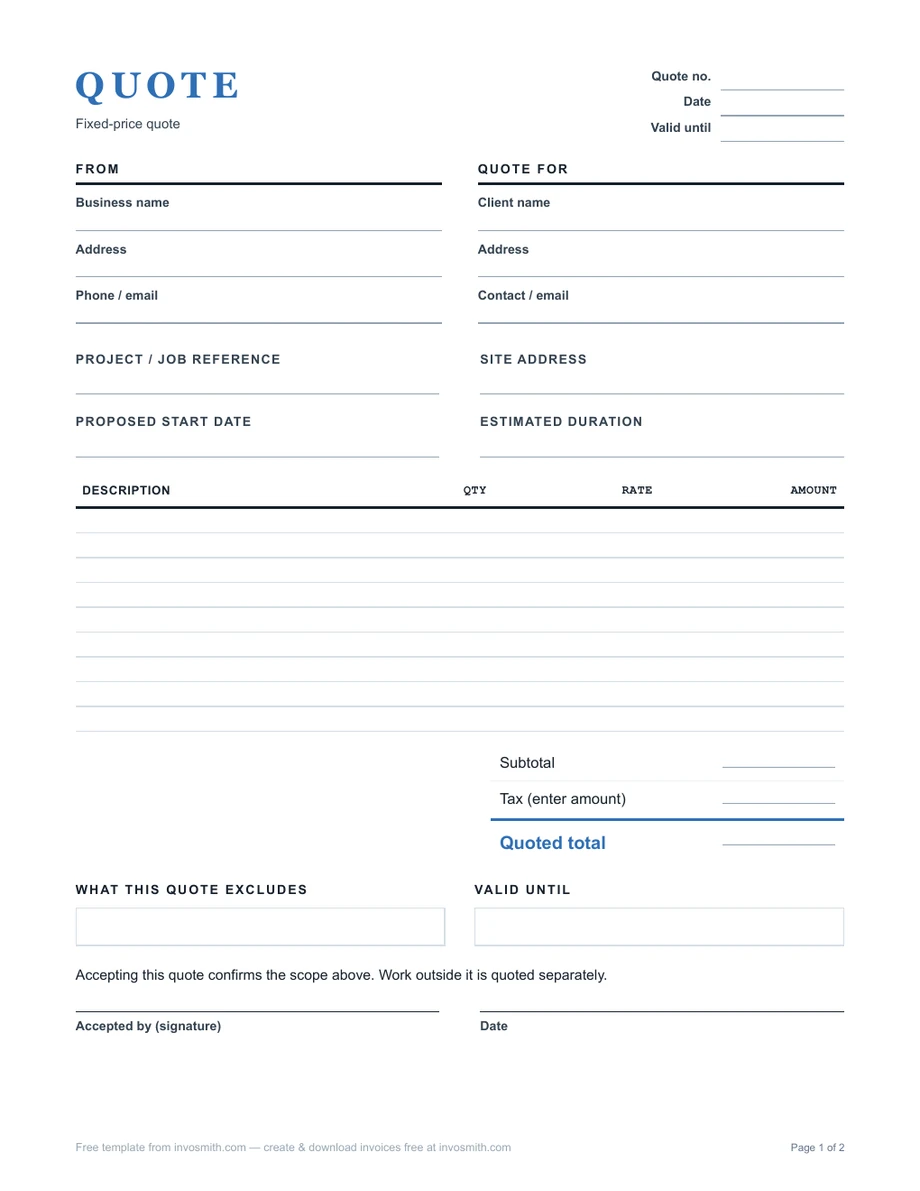
Open the free quote template first, then fill it in from top to bottom. The document is available as PDF, Word and Excel; use the format your customer can review without editing the original by accident.
- 1. Identify the quote. Add a quote number, issue date and a specific valid-until date.
- 2. Identify both parties. Add your business and contact details, then the customer and job-site details.
- 3. Define the scope. Give each deliverable, phase or service its own line rather than hiding the job inside one label.
- 4. Price the lines. Show the quantity, unit or pricing basis and amount. State whether tax is included, excluded or not applicable.
- 5. Name exclusions and assumptions. Record customer-supplied items, access assumptions, permits, disposal or other work outside the price.
- 6. State payment and change terms. Show any deposit, milestone, due date and the process for approving extra work.
- 7. Make acceptance explicit. Provide a signature/date field or a precise written-acceptance instruction.
Job quote sample: what goes in each field
The numbered regions below show both pages of the actual blank PDF. Match each number to the example and explanation in the field map. Tap either image to inspect it at full size. Example entries are fictional, not an accepted contract or a recommended deposit policy. Keep the same quote number on the quote and its attached terms.
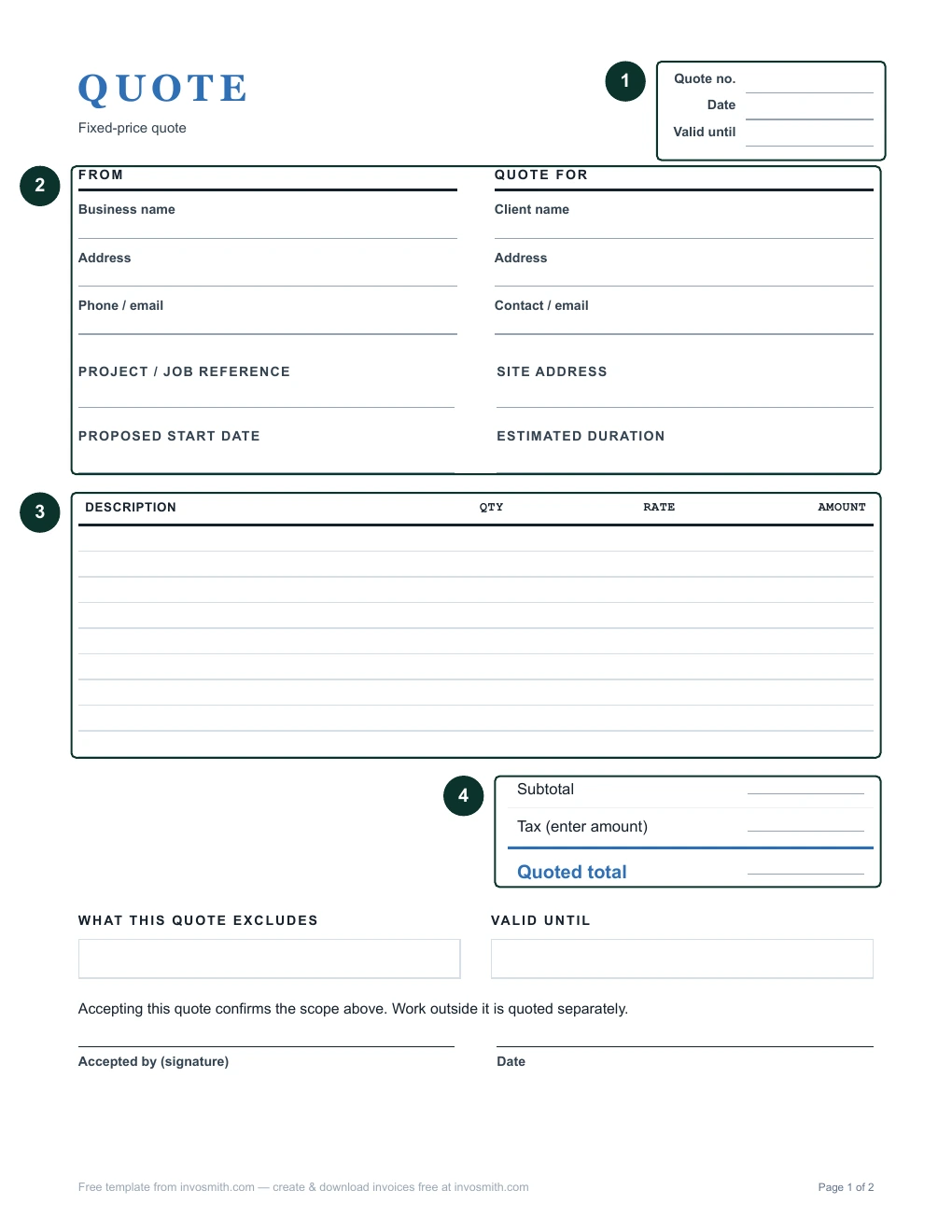
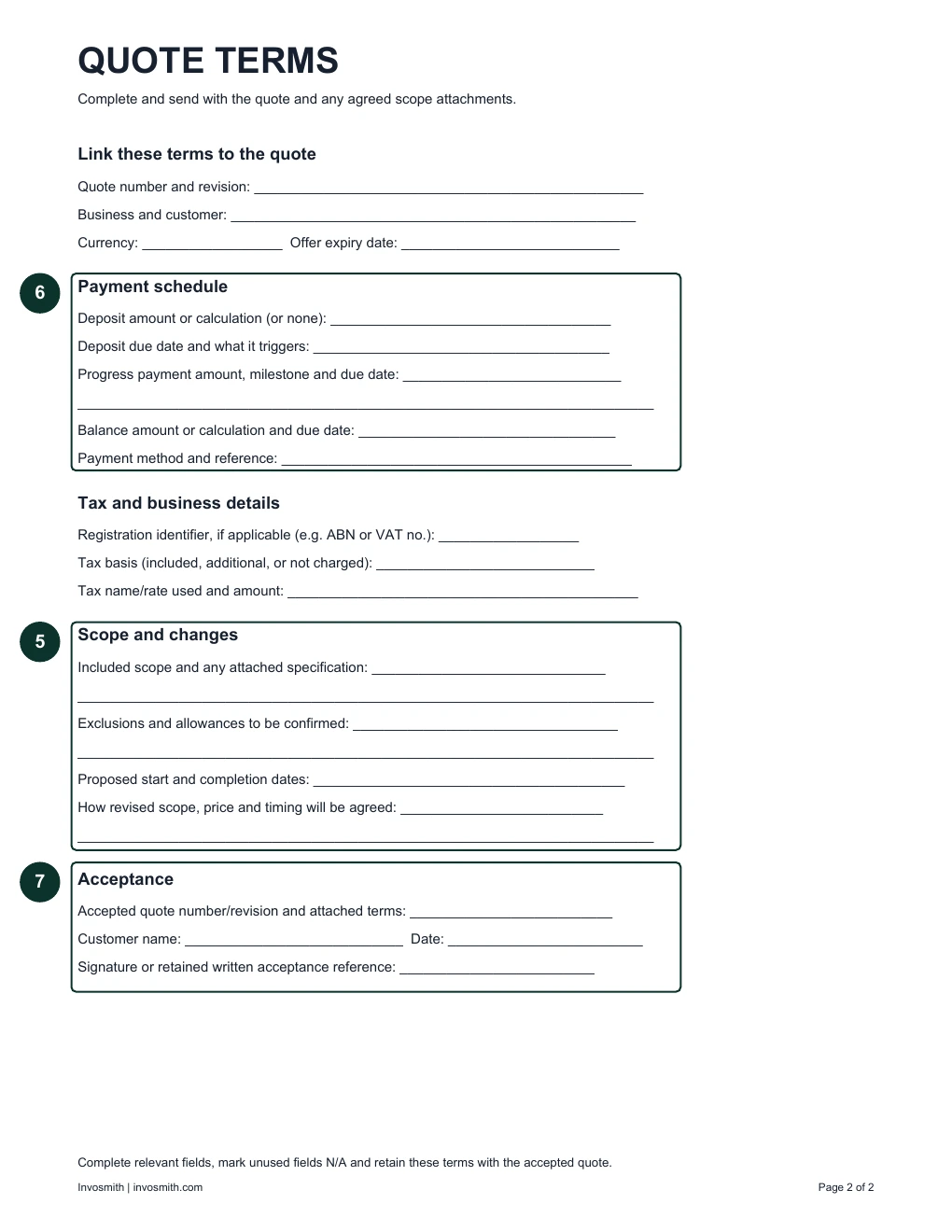
| Field | Example entry | Why it belongs here |
|---|---|---|
| 01 · Quote identity | Q-1041, revision 1; issued 26 September 2026; valid until 18 October 2026 | Which offer and price window is the customer accepting? |
| 02 · Parties and job site | Alder Deck Services → Sam Lee; work at 44 Alder Street | Who is doing the work, who is buying it, and where? Use real business/contact details. |
| 03 · Work and price | Supply and install 200 sq ft composite decking — $3,600 | What measurable result does this line buy? Put additional work on separate lines. |
| 04 · Total and tax basis | Example total $5,500; no tax included in this illustration | What is the currency and final quoted amount? Replace the illustration with the actual tax treatment. |
| 05 · Boundaries and changes | Excludes hidden structural repairs; extra work requires written scope, price and schedule approval | What is outside this price, and how will a change be agreed? |
| 06 · Payment and timing | Illustrative deposit $1,100 on acceptance; $4,400 balance within 7 days of completion; method: bank transfer | How much is due, when, by what method, and what does payment trigger? Check applicable deposit restrictions. |
| 07 · Acceptance | I accept Q-1041 revision 1, including its scope and attached terms. Name / signature / date | Does the saved approval identify the exact offer and attachments? |
Write scope lines with a visible boundary
Use the pattern action + measurable output + boundary. “Prepare and paint 42 m² of internal wall, two coats, customer-selected standard colour; excludes plaster repair” is easier to approve and later compare with the completed work than “painting — $1,480.”
Separate an assumption from an exclusion. An assumption describes the condition used to price the work, such as clear weekday access. An exclusion states work that is not included, such as hazardous-material removal. If either changes, record the revised scope and price in writing before doing the additional work.
Lines a customer checks in each trade
The lines a customer checks first depend on the trade: carpenters are judged on materials and finish, plumbers on fixtures and call-out terms, and flooring installers on area and preparation.
Write each item in the middle column as its own priced line, then copy the right-hand column into the quote’s exclusions note. Where the trade’s real cost stays hidden until the work is opened up, such as a leak behind tiles, price it as an estimate instead: the job estimate template keeps labour, materials and an allowance on separate lines, in Word, Excel and PDF.
| Trade | Lines to itemise | Exclusions to name |
|---|---|---|
| Carpentry and joinery | Timber species and grade, length or area, hardware, finish coats and installation labour on separate lines | Structural repairs found on removal, painting by others, building approvals |
| Plumbing | Call-out or first hour, labour by task, named fixtures and fittings, pipe runs by length, waste removal | Concealed pipe faults, wall and tile reinstatement, after-hours work |
| Flooring | Area to be laid, subfloor preparation, underlay, trims and thresholds, removal of the old floor | Levelling beyond the stated allowance, skirting replacement, moisture treatment |
| Painting | Surfaces by room or area, number of coats, preparation, paint product, protection and clean-up | Plaster repair, colour changes after work starts, high-access equipment |
| Landscaping | Turf, plants, edging and paving by area or count; soil and mulch by volume; green-waste disposal | Irrigation repairs, retaining walls, plant replacement after handover |
| Electrical | Points and fittings by count, cable runs, switchboard work, testing and certification | Patching after chasing walls, faults in existing wiring, supply-authority fees |
Choose a pricing basis before writing the total
Separate how you calculate a price internally from how you offer it to the customer. A cost build-up can support a fixed-price quote; it does not automatically make the customer responsible for every cost overrun. Use the basis that matches the work you can actually define.
| Basis | Useful when | What to write in the quote |
|---|---|---|
| Fixed price | Deliverables, quantities and exclusions can be defined | A price for the stated scope; identify any allowance and the written-change process. |
| Hourly or daily | The duration is uncertain but the work can be tracked | Rate, unit, estimated hours, any cap and the approval needed to exceed it. Do not present an estimate as a guaranteed total. |
| Per unit | The customer can check a count, area or other quantity | Unit definition × quantity × rate; explain who measures the quantity and how changes affect the total. |
| Cost-plus | Both parties intend documented costs plus an agreed fee | Which costs qualify, how evidence is provided, the fee basis and any cap. Do not describe an uncapped cost-plus offer as a fixed price. |
Quote, estimate, bid or proposal: name it by the price promise
Call the document a quote when the price for the stated scope is fixed, and an estimate when it is your best figure for work that may change.
A guaranteed or fixed estimate works like a quote: the customer can rely on the total for the stated scope. A bid is a quote submitted to compete for a job against a written specification. A proposal, or cost proposal, adds the approach, timeline and options to the price, and is common for project and business-to-business work.
In sales systems, a sales quotation is the quote you send to a customer; a purchase quote, sometimes called a supplier quotation, is the price you request from a supplier before you order. The layout is the same, with the parties swapped.
The full comparison, with copyable wording for each document, is in quote vs estimate. When the price may move once work starts, the online estimate generator writes it as an estimate with a valid-until date, then switches the same draft to an invoice when the work is done.
Price from your job inputs — a worked example
Build the price from inputs you can explain: materials, estimated labour hours, equipment or subcontractors, an allocation for overhead, and the profit or risk amount you choose. This fictional example uses USD and excludes tax so the arithmetic stays visible; it is not a recommended market price.
Worked total: $7,000 before tax. $2,200 materials + $2,640 labour (48 hours × $55) + $350 equipment + $600 subcontractor + $410 overhead allocation + $800 profit/risk = $7,000.
| Input | Calculation | Amount |
|---|---|---|
| Materials | Supplier cost used for this example | $2,200 |
| Labour | 48 hours × $55 | $2,640 |
| Equipment | Quoted hire | $350 |
| Subcontractor | Written subcontractor price | $600 |
| Overhead allocation | Business-selected input | $410 |
| Profit / risk | Business-selected input | $800 |
| Quote total | Before tax | $7,000 |
Markup and margin use different denominators
For a fictional $1,000 cost, a 20% markup adds $200: selling price = $1,000 × 1.20 = $1,200. The $200 profit is 16.67% of that selling price, not a 20% margin.
To target a 20% margin on the same cost, selling price = $1,000 ÷ (1 − 0.20) = $1,250. Profit is $250, or 20% of $1,250. These are arithmetic illustrations before tax, not recommended percentages. Include the costs you intend to recover before applying either calculation.
Use wage data as context, not as your customer rate
As a dated reference, the US Bureau of Labor Statistics reported a $31.42 mean hourly employee wage across construction and extraction occupations for May 2025. That is a national employee-wage statistic, not a contractor billing rate and not a local quote benchmark.
Your customer rate may need to cover non-billable time, payroll costs, insurance, tools, travel, overhead, risk and profit. Use your own records and current supplier or subcontractor prices. If you cite a wage statistic, keep its year, geography, occupation group and “employee wage” label visible.
Source: US Bureau of Labor Statistics, national occupational wage table, May 2025, construction and extraction occupations. Checked 26 September 2026.
Make each quote more accurate than the last
Quotes get more accurate when every price comes from a record: what you measured on site, your own rates from finished jobs, and a comparison of quoted against actual after each one.
- Measure before you price. Record measurements, access, existing condition and photos at the site visit, so each scope line matches what you saw.
- Price from your own unit rates. Keep a list of rates per hour, unit or item from finished jobs, and update it when supplier prices change.
- Get other people’s prices in writing first. If the job needs a subcontractor or hired equipment, have their written price before you send yours.
- Put each unknown on its own line. A named allowance with its own amount shows the customer what is uncertain, instead of spreading the risk across every line.
- Compare quoted with actual. After each job, write the hours and materials you used next to what you quoted. The gap shows which rates need to move.
Set validity, acceptance and change terms
Choose the valid-until date from the period for which your supplier prices, capacity and proposed start window remain dependable. There is no universal duration established by the sources used for this guide. Print the actual calendar date instead of relying only on “valid for 30 days.”
Use an acceptance instruction that matches how you retain records: for example, “Sign and date below, or reply ‘I accept quote Q-1041 and its scope and terms.’” If a deposit is required, state the amount or calculation, due date and what the payment triggers.
For added or removed work, record the changed scope, price and schedule and obtain the customer’s agreement before proceeding. Keep the original quote intact and attach the approved variation to it.
Present the quote so it is easy to accept
A quote is easiest to accept when the total, what it covers and the next step are all visible on the first page.
Acceptance goes smoothly when the customer’s yes names the quote number and revision, as in the acceptance line above. Keep that reply or the signed copy with the quote, and attach any later variation to the same file.
- Open with a one-line summary: the job, the total and the valid-until date.
- Offer options as separate packages, such as a standard and a premium finish, each with its own total, so the customer chooses instead of negotiating.
- Send it as a PDF, so the layout and totals arrive exactly as you wrote them.
- End with one acceptance instruction and the deposit, if any, needed to book the work.
- Send it soon after the site visit, while the details are fresh for both of you.
Check these ten things before you send
Before a quote leaves your hands, check ten things: number and revision, both parties, scope lines, pricing basis, arithmetic, tax line, exclusions, payment terms, the valid-until date and the acceptance instruction.
- The quote number and revision match the file name.
- Both parties and the job site are complete.
- Every scope line has an action, a measurable output and a boundary.
- The pricing basis (fixed, hourly, per unit or cost-plus) is stated.
- Quantities × rates add up to the total.
- The tax line says whether tax is included, excluded or not applicable.
- Exclusions and assumptions are listed.
- Deposit, payment terms and method are stated.
- The valid-until date is a calendar date.
- The acceptance instruction names the quote number and revision.
Country notes for Australia, the UK and the US
Australia. Australian Government business guidance says a written quote should include the business name, ABN and contact details; customer details; a clear description; itemised and total costs including GST if applicable; variations; payment terms and method; start and finish dates; an expiry date; and space for customer acceptance. The same guidance says an accepted quote becomes a legally binding contract in that Australian business context.
United Kingdom. For consumer service contracts, section 50 of the Consumer Rights Act 2015 can treat information said or written about the trader or service as a contract term when the consumer relied on it. Qualifications made at the same time and expressly agreed changes matter. Keep the quote’s scope, qualifications and later variations in writing. This is a UK consumer-contract boundary, not a global rule.
United States. The bounded official-source review did not establish one federal rule that defines every service quote. The document’s wording, acceptance method, trade rules and state law are separate factors.
Sources: Australian Government — Prepare quotes, checked 26 September 2026; UK Consumer Rights Act 2015, section 50, source copy checked 25 September 2026. The UK live recheck was unavailable on 26 September; the dated source copy supports the limited statement above.
Three country-labelled quote examples
These fictional examples show what to write, not market prices or universal contract terms. Tax amounts are stated inputs for illustration, not a determination of the tax owed. Replace names, registration details, dates and payment terms with your own; check applicable rules before requesting a deposit.
Australia · a defined painting job in AUD
Quote AU-104, revision 1: Harbour Paint Services (insert actual ABN and contact details) for Lee Studio, 12 Example Road. Prepare and paint 42 m² of internal wall with two coats: AUD 1,200; protect floors and clean up: AUD 200. Excludes plaster repairs and after-hours access. Proposed work: 12–13 October 2026; offer valid until 5 October 2026.
Subtotal: AUD 1,400. Tax (if applicable): GST, shown as its own line. Illustrative deposit AUD 280 on acceptance; balance AUD 1,120 plus any GST within 7 days of completion, by bank transfer.
Acceptance: “I accept AU-104 revision 1 and its stated scope and payment terms.” Record name, signature/date or the written acceptance. Plaster damage found later needs a separately agreed scope, price and timing before extra work starts.
United Kingdom · a fixed-scope service quote in GBP
Quote UK-208, revision 1: North Studio Services for Example Shop. Build a five-page brochure site: £800; provide one agreed revision round: £200. Excludes hosting, ongoing maintenance and extra pages. Draft delivery: 16 October 2026, subject to receiving approved copy by 5 October; offer valid until 2 October.
Subtotal: £1,000. Tax (if applicable): VAT, shown as its own line. This quote is not the later VAT invoice. Illustrative payment terms: £300 on acceptance and £700 plus any VAT within 7 days of delivery; bank transfer.
Acceptance identifies UK-208 revision 1, deliverables and payment terms. Any extra page requires written agreement on its price and delivery date. If this is a consumer service contract, keep the relied-on promises and qualifications together; do not assume that labelling a promise “informal” removes the section 50 boundary described above.
United States · an hourly service quote with a cap in USD
Quote US-309, revision 1: Maple Support for Example Office. Configure the three listed workstations and hand over setup notes. Labour: 6 hours × $90 = $540; listed parts: $160. Example subtotal and cap: $700 before any applicable tax. Excludes new network cabling and data recovery. Do not treat the absence of a tax amount in this example as a tax exemption.
Offer valid until 8 October 2026; proposed visit 15 October. No deposit in this illustration; actual approved hours and parts are invoiced after the work, payable within 7 days by bank transfer. Stop and obtain written approval before exceeding the $700 pre-tax cap or changing the listed scope.
Acceptance: “I accept US-309 revision 1, including the hourly basis, stated cap and exclusions.” Check state and trade-specific requirements separately; this example does not establish a nationwide legal rule.
Send a short follow-up, then preserve the handoff
A useful follow-up does not rewrite the quote: “Hi Sam — checking that quote Q-1041 reached you. It covers the deck replacement scope discussed and is valid until 18 October. Reply with any scope questions; acceptance instructions are on the last page.”
After acceptance, save the accepted copy and any agreed variations. When work is complete, create an invoice that references the quote number and reflects the accepted scope plus approved changes. A quote proposes the work and price; an invoice requests payment. See invoice vs quote for the document handoff.
Follow up once a few days after sending, and once shortly before the valid-until date. Each message should name the quote number and the date the price ends, so the customer can reply without searching for the file.
When the work is done, build the invoice from the accepted lines plus any approved variations, and show the quote number on it as a reference. The invoice maker downloads it as a PDF with no account and no watermark.
- Right after sending Hi [name], quote [number] for [job] is attached and valid until [date]. When you’re ready to book, reply “I accept quote [number]”, or send me any questions.
- Before it expires Hi [name], quote [number] expires on [date]. If you’d like to go ahead, reply to accept and I’ll confirm a start date.
- When the price is the concern Hi [name], if the total is more than you planned, I can split quote [number] into the essential work now and [option] later, or swap [item] for [alternative]. Shall I send both versions?
Keep track of every quote you send
Track each quote by status (sent, accepted, declined or expired) so you know which to follow up, which to invoice and which to re-price.
In this log, open quotes total $2,720 and accepted work waiting to be invoiced totals $4,180. A spreadsheet works for a handful of quotes; keep the accepted copy, its variations and the final invoice together under the same quote number.
| Quote | Client | Job | Total | Valid until | Status | Next step |
|---|---|---|---|---|---|---|
| QUO-0039 | Harlan Voss | Fence stain | $860 | 2 Oct | Expired | Re-quote at current prices if asked |
| QUO-0042 | Harlan Voss | Interior repaint | $2,720 | 18 Oct | Sent | Follow up before 18 Oct |
| QUO-0043 | Harbour Dental | Reception repaint | $4,180 | 25 Oct | Accepted | Invoice when the work is done |