Free template
Free Estimate Template
An estimate template gives a customer a written approximation before work begins. This job estimate example shows the proposed labor, materials and disposal before the work begins. This free job estimate form works for a repair, installation, cleanup or small project: it records the proposed scope, labor, materials or allowances, other costs, timing, exclusions and the wording that says the total is not a fixed quote. Download the editable Word or Excel version, choose the printable PDF for handwriting, or open the estimate generator to fill one in online. No sign-up is needed for the downloads, and the Word and Excel files are yours to edit and reuse.
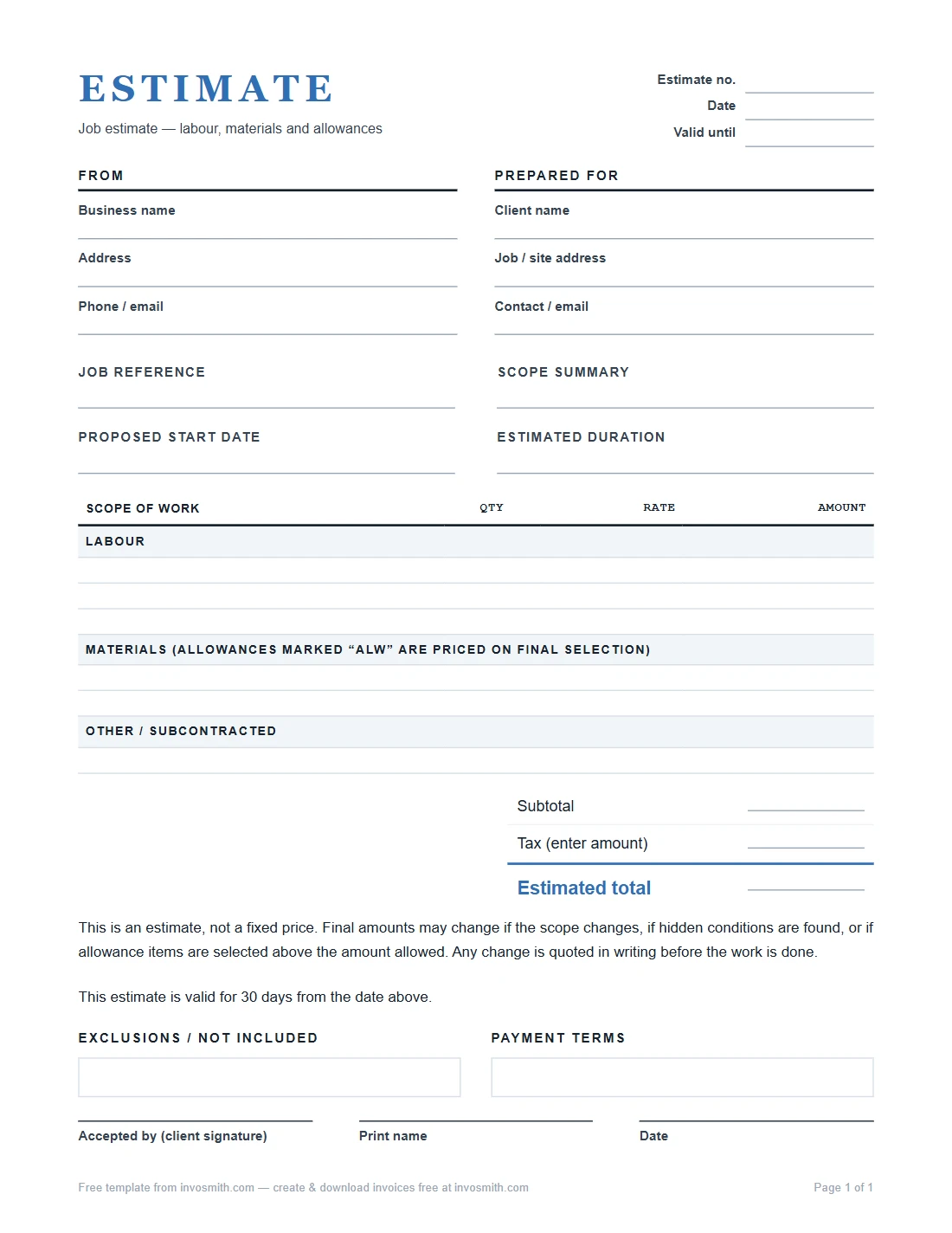
Download the free estimate template — Word, PDF & Excel
Job Estimate Template (Word / PDF / Excel)
Word version (.docx). A plain job estimate template for Word that edits like any document: swap in your logo, retype the scope lines, adjust the amounts, print or save as PDF.
PDF version. Fixed-layout and print-ready for a clipboard or job folder. Print it and write the lines in by hand; this PDF does not contain interactive form fields.
Excel version. The same layout in a spreadsheet grid for people who prefer typing into cells. Enter each description, quantity and rate; the line amounts, subtotal and estimated total calculate automatically. The tax amount stays as a separate hand-entry cell so the spreadsheet does not choose a tax rule for you.
All files print on US Letter. None of them ask for an email address, and all three carry the same fields in the same order, so you can move between formats without re-learning the layout.
What goes on a job estimate, field by field
Use the pricing calculator to combine labor, materials and overhead before entering the estimated prices.
Rather fill it in online? The free estimate generator makes the same estimate in your browser and downloads a PDF, no account needed.
Here is what each one does — this is the same field set you would want on any work estimate template, whatever the trade:
- Estimate number and date. Number your estimates the way you number invoices. The number is how a customer's yes, a mid-job change, and the eventual invoice all point back to the same piece of paper.
- Customer and job address. Both, and they are often different — bill the landlord, do the work at the rental. The job address is what your notes, photos and any permits reference.
- Scope, described line by line. One line per distinct piece of work, in plain words: "Remove damaged drywall behind vanity," not "repairs as discussed." The scope lines are what protect you later, because anything not on a line is visibly not in the estimate.
- Labor. State the hours and the rate on the line — "8 hrs @ $60.00/hr." The Word and printed PDF versions leave the amount to you; the Excel version multiplies the quantity by the rate. In every format, the hours and rate are still your professional judgment rather than numbers the template can choose for you.
- Materials, with an allowance note. When you cannot price materials exactly yet, enter an allowance — a stated budget figure — and mark it as one. The note tells the customer this line is a placeholder with a named number, not a guess with no number.
- Other costs. Disposal, permits, equipment rental, travel — the small lines that turn into arguments when they appear for the first time on the invoice. If you know one is coming, it belongs here.
- Expected schedule. Add an estimated start window and completion window when timing matters. Keep it separate from a promise: access, approvals and newly discovered work can change the schedule, so record revisions in writing.
- Exclusions and assumptions. List what the estimate does not cover and what the number assumes — customer-supplied materials, clear access, hidden damage not yet visible. This is where uncertainty becomes readable instead of becoming a surprise.
- Estimated total. One figure, clearly labeled estimated.
- Deposit or payment schedule, when proposed. Record the amount or milestone you are proposing, then make the signed agreement — not this blank template — the authority for what is actually due. Do not use a generic template to choose a lawful deposit limit for a jurisdiction.
- Validity. "Estimate valid for 30 days." Prices move; an expiry date lets you re-price a stale job without an awkward conversation.
- The note line: "This is an estimate, not a fixed price." One sentence, printed on the document, doing more work than any other field on it.
- Prepared by, with a signature. A name and signature tell the customer a specific person stands behind these numbers.
- Customer acknowledgment and next step. A line for the customer to confirm they received and reviewed the estimate, plus the next document: a signed agreement, accepted work order or other written authorization. The label on a template does not by itself decide its legal effect.
How can I create a project estimate in Excel?
Start with the Excel version of the job estimate template. Replace the business, customer and job details, then assign the estimate number, issue date and validity date. List each task separately so the client can see the scope behind the total.
Enter the quantities and rates for labor, materials and other costs. Mark an allowance as an allowance and record what it covers. Keep the calculated line amounts, subtotal and estimated total intact; enter any applicable tax amount separately. Microsoft's formula guide explains how cell references, multiplication and SUM work. If you add rows, inspect the affected formulas rather than assuming the new rows are included.
Add exclusions, assumptions, timing and the next approval step. Review the print layout and keep a PDF copy of the estimate you send. Keep the editable workbook for a dated revision if the scope changes. Excel organizes the prices you enter; an accurate estimate still needs measured quantities, documented costs and a clear description of the work.
Job estimate example, line by line
The fastest way to understand the template is to see one filled in — here is a small bathroom repair job, complete:
Estimate #2041 · July 30 · Valid for 30 days · Job address: 14 Alder St, Unit 2
| Line | Amount |
|---|---|
| Labor — remove damaged drywall, patch, sand and repaint (8 hrs @ $60.00/hr) | $480.00 |
| Materials — drywall, compound, primer, paint (allowance) | $265.00 |
| Waste disposal | $60.00 |
| Estimated total | $805.00 |
This is an estimate, not a fixed price. Final billing reflects actual hours and materials. Prepared by M. Torres.
Two lines on this document carry most of its weight. The first is the materials allowance. $265.00 is a stated budget, not a quoted price — and the allowance label is what makes the difference legible. If the paint the customer picks runs above the allowance, the revised cost is visible because the estimate identified that line as an allowance. Without the label, the entered number can quietly read as a commitment.
The second is the note line. "This is an estimate, not a fixed price" is the sentence that keeps this document from being read as a quote — the single line that sets the customer's expectation that the total is a well-informed approximation, and that the invoice will reflect what the job actually took.
When the job grows mid-way
When the scope changes mid-job, the change gets a revised estimate or written change note before the work continues, not after. The drywall comes off and the pipe behind it is corroded; the customer adds a second room while you are already set up. Whatever the trigger, put the new work and its cost in writing, reference the original estimate number ("Change to Estimate #2041"), and record consent using the form required by the agreement and applicable applicable rules before continuing. Silence followed by a bigger invoice is not approval.
The estimate number gives the change somewhere to attach — one job, one number, one paper trail from first estimate through every change to the final invoice. And the line-by-line scope is what makes the change visible at all: when "remove damaged drywall behind vanity" is a line, "replace corroded supply pipe" is obviously a new one. A one-line scope like "bathroom repairs" swallows the extra work whole, and with it, your ability to bill for it without a fight.
From estimate to accepted work and the final invoice
Treat the estimate as the first version of one job record. The customer reviews the proposed scope and approximate price; the parties then use their signed agreement, accepted work order or other written authorization for the actual commitment. If scope, allowance or timing changes, issue a dated revision that references the original estimate number. When the work is complete, the invoice references the accepted estimate and any approved revisions, then bills the actual documented amounts.
This chain does not require special software: Estimate #E-2041 → Revision #E-2041-R1 → Invoice #INV-3306 is enough. A customer can see what was first expected, what changed, when it changed, and how the final amount was built.
- 1. Estimate. Proposed scope, assumptions, allowances, approximate price, schedule and validity.
- 2. Written authorization. The agreement or work order that records what the customer accepted and any payment schedule.
- 3. Revision or change note. Added, removed or changed work, with the price and timing effect recorded before that work continues.
- 4. Invoice. Actual billable lines, cross-referenced to the estimate and approved revisions.
- 5. Review. Compare estimated and actual labor, materials and other costs so the next estimate uses better inputs.
Estimate guidance in the United States, Australia and the UK
These sources illustrate why a usable estimate needs specific scope and written boundaries. Each cited source covers its stated jurisdiction and job type.
- United States. The US Federal Trade Commission says a written home-improvement estimate should include a description of the work, materials, completion date and price, and points readers to their state’s contractor requirements. See the FTC home-improvement guidance (checked September 26, 2026).
- Australia. business.gov.au says a written quote should be clear, specific and complete, and should include an expiry date and space for customer acceptance. If your document promises a fixed price rather than an approximation, review the Australian Government guidance on preparing quotes and the rules that apply to your job (checked September 26, 2026).
- United Kingdom. Citizens Advice describes an estimate as the trader's best guess and a quote as a promise to do the work at an agreed price. It also says a disputed final price after an estimate should be reasonable, considering the estimate, changes and events outside the trader's control. See its home-improvements guidance (checked September 26, 2026).
Frequently asked questions
What is the difference between an estimate and a quote?
An estimate is an informed approximation that can move; a quote is a fixed price for a defined scope. The document title is not the only thing that matters — the wording, price certainty, scope and acceptance terms matter too. The invoice vs quote guide explains how the fixed-price document fits into the wider billing sequence.
Can the final bill be higher than the estimate?
Yes — an estimate is an approximation, and the final bill reflects actual hours and materials. The way to keep that from becoming a dispute is expectation management on paper: the not-a-fixed-price note, allowances labeled as allowances, and a written change note before any added work. A customer surprised by the number is a problem; a customer who watched it change in writing rarely is.
Should I charge for estimates?
Most trades give simple estimates free and charge when the estimate itself takes real work — a site visit, measurements, a detailed takeoff. If you charge, say so before you visit, and many businesses credit the fee against the job if the customer goes ahead.
How long should an estimate stay valid?
Choose a validity period that matches how long you can honor the scope, labor availability and material prices, then state the exact expiry date. If that date passes, review the assumptions and issue a fresh estimate instead of relying on an old price.
Do I invoice against the estimate?
Yes — when the job is done, send an invoice and reference the estimate number on it ("As per Estimate #2041"). The invoice bills actual amounts; the reference lets the customer compare it to what they agreed to, line by line, which is exactly the comparison you want them to make.