INVOICE
| Schedule of values | Contract value | Complete % | Completed to date | Remove line |
|---|---|---|---|---|
| $6,000.00 | ||||
| $34,000.00 | ||||
| $15,300.00 | ||||
| $0.00 |
Total contract value$65,000.00
Completed to date$55,300.00
Current claim$19,700.00
Amount due this invoice$19,700.00
A construction invoice records the work being billed, the project and contract reference, and the amount due. The right layout depends on your agreement: a fixed price, measured quantities, time and materials, or a progress claim. Choose from seven free PDF, Word and Excel templates below, then check a filled example before adding your own figures. No sign-up or watermark. For a small trade job with a deposit and a simple balance, use the contractor invoice template.
| Schedule of values | Contract value | Complete % | Completed to date | Remove line |
|---|---|---|---|---|
| $6,000.00 | ||||
| $34,000.00 | ||||
| $15,300.00 | ||||
| $0.00 |
Total contract value$65,000.00
Completed to date$55,300.00
Current claim$19,700.00
Amount due this invoice$19,700.00
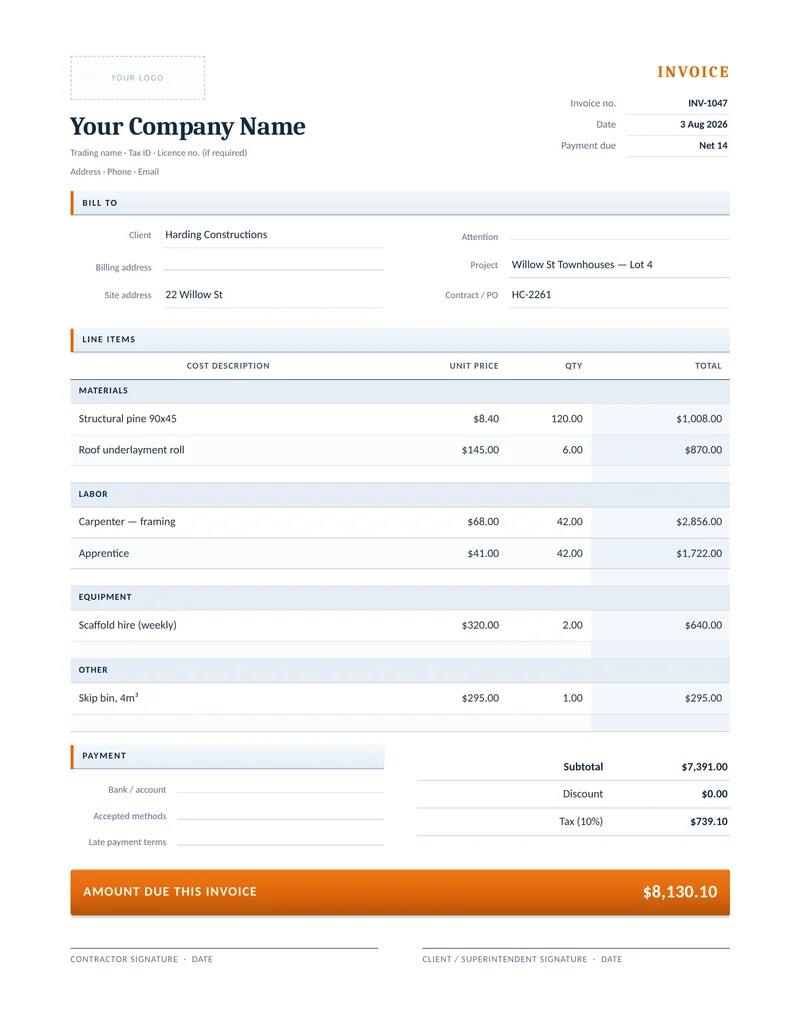
A blank construction bill with separate materials, labor, equipment and other charges.
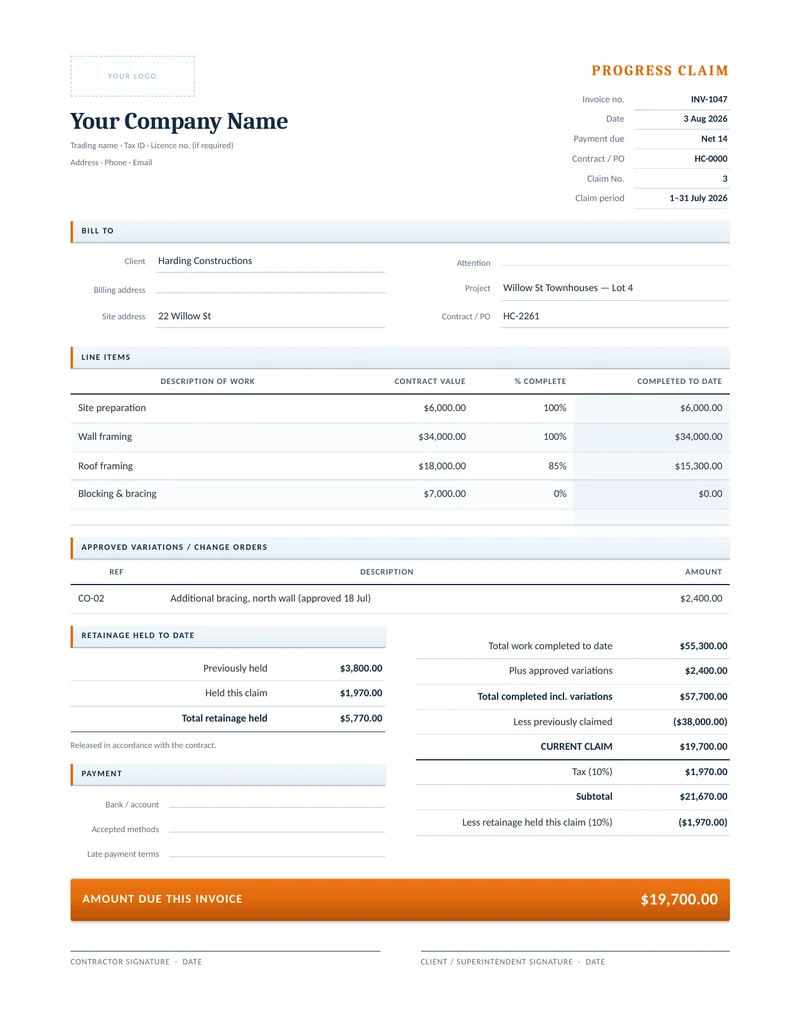
Contract value, work completed to date, approved variations, previously claimed amounts and a running retainage balance.
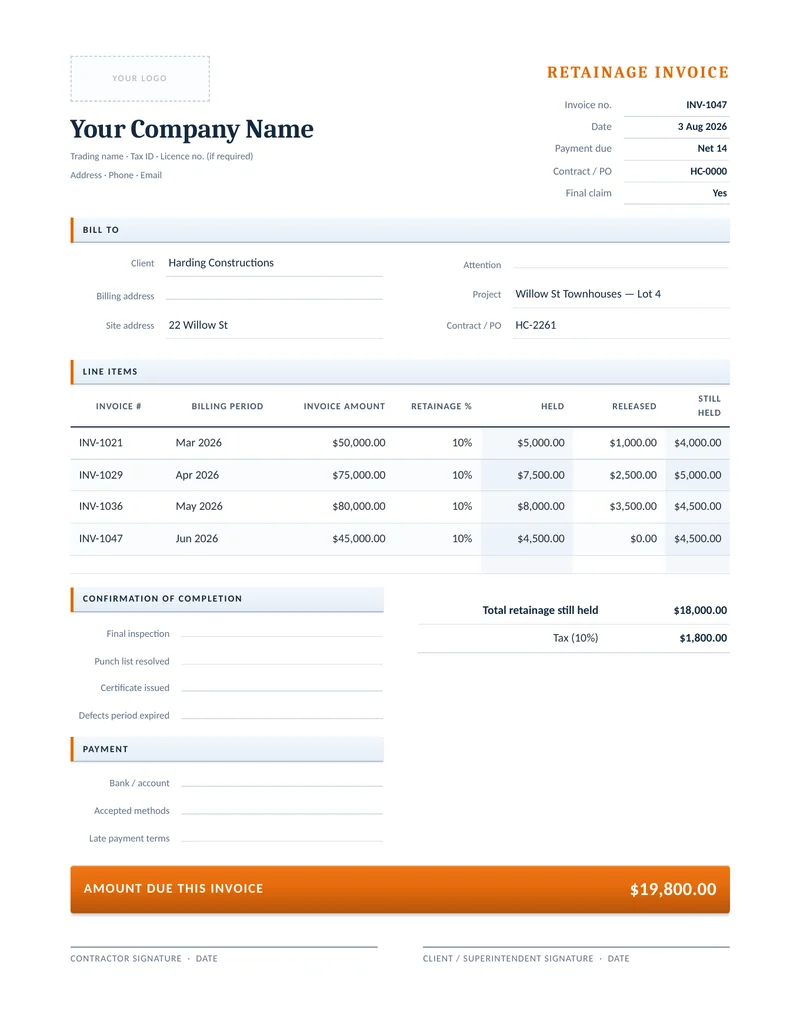
List amounts withheld across earlier claims and request the release that is due under the contract.
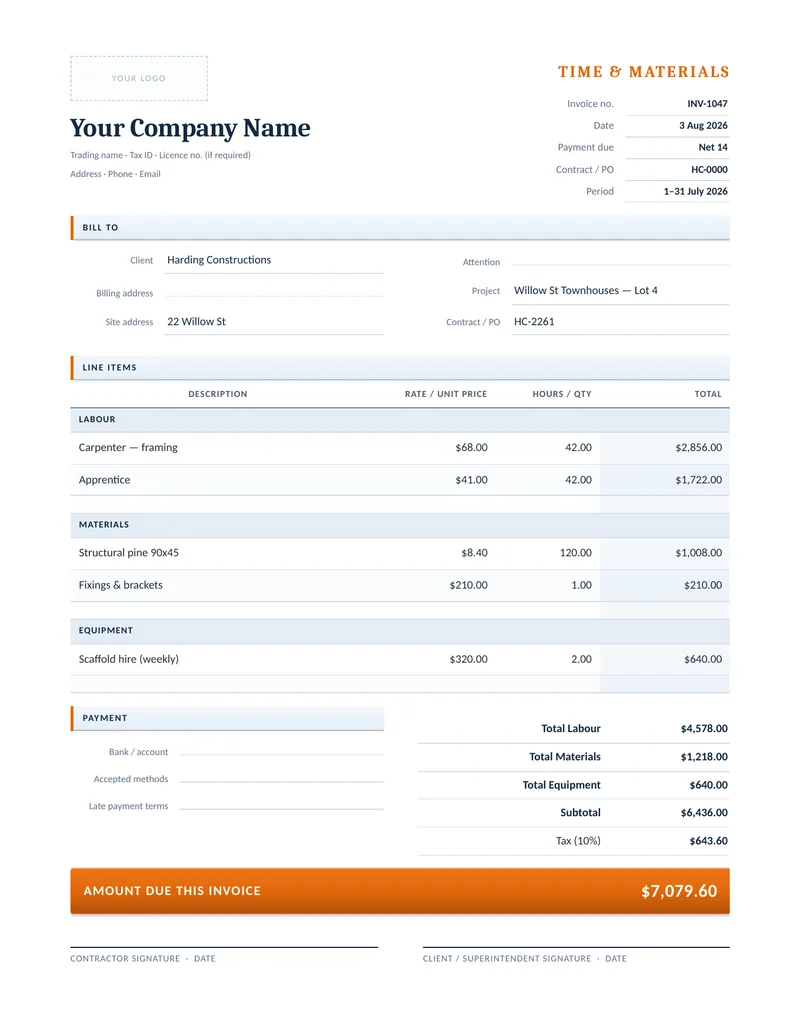
Keep labor hours, material quantities and equipment charges separate for the billing period.
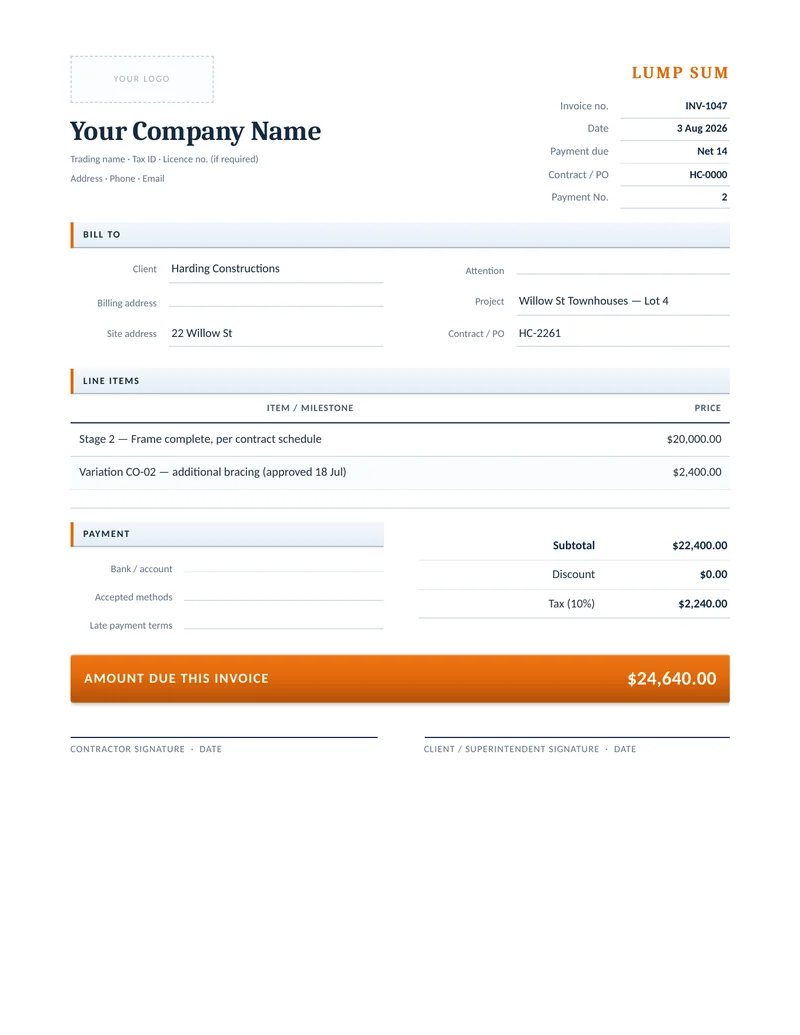
Bill an agreed fixed scope at completion or at the milestones specified in the contract.
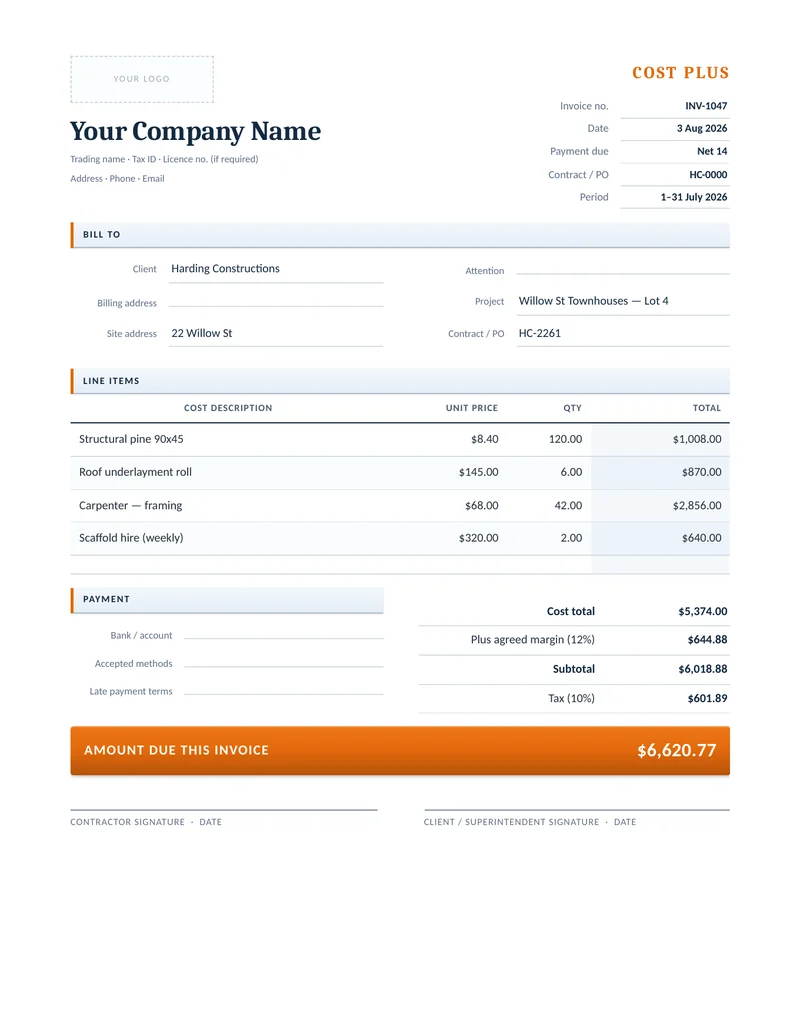
Show actual costs and the agreed fee or markup separately, with references to supporting records.
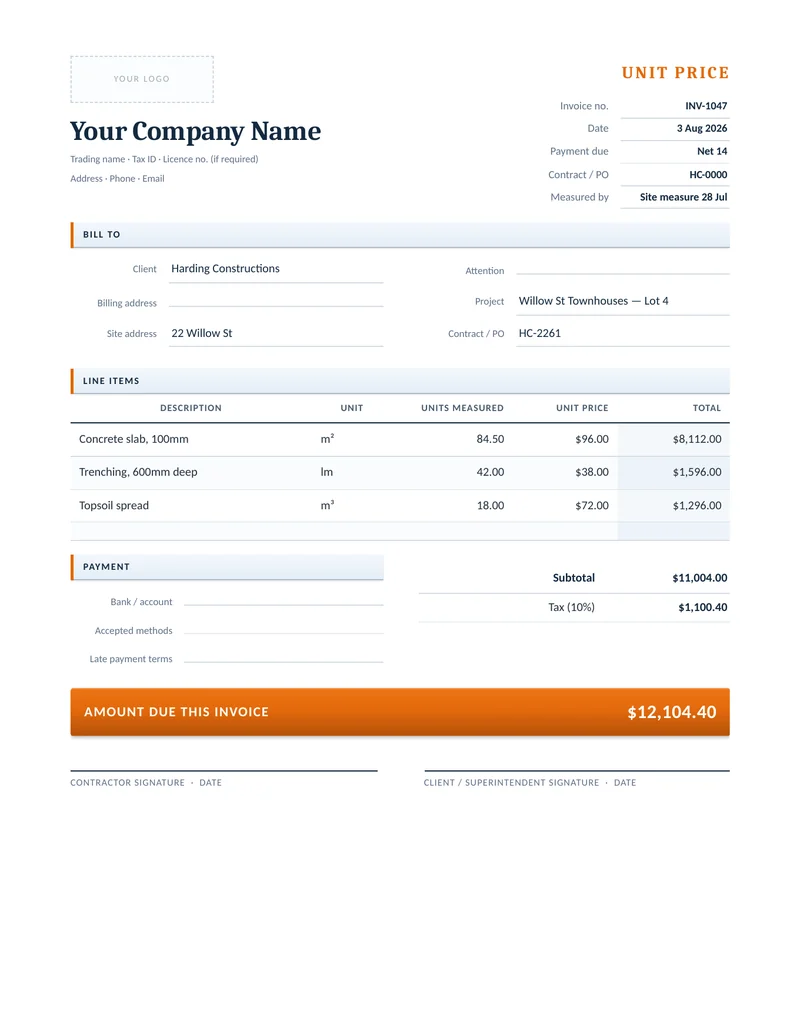
Bill measured quantities at agreed rates, with units and measurement references visible.
Every download is free — no email, no sign-up, no watermark.
Use PDF for a fixed printable layout, Word to edit the document, or Excel for a spreadsheet. Replace sample values and check the calculations, tax treatment and contract requirements before issuing the invoice.
Progress billing and retainage are payment arrangements, not separate pricing types: a fixed-price job can also use progress claims and retainage.
For terminology, US Federal Acquisition Regulation Part 16 describes firm-fixed-price, cost-plus-fixed-fee and time-and-materials contracts in sections 16.202-1, 16.306 and 16.601. Those definitions concern federal procurement, not mandatory rules for every private construction job. The selection advice below is practical guidance; follow your actual contract. Source checked 25 September 2026.
| Agreement or billing need | When this layout fits | Fields to show | Start with |
|---|---|---|---|
| Lump sum / fixed price | An agreed price for a defined scope, billed at completion or an agreed milestone. | Scope reference, contract value, milestone, prior payments and balance. | Lump Sum PDF |
| Cost plus | Recover agreed actual costs plus the fee or markup specified in the contract. | Cost categories, supporting-record references and a separate fee or markup calculation. | Cost Plus PDF |
| Time and materials | Bill the agreed hours, materials and permitted equipment or other charges for a period. | Labor hours and rates, material quantities and rates, hire duration and supporting records. | Time & Materials PDF |
| Unit price | Payment is based on measured units at agreed rates. | Description, unit, measured quantity, agreed rate and measurement date/reference. | Unit Price PDF |
| Progress / stage payment | Bill completed work or an agreed stage before the whole job is finished. | Contract or schedule of values, completion, approved changes, prior claims, current claim and retainage if applicable. | Progress Claim PDF |
| Retainage release | Request an amount previously withheld when its release conditions have been met. | Earlier claim references, retained amounts, prior releases, release condition and amount now requested. | Retainage PDF |
Sample only: Alder Build invoices a completed fixed-price garage fit-out for $18,000 under contract AB-026. The customer has already paid a $4,500 deposit, recorded as receipt R-004. This example has no change orders, retainage or tax amount; it illustrates the payment calculation, not a tax exemption.
The invoice references the agreed scope and completion milestone. It does not rebuild a fixed price from the supplier’s actual labor and material costs. If a scope change has been approved, show that change separately instead of silently changing the original contract price.
| Entry | Amount / reference |
|---|---|
| Completed garage fit-out — contract AB-026 | $18,000.00 |
| Deposit already received — receipt R-004 | −$4,500.00 |
| Balance due on this invoice | $13,500.00 |
| Payment deadline and method | Enter the actual agreed deadline and payment instructions. |
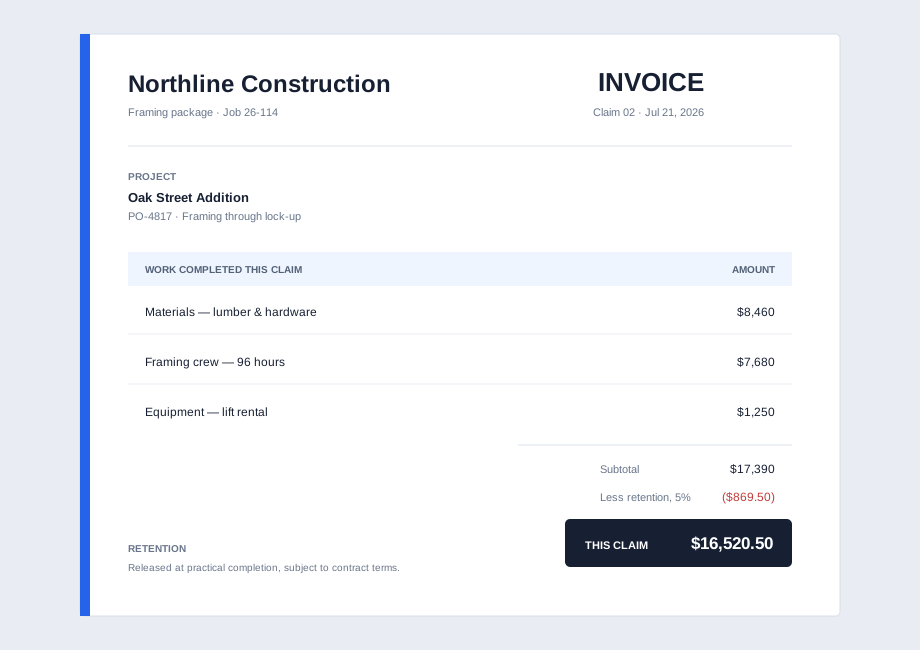
This existing sample shows Northline Construction billing the Oak Street framing package, job 26-114, against PO-4817. The quantities and figures are illustrative. Materials are $8,460, crew labor is 96 hours at $80, and lift rental is $1,250. This sample assumes no prior payment and no tax amount. Its 5% retention is an example contract term, not a recommended or legally standard rate.
Keep the full value of the work visible, then show the withheld amount as its own deduction. The preview states release at practical completion subject to contract terms; replace that wording with the actual release condition for your job. A different contract may use no retention or different conditions.
| Work or calculation | Amount |
|---|---|
| Lumber and hardware | $8,460.00 |
| Framing crew — 96 hours × $80 | $7,680.00 |
| Lift rental | $1,250.00 |
| Subtotal — $8,460 + $7,680 + $1,250 | $17,390.00 |
| Sample retention — 5% × $17,390 | −$869.50 |
| Amount due for this claim | $16,520.50 |
Sample only: Grant & Sons Carpentry bills Harding Constructions for the Willow St Townhouses framing package, contract HC-2261. Invoice INV-1047, dated 3 August 2026, covers 1–31 July. This preserves the page’s progress-claim example; the names and figures are illustrative, not a reported customer job.
The $65,000 original schedule comprises site preparation $6,000 at 100%, wall framing $34,000 at 100%, roof framing $18,000 at 85% ($15,300 earned), and blocking/bracing $7,000 at 0%. That gives $55,300 completed before the approved $2,400 variation CO-02. Its approval reference is 18 July.
Claims #1–2 already billed $38,000 of work. Subtract that billed value to avoid billing it twice; do not substitute cash received into this calculation. If an earlier invoice remains unpaid, track its balance separately. The assumed retention is 10% of this sample’s $19,700 current work claim. Add tax only when it applies.
| Entry | Calculation / amount |
|---|---|
| Completed original work | $6,000 + $34,000 + $15,300 + $0 = $55,300 |
| Approved change CO-02 | +$2,400 |
| Total completed including approved change | $57,700 |
| Less previously claimed work — Claims #1–2 | −$38,000 |
| Current work claim | $19,700 |
| Tax (if applicable) | — |
| Subtotal before applicable tax | $19,700 |
| Retainage this claim — illustrative 10% × $19,700 | −$1,970 |
| Amount due before applicable tax | $17,730 |
| Previously held retainage + this claim | $3,800 + $1,970 = $5,770 held in total |
Cost Plus: show the costs recoverable under your agreement and the agreed fee or markup separately. Reference invoices, receipts or job-cost records so the billed items can be traced. A fixed fee and a percentage markup are different arrangements; do not substitute one for the other.
Unit Price: show measured quantities and the agreed unit rate. Name the unit and the record used to check it, such as a measurement sheet or delivery docket. Keep a new rate or changed scope separate from the original agreed rate.
Standard blank construction invoice: use it when you need a straightforward construction work invoice with separate material, labor, equipment and other lines, without a cumulative schedule of values. Add only the fields the job requires.
Retainage Invoice: reconcile the amounts held against earlier claim references, deduct any amount already released, and identify the release condition you are relying on. It requests withheld money; it is not a second bill for the same completed work. Check the contract and applicable law before treating the amount as due.
The same masonry job might be fixed-price, unit-price or staged; a template does not change that agreement.
| Trade / job | Possible starting layout | Useful line details |
|---|---|---|
| Masonry and concrete | Unit Price for measured work; Lump Sum for fixed scope; Progress Claim for staged work. | Area/volume or other agreed measure, unit rate, pour or work area, measurement reference, approved extras. |
| Excavation and earthwork | Time & Materials or Unit Price, as agreed. | Machine and operator time, trench/earthwork quantities, hauling, disposal and site location. |
| Demolition | Lump Sum for agreed scope; Time & Materials for approved variable work. | Area or structure removed, crew/equipment time, disposal records and approved additional work. |
| Framing and carpentry | Lump Sum or Progress Claim for a package; Time & Materials for hourly work. | Work area, framing stage, material package, crew hours and approved bracing or scope changes. |
| Roofing | Roofing invoice or the agreed construction billing layout. | Measured roof area, tear-off, installed system, disposal and approved deck repairs. |
| Electrical | Electrical invoice for trade-specific detail. | Circuit/work area, installed equipment, labor, materials and permit/inspection reference when applicable. |
| Plumbing | Plumbing invoice for trade-specific detail. | Work location, fixtures or pipework, parts, labor and testing or authorization references. |
| HVAC | HVAC invoice for trade-specific detail. | Equipment or system, installation/service scope, labor, parts and agreed additional charges. |
These are practical fields, not a claim that one form satisfies every jurisdiction. Tax IDs, licence numbers, tax treatment and supporting documents depend on the parties, location and contract.
| Field | What to enter |
|---|---|
| Business and client | Names, billing addresses and contact details; required business/tax/licence identifiers where applicable. |
| Project and agreement | Project/site address and contract, PO, subcontract or approved-quote reference. |
| Invoice and claim references | Invoice number/date and, if the client uses one, a separate claim number; billing period and agreed payment date. |
| Work being billed | Scope or schedule-of-values lines; completion or measured quantities; materials, labor hours/rates, equipment and subcontract charges as applicable. |
| Approved changes | Separate description, amount, approval reference and date; do not bury extra scope in an old line. |
| Earlier claims and payments | For cumulative claims, show previously billed work separately from payments received. For a final invoice, clearly credit deposits or other payments already applied. |
| Tax and amounts due | Subtotal, applicable tax amount, credits or deposits, retainage if applicable, and the balance now due. Avoid subtracting the same payment or retention twice. |
| Retainage record | Current amount withheld, previous amounts held, prior releases and running balance, with the applicable release condition. |
| Payment and supporting records | Payment instructions and actual terms; attach the timesheets, measurements, approvals or other documents required by the agreement. |
If you are billing a general contractor, use the subcontract or PO reference and the claim numbering their approval process requires. Keep your own record of work billed, payments received and retainage held or released. For the fuller sub-to-GC field checklist, see the subcontractor invoice template.
For unfinished work, use the basis allowed by the agreement: a completed milestone, an agreed schedule of values or another supported measurement of progress. Include approved changes and earlier claims on the same basis, and show your working. An invoice does not itself create a right to a progress payment where none otherwise exists; check the contract and applicable payment law.
Check the agreed payment schedule before sending a new demand. If you want to change completion-only terms, a factual request could be: “We have completed [scope] and supplied [materials]. Would you agree to a staged payment for [amount], with the remaining balance due on completion? I can provide the work breakdown and supporting records.” This is a request to agree terms, not a statutory payment notice.
For the next job, discuss the deposit, milestones and final payment before work starts. For the broader sequence, payment applications and reconciliation, follow the construction invoicing guide. Use the job estimate template to record proposed scope and price before it becomes a bill.

Keep money withheld from a claim separate from the value of completed work. Use the label and release conditions in your contract; seeing “retainage”, “retention” or “holdback” does not establish one universal rate or legal treatment. The 5% and 10% figures in the examples above are illustrative assumptions.
FAR 32.103 addresses US federal construction progress payments: when satisfactory progress has not been achieved, withholding is assessed case by case, and retainage under that provision cannot exceed 10% of the approved estimated amount. It is not an instruction to withhold 10% on every job. Private, state and other contracts may follow different rules. Source checked 25 September 2026.
Do not treat a retention label as a mechanics-lien document or an adjudication application. Payment disputes and release rights need the applicable contract and applicable rules.
For covered NSW construction progress payments, section 11 of the Building and Construction Industry Security of Payment Act 1999 sets a due date 15 business days after a Part 3 payment claim for a payment from a principal to a head contractor, and 20 business days for a payment to a subcontractor, or an earlier contractual date. Both rules exclude exempt residential construction contracts.
Under section 11(1C), an exempt residential construction contract follows its express payment terms, or a 10-business-day default after the Part 3 claim where no express provision exists. Check the Act’s definitions and which rules apply to your contract; these numbers are not general Australian invoice terms.
Section 13 requires the payment claim to identify the work or related goods/services, state the claimed amount and state that it is made under the Act. Head contractors have an additional supporting-statement requirement. Section 14 separates the payment-schedule response deadline: the contractual period or 10 business days after service, whichever expires earlier. A generic invoice file is not a guarantee of a valid statutory claim. Source checked 25 September 2026.
For contracts covered by Part II of the Housing Grants, Construction and Regeneration Act 1996, distinguish the payment due date, the payment notice and the final date for payment. Section 110A requires the contract’s applicable payer/specified-person or payee notice arrangement no later than five days after the payment due date; the notice states the sum and how it was calculated. That is not a rule that every invoice must be paid within five days.
Section 111 generally requires payment of the notified sum by the final date for payment, subject to its provisions, including a compliant pay-less notice. The pay-less notice period comes from the agreement or the applicable Scheme for Construction Contracts; it is not one universal period stated here.
This Part concerns construction operations in England, Wales and Scotland, with excluded operations and a residential-occupier exception. It is not an all-UK rule or a rule for every homeowner job. Check the contract and applicable legislation before treating an ordinary invoice as the required notice. Source checked 25 September 2026.
Use the existing claim builder to edit the schedule, check the current claim and print or save a PDF.
Answers to check before you choose, edit or send a construction invoice.
Read the construction invoicing guideUse the structure agreed for the job: fixed price, measured units, time and materials, or cumulative progress billing. Identify the project and contract, describe the work, separate approved changes, and show earlier claims or payments, tax and retainage when applicable. The selector above connects each billing need to a file.
An invoice records an amount requested for work; a payment application can be the wider approval package required by a construction contract, with a schedule of values and supporting documents. Use the form and process required by your agreement. These generic templates do not promise to replace a required AIA form or statutory notice. See the construction invoicing guide.
Use this construction page when you need contract-based layouts, progress calculations or retainage records. For a straightforward trade job with labor, materials, a deposit and a balance, use the contractor invoice template. Choose by the billing task, not just the job title.
Give the change its own line or section, with the approved scope, amount, reference and date. Keep it separate from the original scope so the client can match the invoice to the agreement and approval record.
Use the Progress Claim layout when it fits the contract and applicable rules. Show the completed stage or schedule-of-values calculation, approved changes, previous claims, any retainage and the current amount due. The invoice layout alone does not establish a right to payment or satisfy every payment-claim procedure.
Neither is a universal default. The examples use illustrative contract assumptions. Check whether retainage applies, its permitted rate, calculation base and release conditions under your contract and applicable law. The federal FAR rule discussed above is not a standard rate for private construction.
Not automatically. Statutory claim and notice procedures depend on the jurisdiction, contract, required content, service and timing. The scoped NSW and England/Wales/Scotland notes above link the applicable official rules.
Start with the downloaded layout that matches your agreement, or open the invoice generator for a new invoice. Check the amounts, supporting records and payment requirements before sending. A construction invoice connects the billed work, earlier payments and balance due to the agreed billing method.
The examples keep licence numbers, tax treatment, progress-payment rights and required forms tied to the cited jurisdiction and contract.