Free template
Free Security Deposit Receipt Template (PDF & Word)
A security deposit receipt records money received at move-in: who paid it, the property, amount, date, method and purpose. It is not the lease and it does not decide whether a later deduction is allowed. Use the receipt to establish the starting amount, then use a separate return-or-deduction statement at move-out. The free PDF and Word files include tenant and landlord copies; the country and state panel below shows why the surrounding workflow must be checked locally.
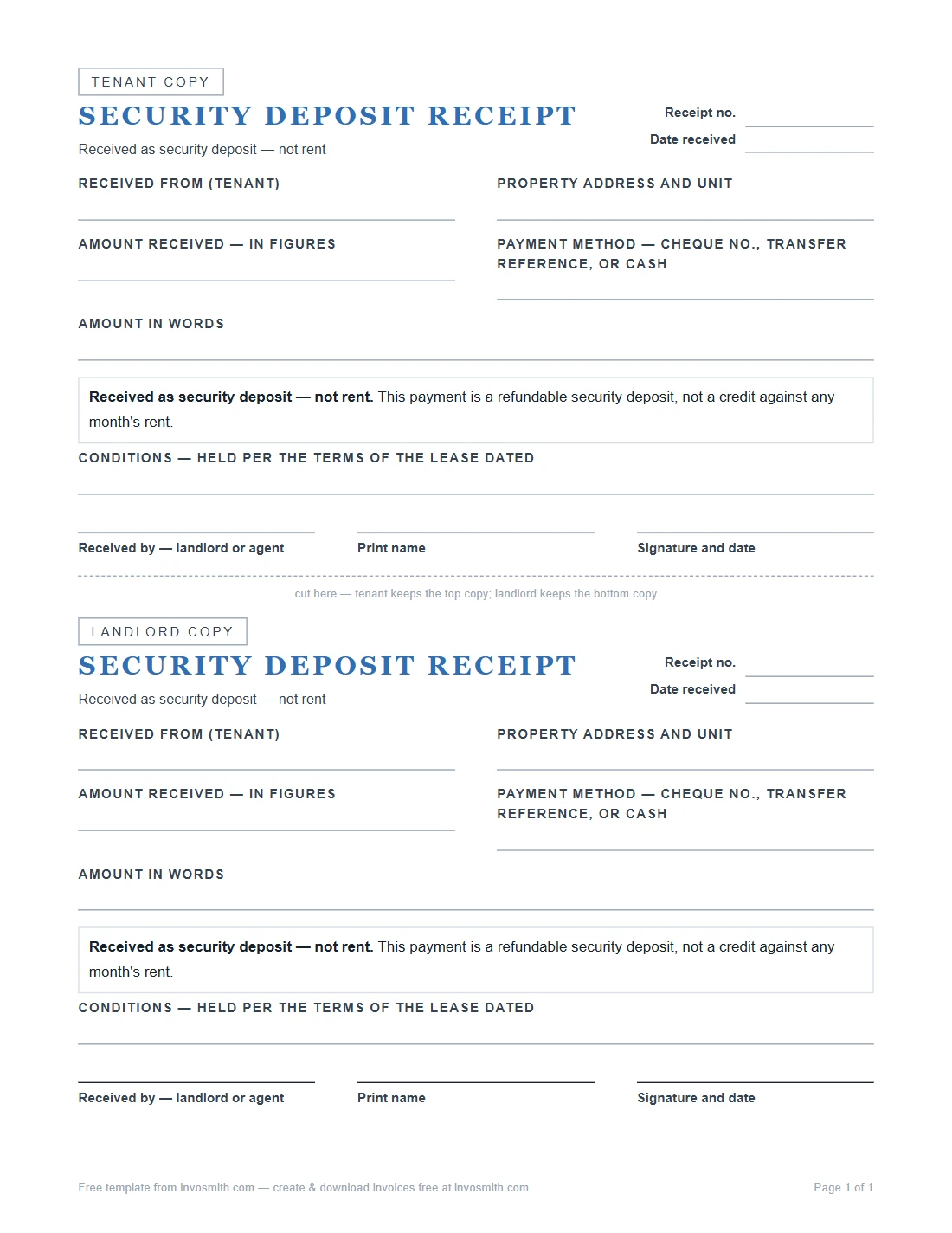
Download the security deposit receipt template
Security Deposit Receipt (PDF / Word)
A two-copy receipt with amount, property, payment-method, purpose and signature fields.
Security deposit return statement
A move-out statement for the original deposit, itemized deductions, amount returned and payment reference.
Both files print on US Letter. The PDF is fixed-layout for fill-and-print at a lease signing; the Word file is fully editable if you want to add fields or pre-fill your property details once and reuse the file.
Each sheet includes a tenant copy and a landlord copy separated by a dashed cut line. Neither file asks for an email address.
What goes on a security deposit receipt
A deposit receipt is short, and every line on it is there to end a specific future argument:
- Receipt number and date. The number ties this receipt to your records; the date fixes when the money was received — which matters when the deposit was paid days before the lease began.
- Received from. The tenant's full name, matching the lease. If two tenants split the deposit, name both and note the split.
- Property and unit. The full address including the unit — a landlord with several units needs the receipt to say which door this deposit stands behind.
- Amount, in figures and in words. Record the same amount twice and compare the entries before signing. The duplicate wording helps reveal a mismatch but does not make alteration or dispute impossible.
- Payment method. Check number, transfer reference, or cash. Cash makes the receipt itself the only record, so this line earns its keep most on cash deposits.
- What it is for. State “security deposit” and identify any other same-day payment separately. Whether the deposit may later be applied to rent, damage or another obligation depends on the lease and applicable law; the receipt does not decide that question.
- Conditions note. One sentence tying the deposit to the lease: "held per the terms of the lease dated August 1." The receipt does not restate those terms; it points to them. Many states cap deposits and set return deadlines, so check your state's rules rather than relying on any template's wording.
- Received by and signature. The landlord's or agent's name and a signature. Unsigned, the receipt is a note; signed, it is an acknowledgment.
Filled example
This fictional move-in example shows the starting record: tenant, property, amount, method, purpose and the lease it relates to. The duplicate amount wording helps the parties compare the entry before signing; it does not override the lease or local deposit rules.
| Field | Entry |
|---|---|
| Receipt no. / date | SD-041 / August 1 |
| Received from | Dana Whitfield |
| Property | Unit 4B, 312 Alder Street |
| Amount | $1,850.00 |
| Amount in words | One thousand eight hundred fifty dollars and no cents |
| Payment method | Check #1123 |
| For | Security deposit — not rent |
| Conditions | Held per the terms of the lease dated August 1 |
| Received by | M. Okafor, landlord — signed |
A year later, at move-out
The receipt earns its keep on the day the tenancy ends — often a year or more after it was signed, when memories of the move-in day have gone soft. The tenant remembers paying "about two months' worth of money" at signing; the landlord's ledger shows one lump sum that could be first month plus deposit, or deposit plus a pet fee, or something else entirely. Now the walkthrough is done, there are deductions to discuss, and the first question is not about the carpet — it is how much was the deposit, exactly?
With the receipt, that question takes ten seconds: $1,850.00, security deposit, not rent, dated August 1. Both sides start from the same number and the conversation moves straight to the deductions, which is the only part actually worth discussing. Without it, the deposit's very amount is contested territory, and every later disagreement inherits that fog. The receipt does not settle who pays for the carpet — the lease and the walkthrough do that — but it fixes the number the whole settlement is computed from.
If you're the tenant
Get the receipt in writing at move-in, before the money leaves your hands — a signed paper receipt or at minimum a dated written acknowledgment naming the amount and calling it a security deposit. Then keep it with the lease, because the two documents work as a pair: the lease says what the deposit is held against, the receipt proves you paid it. A deposit paid in cash with no receipt is the single easiest sum of money to lose track of in a tenancy.
Close the deposit record at move-out
A move-in receipt and a move-out statement answer different questions. The first proves what was paid. The second records what was returned and itemizes any deduction. Keep the same tenant, property and original receipt number on both so the records can be matched.
| Return statement field | Example |
|---|---|
| Original deposit receipt | SD-041, received August 1 |
| Deposit held | $1,850.00 |
| Deductions | Cleaning beyond ordinary wear — $120.00 (itemized supporting record attached) |
| Amount returned | $1,730.00 |
| Return date and method | August 12 — bank transfer reference 8F2A |
Security deposit rules: six bounded examples
Use these official-source checks to identify the local workflow. They do not replace the lease or local legal advice, and the template does not calculate caps, interest or deductions.
California
California Civil Code section 1950.5 governs residential security deposits, permitted deductions and the post-tenancy accounting. Check the current cap and deadlines from the statute before writing them into a lease or notice.
New York
New York General Obligations Law section 7-108 contains the residential deposit return and itemized-statement rules. Section 7-103 separately covers trust treatment and bank notice; do not cite one section for the other.
Texas
Texas Property Code chapter 92 contains the state security-deposit rules. Use the current statutory text for timing, forwarding-address and deduction questions.
Florida
Florida Statutes section 83.49 covers deposit holding and notices. Current text permits qualifying email under section 83.505 in some notice workflows, so older “certified mail only” summaries can be incomplete.
England
GOV.UK tenancy deposit protection describes the current protection workflow. Check the tenancy type and current commencement dates; older AST-only wording may no longer describe the live regime.
New Zealand
Tenancy Services bond guidance explains bond lodgement, records and refunds. Use the official bond process rather than treating this receipt as the bond form.