Free template
Consulting invoice template
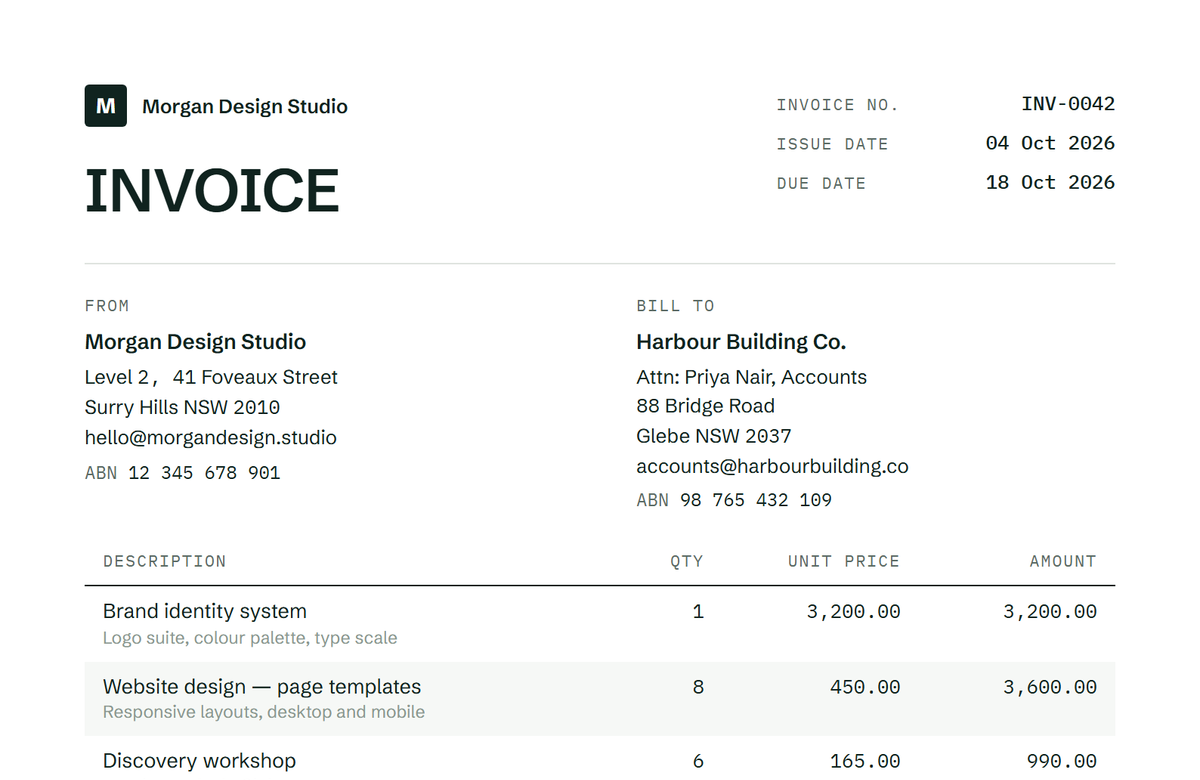
A consulting invoice connects the client, engagement, billing period, and work delivered. Whether the agreement uses hourly work, a milestone, or a retainer, make the basis of the charge clear enough that the client can compare it with the statement of work.
Preview unavailable. Download a template to view the document.
What goes on it
Consulting Invoice fields
| Field | What to write | Example |
|---|---|---|
| Client and engagement | Name the client and project or statement-of-work reference. | — |
| Billing period or milestone | State the period or deliverable being billed. | — |
| Hours, rate, or fixed fee | Show the agreed calculation rather than a blended unexplained amount. | — |
| Retainer and expenses | Show applied retainers, credits, and approved expenses separately. | — |
What a consulting invoice invoice should explain
A consulting invoice connects the client, engagement, billing period, and work delivered. Whether the agreement uses hourly work, a milestone, or a retainer, make the basis of the charge clear enough that the client can compare it with the statement of work.
The invoice is the billing record for the agreed work. It should let the customer match the charge to the client and engagement and to the scope, rate, or milestone that was actually approved.
- Hourly advisory work billed for a period. Keep the related work, dates, quantities, and agreed amount on a line the customer can check.
- A milestone payment for a delivered report. Keep the related work, dates, quantities, and agreed amount on a line the customer can check.
- A retainer applied against additional work. Keep the related work, dates, quantities, and agreed amount on a line the customer can check.
Fields that keep the job recognizable
Use the fields that identify this job without inventing facts. If a value is not in the agreement or work record, leave it editable and confirm it before sending.
| Field | Why it belongs |
|---|---|
| Client and engagement | Name the client and project or statement-of-work reference. |
| Billing period or milestone | State the period or deliverable being billed. |
| Hours, rate, or fixed fee | Show the agreed calculation rather than a blended unexplained amount. |
| Retainer and expenses | Show applied retainers, credits, and approved expenses separately. |
Billing situations consulting invoice providers actually meet
Choose the line structure that matches the agreement. A fixed charge, hourly record, milestone, deposit, or pass-through cost should be recognizable as its own basis rather than hidden in a single total.
For a consulting invoice job, the useful question is not only “what is the total?” but “which completed work or approved charge does this line represent?”
- Hours by work category. Show the period, quantity, rate, or reference that lets the customer reconcile it.
- Milestone or fixed-fee deliverable. Show the period, quantity, rate, or reference that lets the customer reconcile it.
- Approved travel or project expenses. Show the period, quantity, rate, or reference that lets the customer reconcile it.
- Retainer credit and outstanding balance. Show the period, quantity, rate, or reference that lets the customer reconcile it.
Make the total easy to reconcile
Keep subtotal, applicable tax, deposits or credits, previous payments, and amount due separate. Enter tax only when it applies to your transaction; this page does not determine tax treatment.
If the customer paid a deposit or an earlier milestone, show it as a separate credit or deduction. Do not silently reduce a work line and make the arithmetic impossible to audit.
- Use a sequential invoice number and issue date.
- State the billing period, milestone, or service date covered by this invoice.
- Copy payment terms and instructions from the agreement instead of promising a legal deadline.
Before you send the invoice
Review every editable field against the job record. A clean invoice is useful when it is specific, not when it is crowded with claims the contract does not support.
The generator can help you assemble the document. It does not provide dispatch, customer management, tax filing, licensing, disposal, warranty, or legal-compliance services.
- Use the correct billing period. Confirm this detail from the agreement or work record before sending.
- Match hours or deliverables to the engagement. Confirm this detail from the agreement or work record before sending.
- Separate expenses and retainer credits. Confirm this detail from the agreement or work record before sending.
Frequently asked questions
What should a consultant invoice include?
Name the client and project, billing period, scope or deliverable, hours and rate or milestone amount, expenses, credits, amount due, due date, and payment instructions.
How do I invoice a consulting retainer?
Show the retainer applied as its own line or credit, identify the covered period, and list additional hours or expenses separately.
Can consulting hours and expenses share one line?
They can, but separate lines are easier to reconcile when the agreement treats expenses differently from professional time.
Which billing tools suit hourly, milestone or retainer consulting work?
Choose a tool that can show the billing basis in your engagement. Hourly work needs a period, work description, hours and agreed rate. A milestone bill needs the named deliverable and agreed charge. A retainer statement needs the covered period, any applied credit and separately agreed extra work or expenses. The invoice generator can assemble those details into an invoice PDF from the lines and amounts you enter. Keep timesheets, milestone records and retainer calculations with the engagement file. If you need project approvals or a wider billing workflow, include those tasks in your software comparison. This page supplies billing guidance; it does not provide time tracking or automatic retainer allocation.
Does this page provide legal or tax advice?
No. Adapt the fields to the engagement and check professional, tax, and jurisdictional requirements yourself.