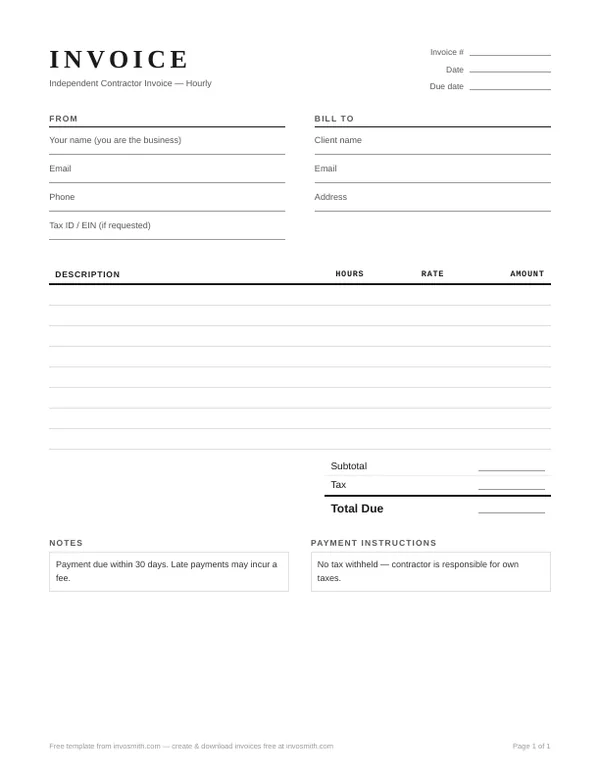
Hourly work
Keep each work stream visible with hours, rate and amount.
A practical invoice for the work you completed, the agreement you made and the payment you are requesting.
Free PDF and Word downloads. No sign-up.Each format keeps a different billing agreement clear without turning a simple independent-contractor invoice into a project claim.
This page is for a self-employed person billing a client directly. The invoice should let someone who was not at the work match the service, the agreement and the amount due.
Use a service period or delivery date and a description the client will recognize.
Include the rate or project price, terms and a contract, proposal, PO or work-order reference when one exists.
Keep any deposit, retainer drawdown or earlier payment visible before the balance now due.
Show the prior payment before the final total so the client can see what remains.
This template fits a self-employed person who invoices a client directly for their own services. The work may be professional, creative or hands-on, but the billing relationship stays simple: one provider, one client, a clear scope and an amount due.
If a general contractor needs to match your bill to a subcontract, progress claim, retainage or schedule of values, use the subcontractor invoice template instead. That is a different billing workflow from direct-client contractor work.
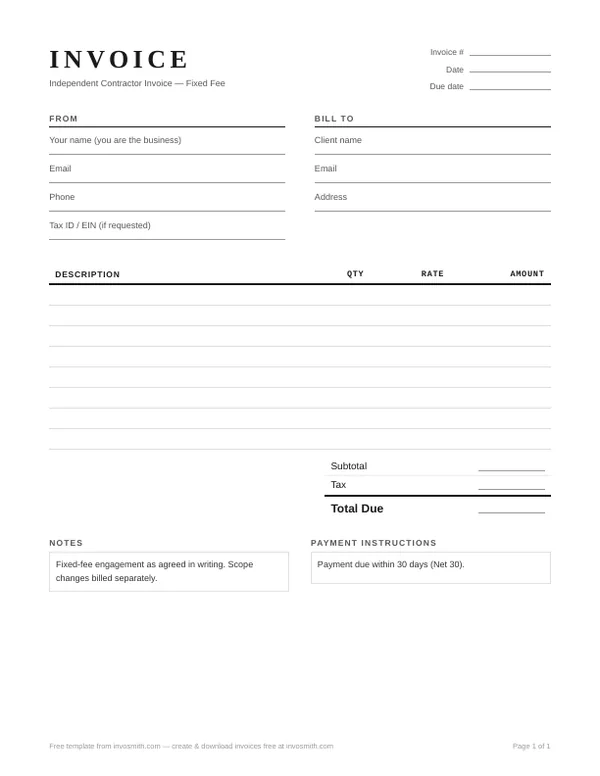
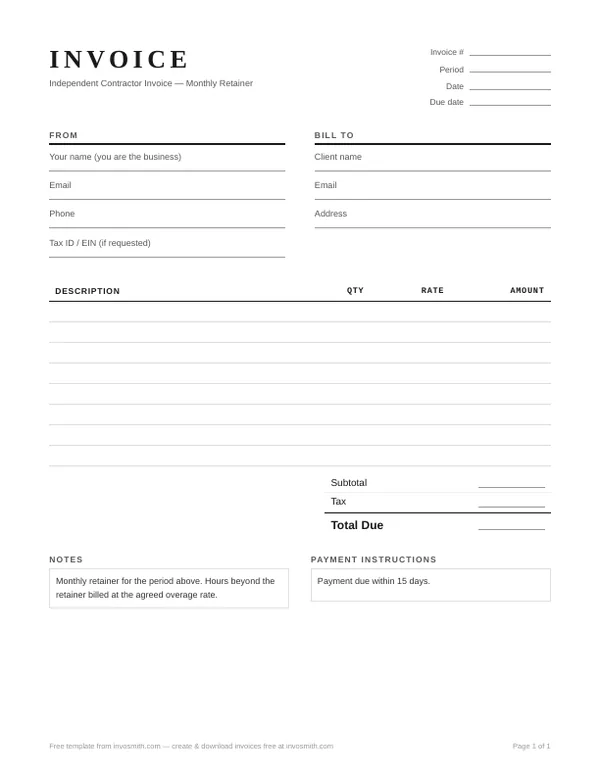
For hourly work, show hours and rate on a line for each work stream, such as "Site visits — 6 hrs × $80." For fixed-fee work, show the agreed price with a scope reference ("Per proposal dated…"). If the client approved hourly extras on a fixed-fee job, list those separately. For a retainer, show the service period ("Services for March") and list any overage hours at the agreed rate. Use the calculator to total the hours for each work stream before billing.
Give the client enough detail to match the bill to the work without another email: your name or business name and contact details, their billing details, an invoice number and date, the service period or delivery date, a clear work description, the rate or project price, payment terms and the total due. Add the contract, proposal, purchase-order or work-order reference when the client uses one.
An invoice requests payment; it is not Form 1099-NEC. The IRS independent-contractor forms guide tells a payer to collect Form W-9 for the contractor’s correct name and taxpayer identification number, then keep the W-9 in its files. Keep the SSN or EIN on that tax form and vendor record rather than printing sensitive taxpayer data on an ordinary customer invoice.
The current IRS Form W-9 provides the taxpayer identification number to a person that must file an information return. It says an individual generally uses an SSN and other entities use an EIN, with separate instructions for a resident alien, sole proprietor or disregarded entity. The payer keeps the completed form. The invoice can carry the contractor’s business name, address and vendor number without reproducing the TIN.
For payments made after December 31, 2025, the IRS states that the statutory information-reporting threshold increased to $2,000. That means the new threshold applies to payments made during calendar year 2026, including affected nonemployee compensation reported on Form 1099-NEC. The official explanation appears in Internal Revenue Bulletin 2026-19. The threshold is a payer reporting rule; it does not set an invoice amount or calculate the contractor’s tax.
Australia: put the ABN on the invoice when it applies. The Australian Taxation Office no-ABN withholding guidance says a payer must withhold the top rate of tax when a supplier does not quote an ABN, unless one of the listed exclusions applies.
United Kingdom: GOV.UK’s invoice requirements list a unique invoice number, supplier and customer details, description, supply and invoice dates, amounts, applicable VAT and total. A sole trader also includes their own name and an address for legal documents when using a business name. HMRC’s VAT record guidance states that only VAT-registered businesses can issue VAT invoices, so a non-VAT-registered contractor does not add VAT as though registered.
Philippines: after the Ease of Paying Taxes changes, the Bureau of Internal Revenue states that an “Invoice” is the primary document for a sale of goods or services. Revenue Memorandum Circular No. 77-2024 explains the terminology and invoice fields.
Keep the original invoice number, due date and outstanding balance together in every follow-up. The past-due invoice guide covers reminder wording and a sequence that keeps the original billing record intact.
Fictional example (names, dates and figures are illustrative, not price guidance): Harborline Studio (issuer) invoices Northstar Retail Co. (client) under proposal P-41. Invoice IC-2026-014, dated May 4, 2026, covers services delivered April 1–30, 2026. The lines are product-description work — 8 hours × $90 = $720; landing-page copy — 5 hours × $90 = $450; and an additional revision round — 2 hours × $90 = $180, approved April 28 under P-41.
The line items total $1,350. Subtract the $300 deposit received April 1 (receipt R-204) to show a balance due of $1,050. Terms: net 14 days, due May 18, 2026. The arithmetic is $720 + $450 + $180 = $1,350; $1,350 − $300 = $1,050.
Make the invoice easy for the client’s approver to match: include the contract, proposal, purchase order, job, project or work-order reference that actually governs the work, plus the service period, milestone or deliverable date. If the client uses none of those, a clear project name and completed-work description are better than inventing a reference.
For a deposit, retainer drawdown or partial payment, show the original charge, each prior payment or credit with its own receipt or invoice reference, and the balance now due. That is a reconciliation aid, not a new tax or contract rule; keep the underlying agreement and payment records with the invoice.
Use the subcontractor invoice instead when the work needs a subcontract reference, retainage, a progress claim or a schedule of values.
Explore subcontractor invoicesAn invoice and Form W-9 serve different purposes. The IRS identifies Form W-9 as the document a payer uses to request a payee’s taxpayer identification number. Keep the completed W-9 in the payer’s vendor file rather than placing an SSN or EIN on the ordinary invoice.
You send an invoice to request payment for your work. For U.S. federal reporting, the IRS says a payer may need to file Form 1099-NEC for qualifying payments for services; it is not a form the contractor sends instead of an invoice. Keep the invoice with the agreement and payment record.
Show hours and the agreed rate on separate lines by work stream, and refer to a time log when it helps the client review the charges. Use the rate and terms agreed with the client.
Yes, when the client approved both. Put the fixed project fee on its own line, then label the extra work separately with the hours, rate and approval or scope reference. Do not hide the extra work inside the original fixed price.
List approved expenses as their own dated or described lines. Show a deposit, retainer drawdown or earlier payment as a credit with the relevant receipt or invoice reference, then show the remaining balance due clearly.
Follow the schedule in the agreement, such as monthly, at a project milestone or on delivery. State the service period on the invoice and send it consistently, so the client can approve it against the same timing each cycle.
They share core invoice fields, but the approval context differs. Use the freelance invoice template for project, milestone or hourly creative and professional work. Keep this page for 1099, self-employed and vendor-file billing context. Pick the template whose lines match how you bill.