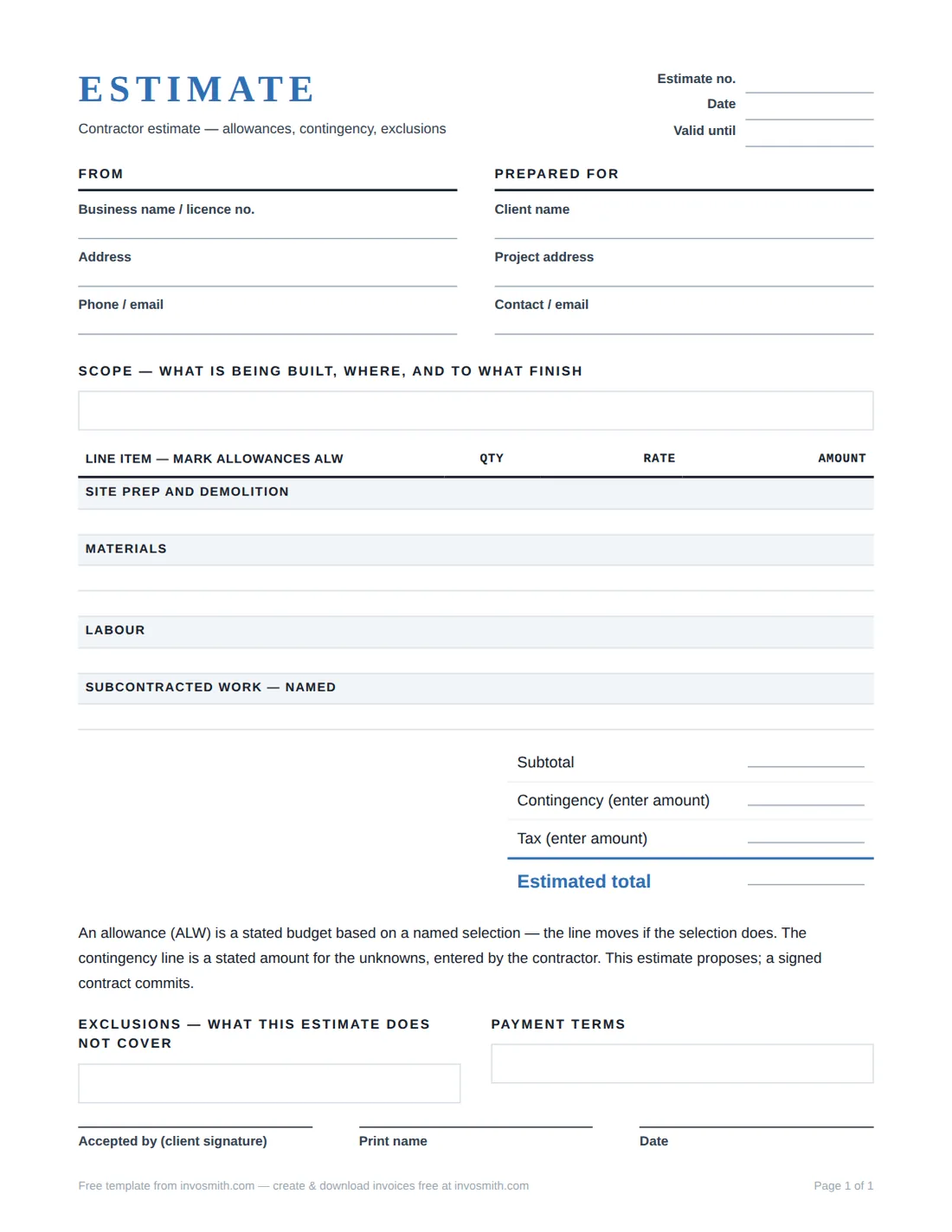
Contractor Estimate Template (PDF / Word / Excel)Standard contractor estimate — line-item costs, allowance labels, an exclusions section and a contingency line, with a valid-until date.
Open this template in the invoice makerFree template
A contractor estimate wins or loses on its cost breakdown. A homeowner who can see site prep, materials, labor and contingency as separate lines can follow how the total was built — and a total they can follow is a total they can trust. Hand them one number instead, and that number does the opposite of what you hoped: it invites three competing bids, because there's nothing in it to believe. This free contractor estimate template is built around that breakdown, plus the two labels that keep an estimate from being misread as a fixed quote — the allowance flag on lines where the client's selection sets the price, and the exclusions note that says what the number does not cover. Download it as PDF, Word or Excel below. No sign-up, no watermark.
Every download is free - no email, no sign-up, no watermark.
The header is standard — your business and license number, the client, the project address, an estimate number and date. The body is where the trust gets built, and it's built out of separate lines:
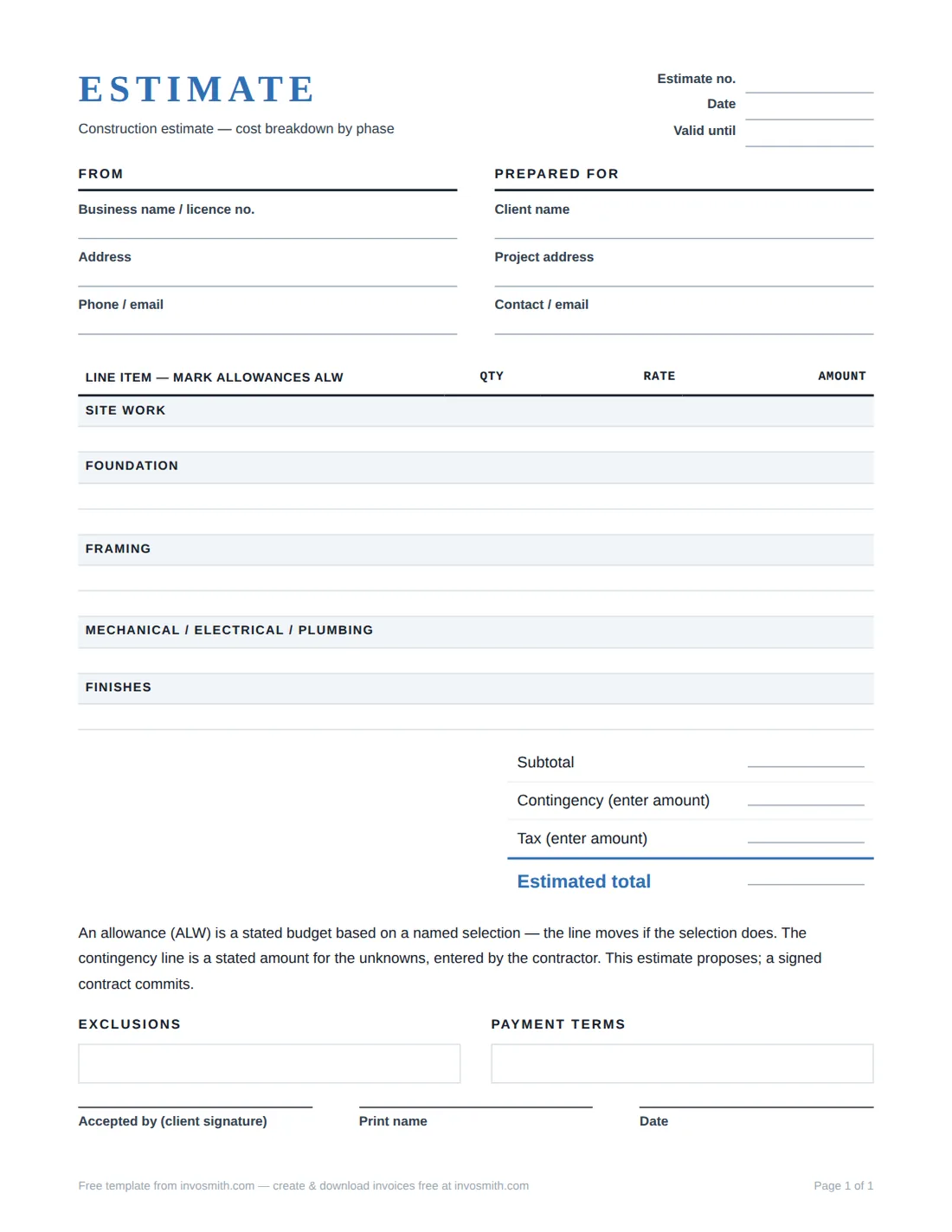
Search for a construction estimate template and you'll find the same document this page describes, organized one level up: instead of a flat list of lines, the estimate groups costs by phase — site work, foundation, framing, mechanical/electrical/plumbing, finishes — with the line items living inside each phase. Which structure you use is a question of project size, not of document type. A deck, a bathroom, a fence: a flat line-item list reads cleanly and fits on a page. A full remodel or a ground-up build: phases keep forty lines from becoming a wall of text, and they let the client see where the money concentrates before they read a single line.
The rules don't change when the structure does. Every phase still breaks into visible lines; allowances still get labeled inside whichever phase they fall in; the contingency line still sits at the bottom, entered by you; the exclusions section still closes the document. The phase-by-phase download above exists for exactly this case — same fields, one more level of grouping. And either way, resist the one temptation that phase totals invite: collapsing each phase to a single number. A phase total with no lines under it is just the one-number estimate wearing a better outline.
For general single-trade jobs outside construction, the job estimate template covers the simpler flat form.
A composite deck build, priced as a line-item breakdown:
Read what the lines are doing. The materials line carries an allowance label naming what the figure is based on — if the client upgrades to a premium board line, that line moves and the estimate says so in advance, which is the difference between a revised estimate and an argument. The contingency line is an amount, not a promise: it was worked out by the contractor and entered, sized to this job's unknowns, and it tells the client the truth that every remodel hides — that some cost lives behind the old decking and can't be priced until it's exposed. Six lines and a total: a client can take this apart, question any single line, and put it back together. That's what one number can never survive.
| Description | Amount |
|---|---|
| Site prep & demolition — remove existing deck, haul-off | 600.00 |
| Materials — composite decking & framing lumber (allowance: based on selected board line) | 3,840.00 |
| Labor — framing & decking | 2,750.00 |
| Railing installation — materials & labor | 980.00 |
| Waste disposal — dumpster & fees | 180.00 |
| Contingency (10%) — worked out by the contractor and entered | 835.00 |
| Estimated total | 9,185.00 |
| Estimate valid until: thirty days from the date above |
The breakdown wins, and it wins before anyone checks the totals. Picture the homeowner with two estimates side by side. One reads "Kitchen remodel — $24,500." The other lists demolition, cabinets as a labeled allowance, counters as another, plumbing and electrical as named subcontract lines, labor, waste, a contingency line, and an exclusions note about the permit — and lands somewhere in the same range. The homeowner can't evaluate either total against the market. But they can evaluate the second document, because it shows its reasoning: they can see that the cabinet figure is a placeholder for their own choice, that the unknowns have a budget, that the permit question was thought about. The one-number bid offers nothing to inspect — so the homeowner does the only diligence available to them and collects more bids to triangulate it.
This is the quiet economics of the estimate itself: the breakdown converts "is this price fair?" — a question the homeowner can't answer — into "does this plan make sense?", a question they can. It also survives the follow-up conversation. When the homeowner asks the one-number contractor whether the price includes new lighting, the answer is a memory test. When they ask the breakdown contractor, the answer is a line on the page or a sentence in the exclusions. Every question the document can answer by itself is a question that doesn't erode trust.
None of this requires pricing low. Line-item transparency is how a mid-priced bid beats a cheaper opaque one: the client isn't buying the smallest number, they're buying the total they understand — and the contractor who showed the parts is the one who looks like they've already built the thing once on paper.
An estimate is an informed approximation that can move as the work reveals itself; a quote is a fixed price for a fixed scope; a bid is a formal offer against someone else's specification, usually in competitive award. The full distinction — and when each one binds — is in our invoice vs quote guide.
Thirty days is common, and shorter is defensible when material prices are moving. The valid-until date isn't decoration: it protects the client from acting on a stale number and protects you from being held to prices your suppliers no longer honor. Put the date on the estimate and re-issue past it rather than stretching it.
Yes. A visible contingency reads as experience, not padding — it tells the client the unknowns were considered and budgeted before demolition, not sprung afterward as change orders. State what it covers in a phrase, and note that unused contingency isn't billed. Hiding the same amount inside inflated lines buys nothing and costs you the credibility the visible line would have earned.
Two mechanisms already on the template handle it. The valid-until date caps how long the number lives; past it, you re-estimate rather than absorb the move. And the allowance label handles the client-selection lines — an allowance is stated as a budget based on a named selection, so when the price of that selection moves, the line moves with it, visibly, instead of silently eating your margin.
Generally no — an estimate is a proposal, and the binding terms usually live in the signed contract that follows acceptance: payment schedule, change-order procedure, warranty, start dates. But how an accepted estimate is treated can vary with wording, conduct and local law, so keep the estimate labeled as an estimate and put one line on it saying a signed contract follows acceptance. This page isn't legal advice; for contract questions, ask a professional in your state.