Shingle roof replacementTear-off, materials by the square, labor and disposal — the standard replacement bid.
Open this template in the invoice makerFree template
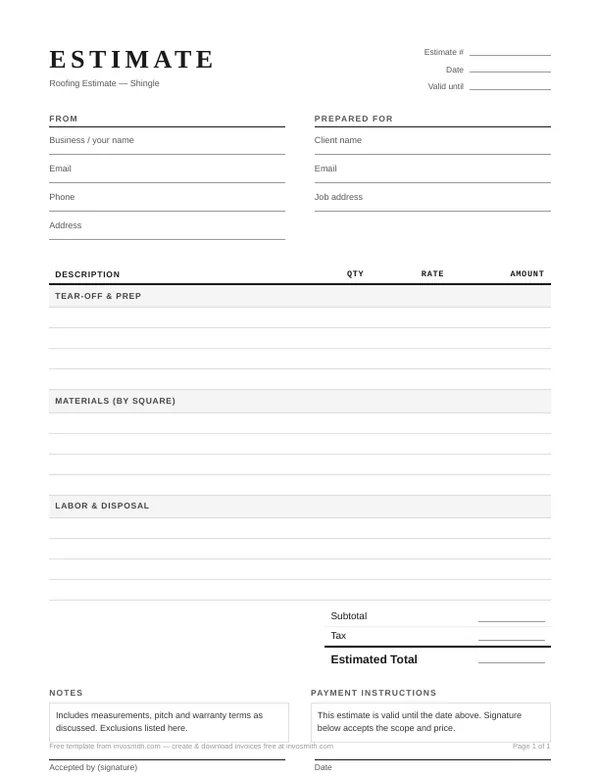
A roofing estimate turns a roof inspection into a scope the property owner can compare and authorize. The sample in this roofing estimate template separates the proposed roof work, materials and labor before the customer accepts it. Record the measured roof areas and pitch, tear-off, materials by the square, labor, disposal, exclusions, validity date and warranty terms. Download a replacement, metal or repair version below, or open the estimate generator to build an estimate online. No sign-up and no watermark.
Every download is free - no email, no sign-up, no watermark.
To build it online, open the online estimate generator with the Contractor & Construction preset.
Start with the property and inspection record: customer, job-site address, estimate number and date, roof areas measured, pitch, number of existing layers, and the measurement source. In US roofing work, one square means 100 square feet of roof area. Keep roof area and waste allowance separate so the customer can see the measured base and the pricing assumption.
Then state the scope decision: localized repair, tear-off and replacement, or another agreed method. List roof covering, underlayment, ice-and-water protection where specified, flashing, drip edge, starter, ridge cap, ventilation, fasteners and accessories. Put labor, permit allowance, access equipment, tear-off, hauling and disposal on visible lines instead of hiding them in a single material number.
Close with assumptions and exclusions, an exact valid-until date, proposed start and completion windows, payment schedule if one is proposed, and the warranty the contractor is actually offering. Identify manufacturer coverage separately from workmanship coverage. An estimate is not a substitute for a contract, permit, engineering document or insurer estimate; applicable requirements may call for additional documents and prescribed notices.
Break a complex roof into named planes, record each plane area, and show the total before waste. Add pitch for each materially different plane and identify valleys, hips, ridges, eaves, rakes, penetrations and wall intersections that affect materials or labor. If the quantity came from drawings or an aerial report rather than a site measure, name that source and date it.
Record how many existing roof-covering layers were visible and whether the estimate assumes one-layer or multi-layer tear-off. Note any area that was inaccessible, snow-covered, concealed by rooftop equipment or otherwise unverified. The estimate should say what will be measured again before ordering and what quantity may change only through a documented revision.
Waste is a pricing assumption, not extra roof area. Put the measured squares and the waste percentage or added squares on separate lines. That makes the estimate auditable if the roof geometry, product exposure or ordered quantity changes.
Replacement estimate. State the tear-off layer count, deck inspection boundary, covering product and color or product allowance, underlayment system, flashings, ventilation, edge details, disposal and cleanup. If the contractor expects to replace decking only after tear-off, keep that work out of the fixed original quantity and explain the change-order unit.
Repair estimate. Identify the observed symptom, inspected area, proposed repair boundary and the component being repaired: pipe boot, step flashing, valley, vent, fastener, membrane patch or another named item. Avoid implying that a contained repair guarantees every source of water entry has been found; write the observed condition and the work being estimated.
Metal-roof quote. Name the panel profile or allowance, gauge when known, finish, clips or fasteners, underlayment, trim, closures, penetrations and fabrication assumptions. The metal version is separate because panel and trim specifications carry more of the scope than a generic per-square line.
A useful material schedule lets the owner compare systems rather than only totals. Name the roof covering by manufacturer and product when selected, or state a clearly bounded allowance. Add underlayment, ice-and-water membrane, starter, ridge cap, flashing metal, pipe boots, vents, drip edge, sealants and fasteners as separate specifications or grouped lines with an attached schedule.
Tear-off should say what is being removed, how many visible layers the price assumes, whether disposal containers and haul-away are included, and whether landscaping or driveway protection is included. State whether permit fees are included, excluded or carried as an allowance. Do the same for scaffolding, lift rental, temporary dry-in and site protection when they apply.
Flashing and ventilation are scope items, not footnotes. Say which flashings are replaced, reused only if serviceable, or excluded; identify ridge, box, turbine or powered ventilation being installed; and state whether intake ventilation work is included. This keeps a low headline price from masking omitted system components.
Record how you reached the quantity: site measure, drawings, aerial report or the customer’s dimensions. Name the roof areas, pitch, principal lengths and the waste allowance used for pricing. If parts of the roof were not visible or accessible, say so rather than quietly treating an assumption as a fact.
Keep the estimate and the later job file connected by number. If removal reveals concealed damage, a different measurement or a requested scope change, photograph or describe it, state the added or removed work and price, and obtain the authorization required for that job before the changed work begins. The estimate remains the original scope; an approved change is its own record.
This fictional example covers 24 measured squares before any separate waste allowance. Tear-off is 24 × $85.00 = $2,040.00; architectural shingles are 24 × $215.00 = $5,160.00; underlayment and flashing are $950.00; ventilation and edge work are $1,380.00; installation labor is $3,100.00; permit allowance is $275.00; and disposal is $650.00. The original estimate is $13,555.00. These are example inputs calculated in code, not market prices.
After tear-off, the crew documents 6 deteriorated deck sheets. At the stated installed change unit of $95.00 per sheet, the proposed change is $570.00 and the revised estimate would be $14,125.00 if the owner authorizes it. The change record should describe the condition, quantity, unit rate, price and any schedule effect before that extra work starts.
Do not pre-authorize an unlimited amount of hidden work with a vague “wood extra” note. Give the original estimate a defined inspection boundary and, where appropriate, a proposed unit price for deck replacement. When concealed deterioration is exposed, record the location, quantity, photo reference, added or subtracted price and schedule effect.
A change is easier to follow when it references the original estimate number and receives its own change number. Keep the original total, change amount and revised total visible. Obtain the written authorization required for the particular contract and jurisdiction before beginning work covered by the change.
For a storm or other insured loss, add the policyholder, property address, carrier, adjuster contact if supplied, claim number, date and type of loss, inspection date, and the estimate or scope reference being answered. Itemize damaged components and measured quantities so the document can be compared with another scope line by line.
Keep four numbers distinct when they appear: the contractor estimate, an insurer-approved amount, any payment already issued, and the amount the property owner owes under the contract. Do not label an insurer payment as customer payment, subtract a deductible that the contract does not authorize you to handle, or present the template as a promise of coverage.
The estimate records observed damage and proposed work. It does not decide cause of loss, coverage, actual cash value, replacement-cost benefits or claim entitlement, and it is not negotiation or legal advice. Use the insurer's required estimating or submission process when one applies.
California Business and Professions Code §7159 applies to covered home-improvement contracts and states that the downpayment may not exceed $1,000 or 10% of the contract price, whichever is less. The section also requires covered extra work and change orders to be written and signed before that changed work begins, and calls for the scope, price adjustment and effect on progress payments or completion to be identified. Read the official California code (checked September 25, 2026). Section 7159 has exceptions and does not replace the full contract rules; this template is not a California home-improvement contract.
For NSW residential building work, the Home Building Act 1989 and its regulation set written-contract thresholds. The official legislation in force when checked September 26, 2026 records a written small-job contract threshold above $5,000 and the fuller section 7 contract rules above $20,000, with prices inclusive of GST; section 8 caps the deposit at 10% of the contract price and contains exceptions, including certain contracts between licensed parties. Read the official NSW legislation and check the current requirements for the job.
These are two location-specific examples of why an estimate may need to lead into a separate signed contract. They are not universal deposit rules, legal advice or permission to rely on the download as the only project document.
Keep the accepted estimate, any signed contract and each approved change with the job record. At completion, create an invoice from the work actually performed: original authorized scope, separately approved changes, credits or omissions, prior payments and the balance due. Do not silently replace estimated quantities with billed quantities without making the final scope readable.
When the work is ready to bill, use the roofing invoice template or create an invoice online. The invoice carries the completed scope and approved changes into the payment request.
Roof measurements in squares, pitch, tear-off or overlay, materials itemized by the square, labor, disposal, exclusions, a valid-until date, and warranty terms — both workmanship and manufacturer.
Set an exact date for which you can honor the quoted materials, labor rates and availability. The template has a field for the date; issue a revision if the customer returns after it expires.
Usage and legal effect vary. An estimate commonly communicates an approximate expected price, while a quote may be treated as a firmer offer once accepted. Use the term and contract documents appropriate to the job and applicable rules, and always write the scope, assumptions and exclusions.
Use a measurement or takeoff tool for roof quantities, then use Word or the estimate generator to present the proposed work and prices. A measurement report supplies quantities; an estimate document explains the scope being priced. Record the measurement source, roof areas and assumptions before entering materials, labor, tear-off and disposal. Keep allowances, exclusions, timing and warranty wording visible in the bid. Save the version sent to the customer and identify later revisions separately. This roofing template and the estimate generator help organize information you provide; they do not measure a roof, perform takeoff or submit bids to a procurement portal.