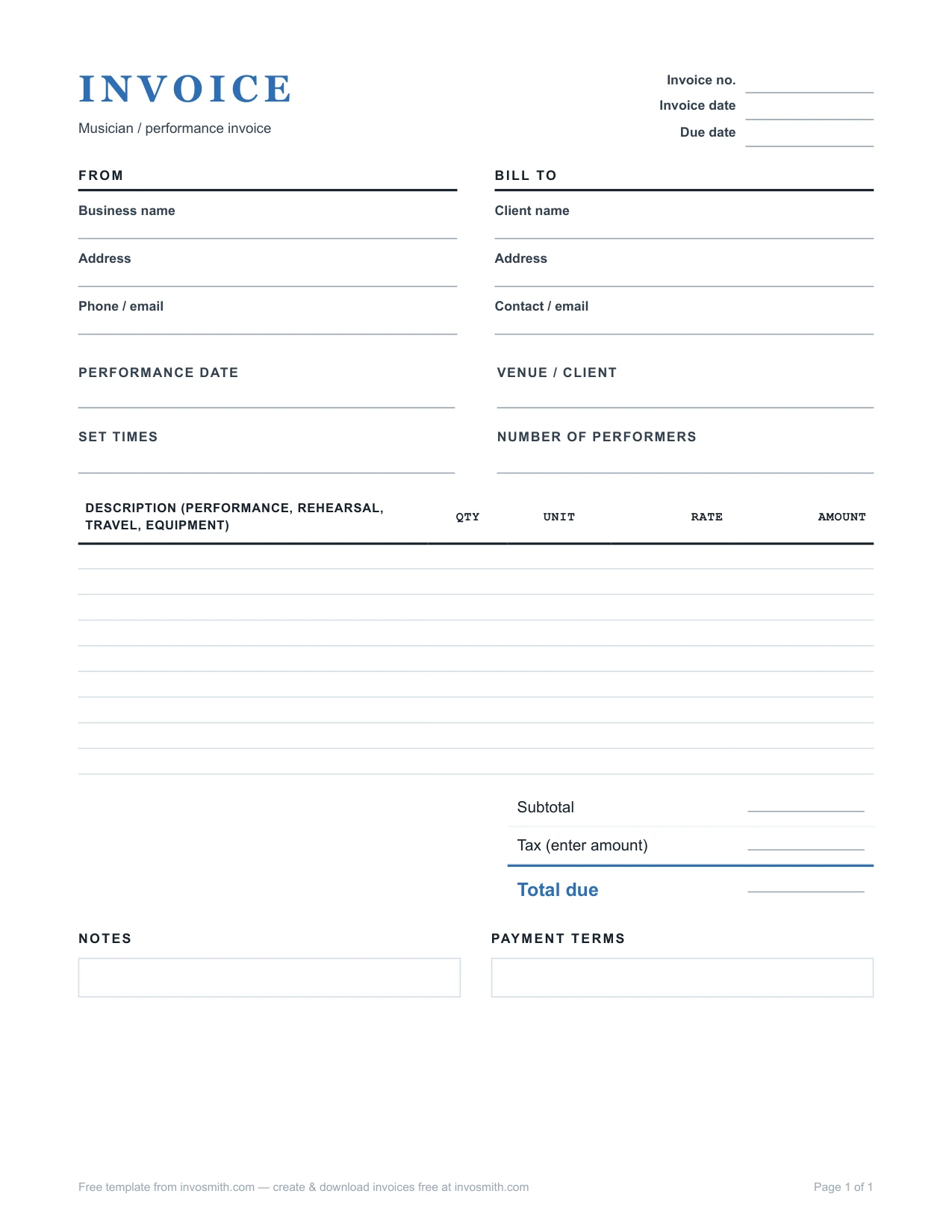
Musician Invoice Template (PDF / Word)Performance, rehearsal, travel and equipment line items.
Open this template in the invoice makerFree template
A musician invoice can refer to a venue performance, agency booking, band engagement or private event. Identify the payer from the booking and keep performance, agreed rehearsal, travel and supplied equipment separate when they have separate agreed prices. This free musician invoice template is designed around those details. Download it as PDF or Word below. No sign-up, no watermark.
Every download is free - no email, no sign-up, no watermark.
The skeleton is any freelance musician invoice: your name or act name, the client, an invoice number, dates, payment terms. The music-specific work happens in two places — the line items and the payer-shaped header:
Illustrative invoice M-118, issued October 20 to Hartwell Hotel for an October 18 performance. Amounts are in USD; tax is excluded. The listed lines total $1,225.00; after the $300.00 deposit received September 2, the $925.00 balance is due November 3 under the sample Net 14 terms.
The performance line names the event and set structure; rehearsal, travel, and backline are separate because the example treats them as separately agreed charges. This is a single invoice from the trio; it does not allocate the group fee among the players.
| Description | Qty | Rate | Amount |
|---|---|---|---|
| Performance — jazz trio, 3 × 45-min sets, Hartwell Hotel, Oct 18 | 1 | 900.00 | 900.00 |
| Rehearsal — 2 hrs, agreed at booking | 2 | 50.00 | 100.00 |
| Travel — 120 mi round trip, flat | 1 | 75.00 | 75.00 |
| Backline — PA and keyboard amp supplied | 1 | 150.00 | 150.00 |
| Subtotal | 1,225.00 | ||
| Deposit received — September 2 | −300.00 | ||
| Tax (if applicable) | — | ||
| Balance due — Net 14 | 925.00 |
The payer needs a booking reference. If an agency or venue supplied a reference, include it with the invoice and use the bill-to details they provided. This keeps the request tied to the booking without making assumptions about the payer’s internal process.
You played the session; the credit is not the fee. Show the session work and the agreed fee and due date under the booking arrangement, with the project and studio identified where useful: "Session — electric guitar, 3 songs, Redline Studio, for the 'Northbound' EP." Keep any credit or royalty arrangement separate from the invoice unless the booking terms say otherwise.
Who booked the work and who owes payment? Identify the party that engaged you and the party responsible for payment under the booking. If a client booked and owes one band or act, that act can invoice for the agreed total; if players were engaged or are owed separately, each can invoice the party that owes their fee. Match the invoice to the actual arrangement rather than assuming every booking has the same payer structure.
The agency takes its cut — but from whom? Check whether the agency or the client owes your fee under the booking. Invoice that party for the amount owed, and include an agency reference when supplied or requested. Confirming the bill-to party and reference at booking time can help avoid later clarification.
The gig grew. A second set added on the night, a ceremony added to a reception booking, an extra rehearsal called by the client. Each is a line at a stated rate on the invoice — ideally a rate that was quoted when the addition was requested. "Additional set — requested on the night, $150" reads as an agreement kept; a silently larger total reads as a bill padded.
Several dates belong to one engagement. Keep the performance date in the main service line and place separately agreed rehearsal or travel dates on their own lines. The invoice date and due date stay in the header. That separation lets the payer match the billing record to the booking without mistaking a rehearsal date for the event date.
A cancellation or replacement changed the lineup. Invoice only the work and charges supported by the booking arrangement, and identify the act or player that is actually billing. Keep internal payments between band members out of the client-facing total unless they are part of what the client agreed to pay.
The client needs a revised copy. Keep the same engagement reference, mark the revision date and make the changed line easy to identify.
Name the party identified in the booking arrangement and include any event, booking, or purchase-order reference the payer supplied. Handle tax forms or other onboarding requests separately using the payer’s instructions and applicable official guidance.
Show rehearsal as a separate charge when it was agreed and priced under the booking. Do not add a separate preparation charge unless the arrangement covers it.
Match invoices to the booking and payment arrangement. If the client booked and owes one band or act, that act can invoice the agreed total and handle internal allocation separately. If individual players were separately engaged or are owed by a bandleader, agency, or client, each can invoice the party responsible for their fee. Do not assume that one invoice format fits every band booking.
Invoice the party responsible for paying you under the booking, and include the agency reference if one was supplied or requested. Confirm any reference or submission instructions with the payer rather than assuming every agency uses the same process.
Use the schedule agreed for the booking and show a clear due date or payment period. If the payer supplied terms or an invoice reference, match those details rather than relying on a general industry timeline.