How can I create a down payment invoice using online tools?
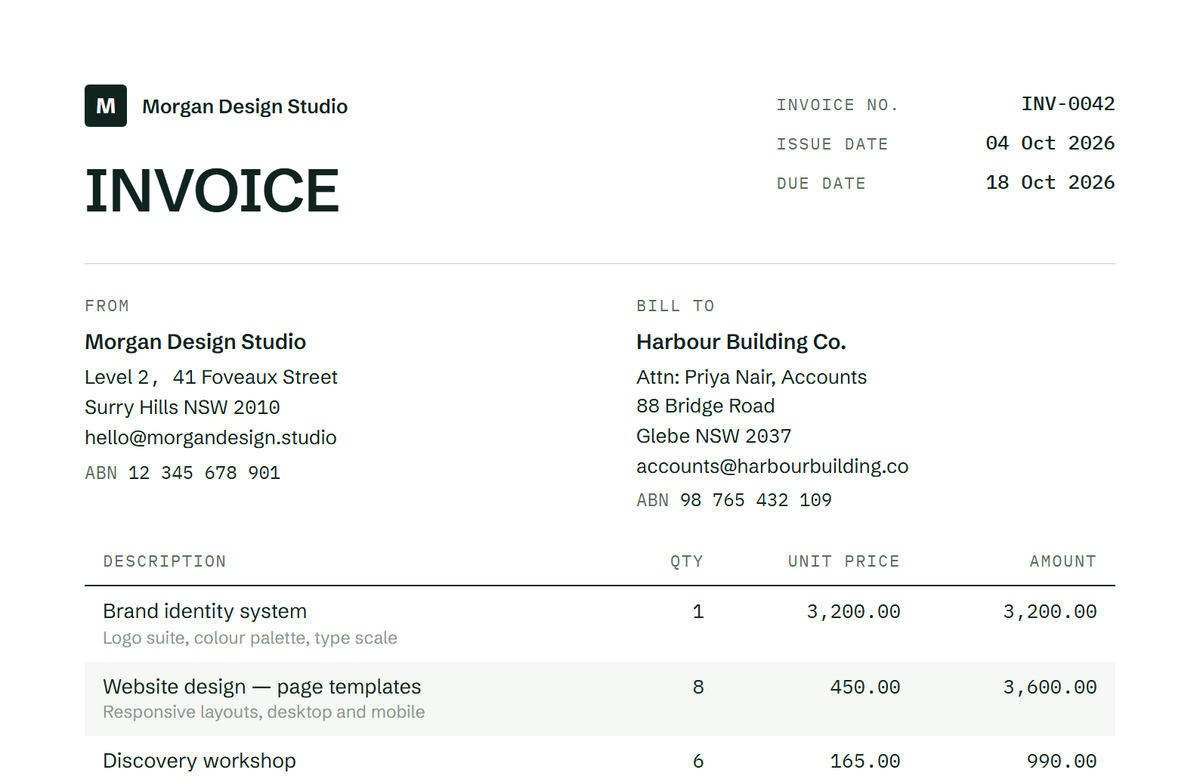
Open the invoice maker and enter the contractor, customer and job reference. Describe the line as a deposit or advance payment for the named project, and state what that payment covers. Enter the amount and due date from the written payment schedule, then include the contract or accepted estimate reference. Keep the requested deposit distinct from money already received. A deposit invoice asks for the payment; a receipt acknowledges it after it arrives. Review the PDF before sending, save the issued copy and record the actual payment against the job. Carry that payment forward when preparing the next claim so it is not requested again. The tool formats the payment request. The amount, timing and scope come from the job's agreement; this example does not set a deposit percentage or a jurisdictional limit.
Construction invoice format and fields
Every construction invoice, from a bathroom remodel to a commercial fit-out, answers the same four questions: who did the work, what exactly was done, what it costs, and what's already been paid. That means your details and license number, the client and job site, a contract or PO reference, then the work itemized — materials, labor by trade, equipment, subcontractors — with variations on their own lines, the deposit and retention accounted for, and a balance nobody has to calculate. The full field-by-field checklist lives on the construction invoice template page; what this guide adds is the part templates can't: when to send which invoice, and why the sequence protects you. For work billed by hours and materials, total the crew hours for the billing period before entering the labor lines.
Step 1 — Set the payment schedule before you start
The invoice argument you win is the one you never have: it was settled in the contract. Before work starts, agree in writing how the job will be billed — deposit percentage, what triggers each progress payment (dates or milestones), what retention is held and when it releases, and payment terms per invoice. On small residential jobs this can be three sentences in the quote. On commercial work it often takes the form of a schedule of values: the contract sum broken into line items, so every progress claim maps to visible portions of the work. Either way, the schedule is the skeleton — every invoice that follows just puts numbers on it.
Step 2 — The deposit invoice
The deposit invoice goes out after signing and before mobilization, and it should look like an invoice, not a text message: numbered, dated, referencing the contract, with the deposit amount and what it covers (materials order, securing the start date). Number it as the first in the job's series — INV-2041-1 — so the paper trail reads as one story. When the deposit lands, say so on the next invoice: a "deposit received" line in the totals, subtracted in plain sight. Clients trust invoices that remember what they've already paid.
Step 3 — Progress claims
A progress claim is an invoice for the portion of work completed since the last one. The rhythm comes from your Step-1 schedule: monthly, or at milestones — foundation poured, frame up, lock-up. Each claim shows the work completed this period (mapped to the schedule of values if you're using one), the value claimed, less any retention, and the total due for this claim. Keep the numbering sequential within the job. Two habits make claims get paid faster: attach evidence (photos, a one-line progress summary — the person approving payment often isn't the person on site), and keep each claim boring. A claim that looks exactly like the last one, plus progress, sails through approval.
Step 4 — Variations get their own paper
The fastest way to lose a payment dispute is a variation that appears on the invoice but nowhere else in writing. When scope changes — client adds a skylight, hidden rot doubles the framing repair — the sequence is: describe it, price it, get written approval, then bill it as its own line referencing that approval ("Variation VO-3, approved June 12"). Never fold variation costs silently into existing lines; the total creeping up without explanation is how trust dies mid-project. Numbered variations with approval dates turn "why is this more than the quote?" into a paperwork lookup instead of an argument.
Step 5 — The final claim and retention
Retention is the amount or percentage the contract holds back from each claim until its stated release conditions are met. It accrues across the job and may release in one or more stages; the contract controls the rate, timing and required closeout documents. Your final claim closes the account: remaining work, plus any retention released under the contract, minus anything already paid. Restate the totals for the whole job — contract sum, variations, total paid, this claim — so the client sees one clean reconciliation. If the contract requires lien waivers on final payment, this is where they change hands. Send the final claim promptly; the job isn't done until the account is.
Invoice vs payment application (AIA G702)
On commercial projects — especially with a general contractor above you — you may be asked for a payment application instead of an invoice: a formal package (AIA G702/G703 in the US) where the claim is presented against the schedule of values, with retainage calculated on the form and a signed certification. The decision is simple, because it isn't yours: bill the way the contract says. If it specifies payment applications, use them; if it doesn't — which covers most residential and small commercial work — a well-structured construction invoice like the stage-payment template is exactly right. The concepts are identical either way: work completed, less retention, total due this period.
Frequently asked questions
How do I invoice for construction work?
Agree the payment schedule in the contract, invoice the deposit before starting, send progress claims at the agreed milestones, bill every variation as its own approved line, and send a final claim that releases retention. Each invoice: itemized work, deposit and retention accounted for, clear balance due.
How does retention work on an invoice?
Show it as a deduction on each claim using the rate or amount in the contract, track the accrued total, and request release only when the contract conditions are met. The contract controls the timing and any required closeout documents.
What's a progress claim?
An invoice for the work completed since the last claim, mapped to the payment schedule agreed up front. Sequentially numbered, evidence attached, retention deducted.
Where do I get a construction invoice template?
The construction invoice template page has the standard, stage-payment and simple-bill formats free in PDF, Word and Google Docs — or build the invoice online in the free generator.
Invosmith is a free invoice generator built for people who bill for their work.
Ready to bill? Open the free generator with contractor fields set, or grab the construction invoice template and start from paper.