Free template
Free Delivery Order Template (PDF, Word & Excel)
The U.S. UCC text hosted by Cornell Legal Information Institute, §7-102(a)(5), defines a delivery order as a record containing an order to deliver goods directed to a warehouse, carrier or a person that ordinarily issues warehouse receipts or bills of lading (checked 2026-09-25). This page covers that release-instruction use, not a seller’s delivery note recording a handover. The free template has fields for an order number and date, issuer and instructed party, intended collector, goods and quantities, and a pickup location and window. Confirm the issuer, authorization and accepted format with the carrier or warehouse holding the goods. Download it below as PDF, Word or Excel. No sign-up needed; the files are yours to edit and reuse.
Samples
Delivery order samples and examples
Sample delivery order
Here is a filled delivery order for an importer releasing stock from a bonded warehouse: **Delivery Order DO-2081 · Date: July 30** **Issued by:** Meridian Imports LLC (consignee) · **To:** Portside Bonded Warehouse, Bay 4 **Release to:** Kestrel Haulage — driver must present company photo ID and quote DO-2081 **Pickup:** Bay 4 loading dock · July 31, 08:00–12:00 This fictional example records twelve pallets, their quantities and shipping marks, plus the named collecting party and intended pickup window. It illustrates fields a sender may use to make an instruction specific; it does not establish which identity checks or release controls a particular warehouse will apply. Confirm the facility’s requirements before the shipment is collected.
Download the delivery order template
Delivery Order Template (PDF / Word / Excel)
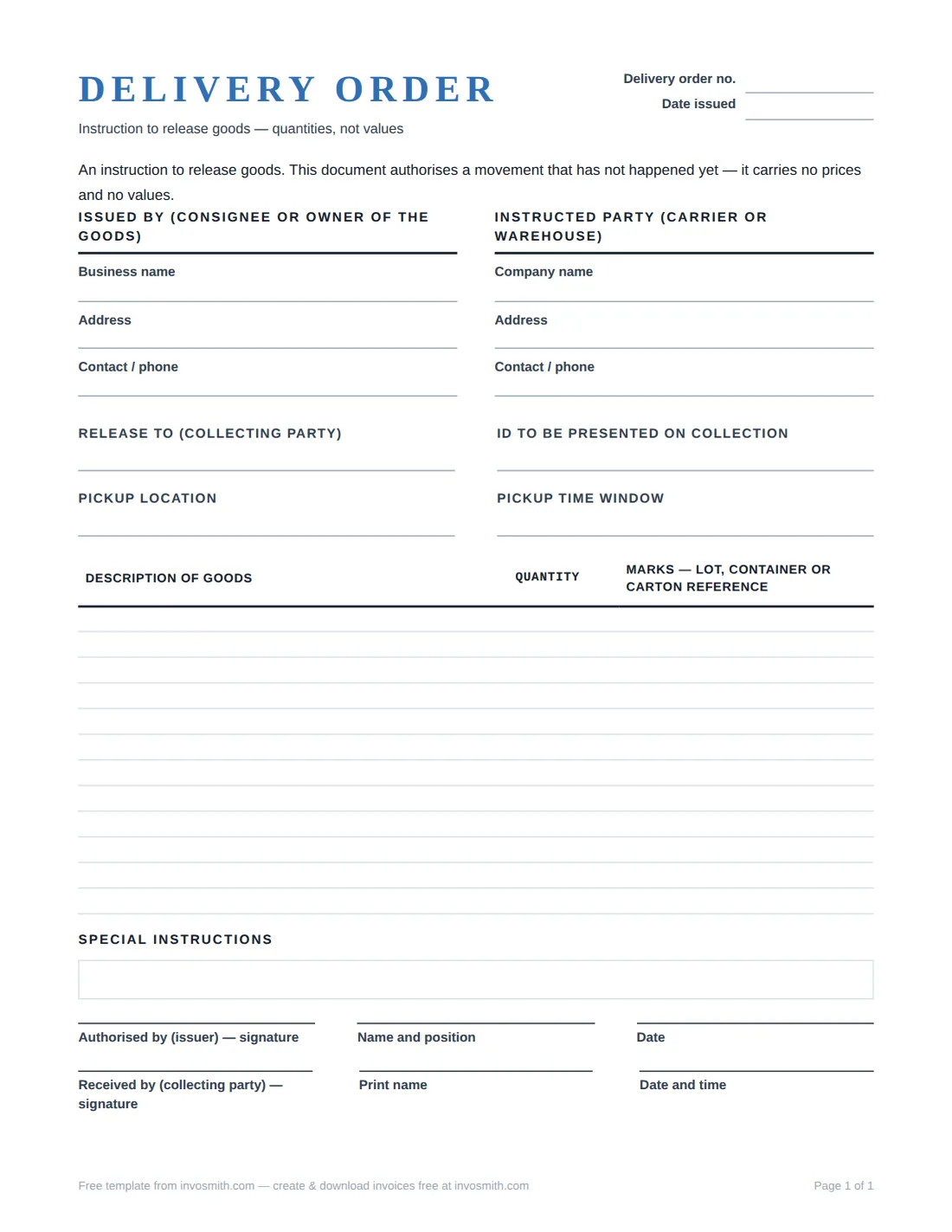
A one-page delivery-order form with fields for an order number and date, issuer, instructed party, intended collector and optional identification details, goods, quantities and marks, pickup location and window, issuer authorization, and collection acknowledgement. Follow the carrier or warehouse’s own document and release requirements. The PDF is fixed-layout for fill-and-print; the Word and Excel versions are editable, so you can add rows, preprint company details or remove unused fields. None of the files ask for an email address.
Delivery order vs delivery note
In the release-instruction sense used on this page, a delivery order directs a carrier or warehouse holding goods to deliver them to a named party. A seller’s delivery note serves a different purpose: it accompanies a delivery and can record the items handed over or received. Their timing and use can vary by workflow; neither document should be treated as a substitute for the other without checking the parties’ process. If you need a document for recording a handover, see the delivery note template; everything below is about the instruction.
“Delivery order” can also mean different things in different shipping and commercial contexts. The U.S. UCC definition is one specific usage; confirm the intended document with the carrier, warehouse or counterparty if their terminology differs.
What goes on a delivery order
The template groups its fields around three practical questions: who is giving the instruction, what goods it concerns, and who is intended to collect them. Confirm the facility’s actual information requirements before use.
Who says so. The issued-by block identifies the party giving the instruction, and the authorization block records approval. The person or organization entitled to issue the instruction, and the records a carrier or warehouse accepts, depend on the transaction and the facility’s process; confirm those requirements with the party holding the goods.
What exactly. The goods table lists each line with a description, the quantity, and the shipping marks — the lot numbers, container references or carton markings that can help identify physical stock. A consistent order reference and date can help parties match the instruction to related shipment records; use a reference that fits your recordkeeping process.
To whom, where, and when. The release-to block can identify the collecting party and any ID they are asked to present; the pickup section records the intended location and time window. The received-by sign-off can record collection. Confirm which identification and sign-off fields the carrier or warehouse requires before pickup.
Sample delivery order
Here is a filled delivery order for an importer releasing stock from a bonded warehouse:
Delivery Order DO-2081 · Date: July 30 Issued by: Meridian Imports LLC (consignee) · To: Portside Bonded Warehouse, Bay 4 Release to: Kestrel Haulage — driver must present company photo ID and quote DO-2081 Pickup: Bay 4 loading dock · July 31, 08:00–12:00
This fictional example records twelve pallets, their quantities and shipping marks, plus the named collecting party and intended pickup window. It illustrates fields a sender may use to make an instruction specific; it does not establish which identity checks or release controls a particular warehouse will apply. Confirm the facility’s requirements before the shipment is collected.
| Description | Quantity | Marks |
|---|---|---|
| Ceramic tableware, cartons on pallets | 8 pallets | MI-4471 / LOT A |
| Glass tumblers, cartons on pallets | 3 pallets | MI-4471 / LOT B |
| Display stands, shrink-wrapped | 1 pallet | MI-4472 |
If you're the warehouse: what to check before releasing
The template provides fields for an order reference, issuer authorization, named collecting party and collection acknowledgement. Whether those fields are needed, and how release details are checked, depends on the facility’s process. Confirm the requirements with the party holding the goods; this sample does not set them.
Frequently asked questions
Is a delivery order the same as a delivery note?
In the release-instruction sense covered here, a delivery order tells a carrier or warehouse holding goods whom they are being instructed to deliver them to. A delivery note can accompany a delivery and record what was handed over or received. They serve different purposes; confirm which document your counterparty means and needs.
Is a delivery order the same as a bill of lading?
No. A bill of lading is a carrier transport document; a delivery order, in the release-instruction sense covered here, directs a party holding goods to deliver them. The party authorized to give that instruction depends on the transaction. See our bill of lading template for the transport-document task.
Who issues a delivery order?
It depends on the transaction. The U.S. UCC text hosted by Cornell Legal Information Institute, §7-102(a)(5), defines a delivery order as a record containing an order to deliver goods directed to a warehouse, carrier or a person that ordinarily issues warehouse receipts or bills of lading; the text was checked 2026-09-25. Section (a)(8) describes the issuer of an unaccepted delivery order. This source describes UCC text and does not establish the enacted rule in every state or identify the authorized issuer for every transaction; confirm the applicable process with the counterparty.
Can a delivery order be emailed?
The U.S. UCC text hosted by Cornell Legal Information Institute, §7-102(a)(10), defines “record” to include information stored in a tangible or electronic medium and retrievable in perceivable form (checked 2026-09-25). This definition does not mean every carrier or warehouse accepts an emailed copy for release, and the hosted text is not proof of each state’s enacted law. Confirm document format and release procedure with the party holding the goods.
How do I document a partial release?
Record the quantities for each release and reconcile them against the remaining balance using the process agreed with the party holding the goods. This template can be adapted for a partial-release record, but confirm whether separate orders, acknowledgements or other documents are required.