Free template
Free Bill of Lading Template (PDF, Word & Excel)
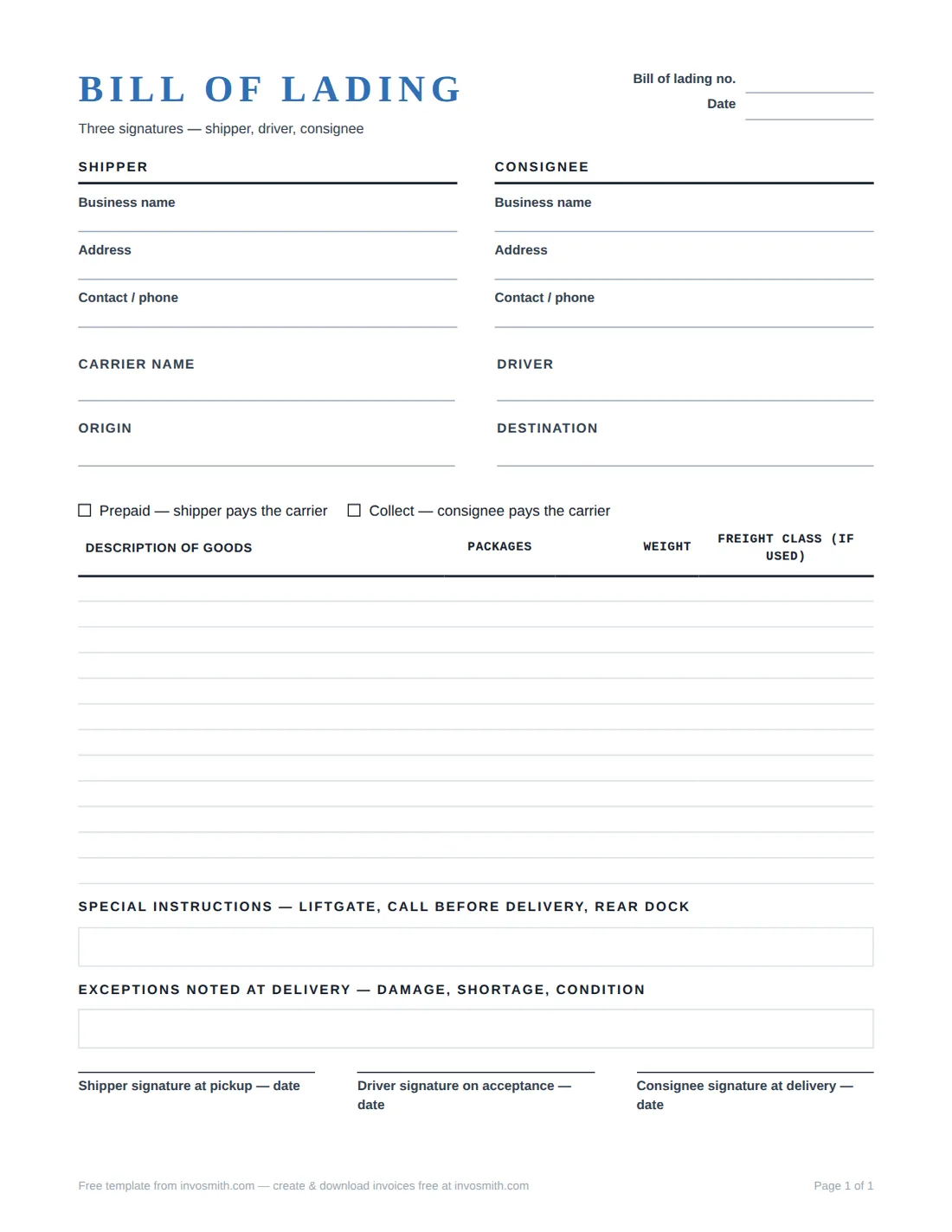
A bill of lading is a transport document connecting the goods and the carrier. Use the editable bill of lading template in Word to enter the shipper, consignee and freight details. In its export guidance, the U.S. International Trade Administration distinguishes non-negotiable straight bills from negotiable order bills for ocean shipments. Use these files as starting records for parties, goods and handover notes, but ask the carrier or forwarder which form, copies and process it accepts for this movement. Do not use a general template as a hazardous-goods declaration or electronic original.
Samples
Bill of lading samples and examples
Sample bill of lading
Illustrative only: here is a fictional domestic-freight furniture shipment, not a carrier-approved form or liability finding: **BOL #7734 · Date: July 29 · Carrier: Blue Line Freight · Driver: M. Okafor** **Shipper:** Harwood Furniture Co., 210 Mill Rd, Grand Rapids, MI · **Consignee:** Foster & Reed Interiors, 88 Canal St, Columbus, OH **Freight terms:** ☒ Prepaid ☐ Collect · **Special instructions:** Liftgate required; call consignee 30 min before delivery The table lists 22 handling units (4 crates + 16 cartons + 2 pallets) and 1,740 lb (720 + 640 + 380); handling units are not the number of individual furniture pieces. If a sideboard arrives with a cracked rear panel, record that observation and keep consistent copies or photos under the carrier's procedure. The example does not establish liability or guarantee a claim outcome. A useful discrepancy note identifies the line and the observed condition: “Sideboards — 2 pallets received; rear panel cracked on one unit.” That is clearer than “damaged goods” because it preserves the listed package count and points to the affected item without assigning a cause. A correction should leave an understandable trail. Keep the original reference, mark the changed entry clearly and retain the dated version used for the next handover. Do not erase an earlier observation or change a quantity on only one copy, because that makes the records harder to reconcile.
Download the bill of lading template
Bill of Lading Template (PDF / Word / Excel)
PDF, Word and Excel layouts for a shipment reference, shipper, consignee, carrier, goods, package counts, weight, instructions and handover notes. Check the actual file and carrier requirements before use. This page does not supply a specialist declaration or determine liability.
Straight Bill of Lading (PDF / Word)
A straight-BOL layout in PDF and Word. The U.S. International Trade Administration describes a straight bill as non-negotiable in its ocean-shipment guidance. Confirm the required instrument with your carrier or forwarder.
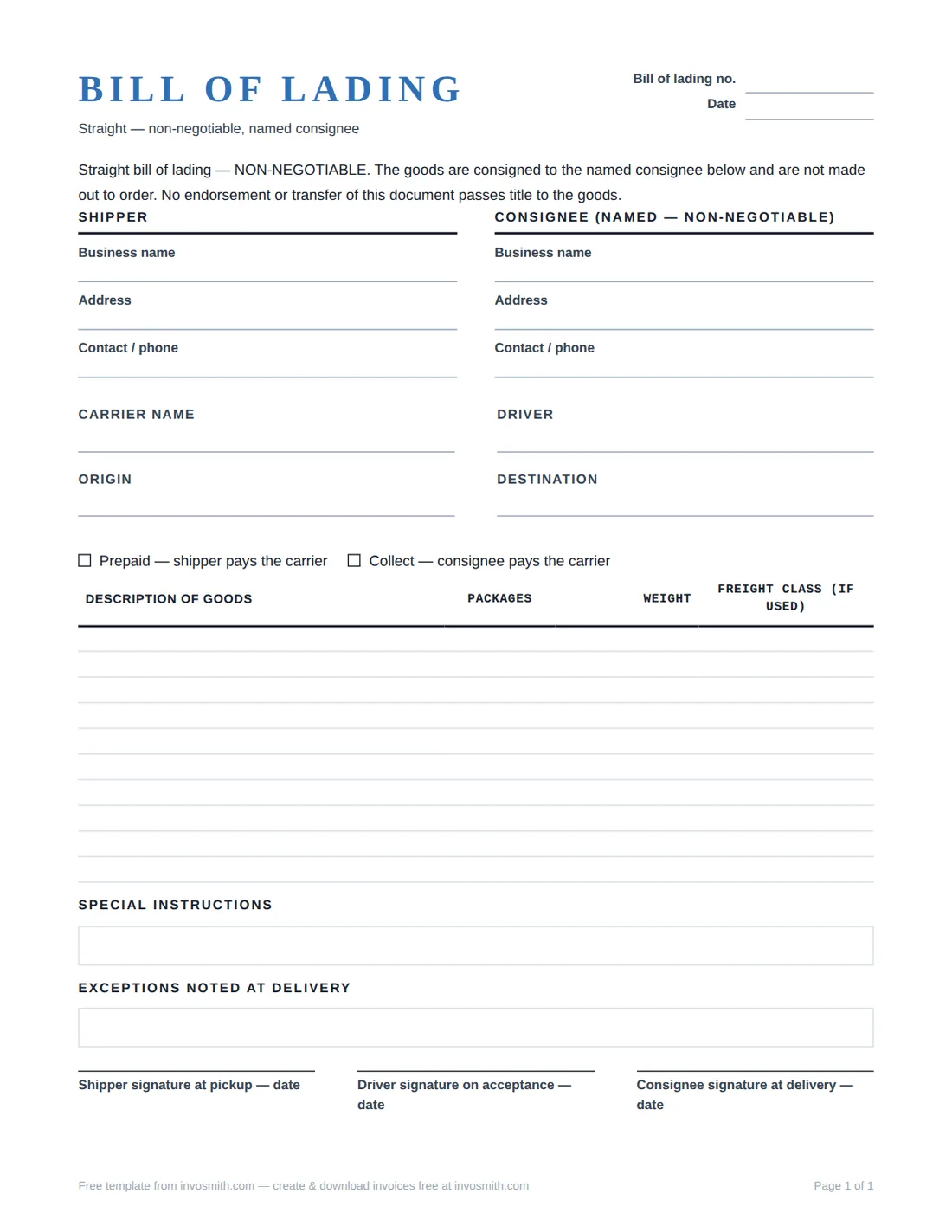
Check the completed file for legibility and confirm the carrier’s accepted original or electronic handover process, including any required copies, before pickup.
Start with the carrier’s handover process
Use the relevant signature or receipt blocks to record who handed over or received the goods and when. Check visible package counts and note a specific discrepancy rather than writing an unsupported “all correct.” Ask the carrier how exceptions, refusal or claims must be handled; this page does not replace those instructions.
Confirm copy and original requirements before pickup. Keep a legible final record and ensure an added notation is not missing from another retained copy. There is no universal three-copy rule asserted here. For billing work, see the trucking invoice template.
Treat each handover entry as part of one continuous shipment record. Use the same BOL reference on the pickup copy, the retained record and any later correspondence. Record the time, location and person involved while the details are available instead of rebuilding the sequence from memory after delivery.
Describe an observed exception in concrete terms: the affected package, visible condition and quantity received. Keep the description neutral and separate from any conclusion about cause or responsibility. Photos, inspection records and follow-up messages can be stored beside the BOL under the shipment file, with each item labelled by the same reference.
Blank bill of lading form fields
Record the shipment reference and date; shipper, consignee and carrier contacts; collection and delivery locations; goods descriptions, package counts and weight with units; agreed instructions and freight terms; and observed handover exceptions.
These are instructions for completing this template, not an exhaustive legal field list. Do not mix pounds and kilograms, infer payment status from a checkbox or guess a freight class. Check specialist declarations with the party responsible for the shipment.
Write package counts and weights as separate facts. “4 crates / 720 lb” is clearer than a single quantity with no unit, and it lets a reader compare the document with the physical load. If origin and destination differ from the shipper and consignee addresses, enter the actual collection and delivery locations rather than repeating an office address.
Keep descriptions recognizable without relying only on an internal SKU. A product name, packaging type and model or material can distinguish one line from another. Use the special-instructions area for agreed handling details that belong with the movement, and keep prices and carrier billing on the records created for those purposes.
Waybill vs bill of lading
U.S. International Trade Administration guidance describes air waybills as non-negotiable and distinguishes straight from order bills of lading for ocean shipments. An air waybill and an ocean bill serve different transport arrangements; do not classify the document merely by the presence or absence of a consignee signature box. Use the carrier's specified document.
Sample bill of lading
Illustrative only: here is a fictional domestic-freight furniture shipment, not a carrier-approved form or liability finding:
BOL #7734 · Date: July 29 · Carrier: Blue Line Freight · Driver: M. Okafor Shipper: Harwood Furniture Co., 210 Mill Rd, Grand Rapids, MI · Consignee: Foster & Reed Interiors, 88 Canal St, Columbus, OH Freight terms: ☒ Prepaid ☐ Collect · Special instructions: Liftgate required; call consignee 30 min before delivery
The table lists 22 handling units (4 crates + 16 cartons + 2 pallets) and 1,740 lb (720 + 640 + 380); handling units are not the number of individual furniture pieces. If a sideboard arrives with a cracked rear panel, record that observation and keep consistent copies or photos under the carrier's procedure. The example does not establish liability or guarantee a claim outcome.
A useful discrepancy note identifies the line and the observed condition: “Sideboards — 2 pallets received; rear panel cracked on one unit.” That is clearer than “damaged goods” because it preserves the listed package count and points to the affected item without assigning a cause.
A correction should leave an understandable trail. Keep the original reference, mark the changed entry clearly and retain the dated version used for the next handover. Do not erase an earlier observation or change a quantity on only one copy, because that makes the records harder to reconcile.
| Description | Packages | Weight |
|---|---|---|
| Oak dining tables, crated | 4 crates | 720 lb |
| Upholstered dining chairs, boxed | 16 cartons | 640 lb |
| Sideboards, blanket-wrapped on pallet | 2 pallets | 380 lb |
If you're the driver: copy discipline
Ask the carrier which copies or electronic records each party needs. Keep the final version relevant to your role and check that exceptions are recorded consistently on retained copies. An emailed PDF is not being represented here as an electronic negotiable original.
Before leaving a pickup or delivery, read back the shipment reference, locations, package totals and any handwritten notation. A clear correction made at the handover is easier to follow than a separate note with no BOL number. Keep later billing references distinct: the transport record identifies the movement, while the carrier invoice records the freight charge.
Frequently asked questions
What is the difference between a waybill and a bill of lading?
Use the carrier's specified transport document rather than a signature-box shortcut. ITA describes air waybills as non-negotiable and distinguishes straight and order ocean bills.
What is the difference between a straight and an order bill of lading?
In its ocean-shipment guidance, the U.S. International Trade Administration describes a straight bill as non-negotiable and an order bill as negotiable. Confirm the required instrument with your carrier or forwarder.
Who keeps which copy of the bill of lading?
Confirm copy and original-document requirements with the carrier before collection. Keep the version relevant to your role and record exceptions consistently.
What tools can I use to create and print a bill of lading?
Use the Word template to edit a shipment document, Excel to enter shipment details in cells, or the PDF for a fixed print layout. Enter the parties, shipment reference, goods, package counts and weights with their units. Keep the handover notes readable on the completed copy. For spreadsheet editing in a browser, you can open the Excel file in Google Sheets. Use File > Print and select the current sheet or the cells containing the form. Google's printing guide explains sheet selection, page breaks and paper settings. Review every page before printing so no goods line, reference or signature area is cut off. This prepares a document from your entries; it does not issue a carrier's electronic original.
Is a bill of lading proof of ownership?
Do not infer ownership from this downloadable layout. Rights and release requirements need the actual bill, transaction and applicable terms reviewed.
Is an electronic bill of lading accepted?
Ask which electronic process the carrier accepts. An emailed PDF is not represented here as an electronic negotiable original.