Free template
Free Packing Slip Template (PDF, Word & Excel)
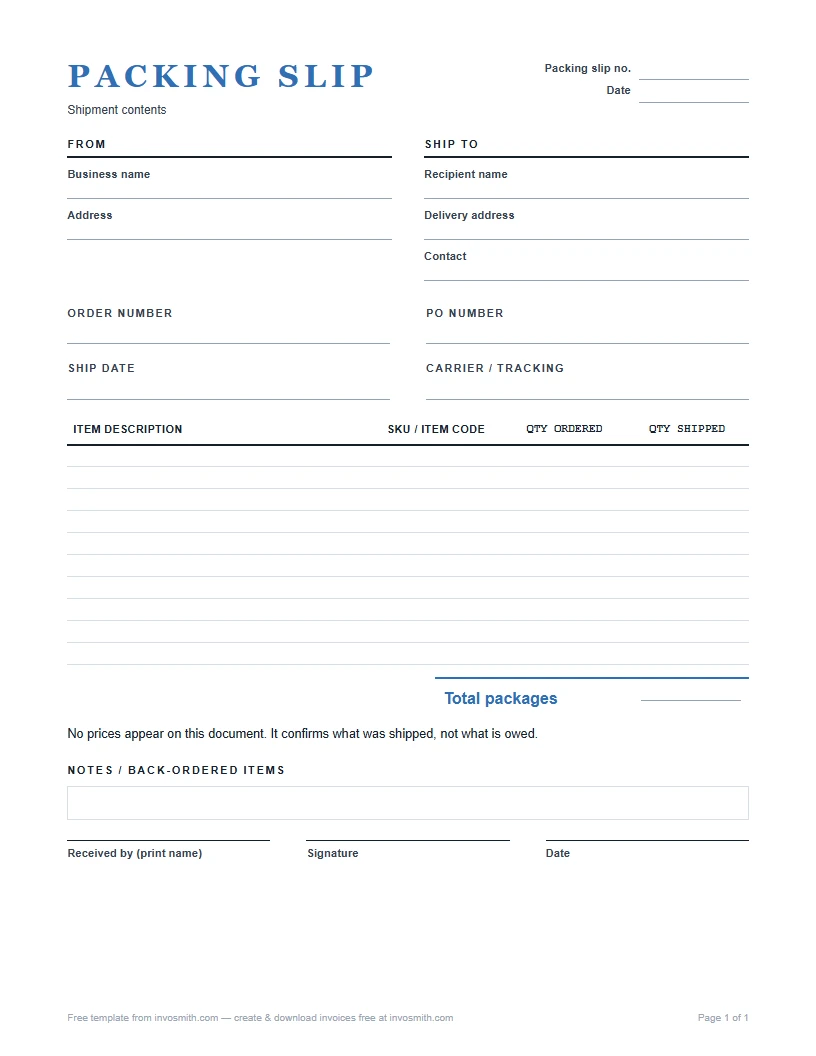
A packing slip travels inside the box. Its whole job is to let whoever opens that box — a warehouse receiver, a store manager, a customer — check what arrived against what was ordered, item by item, without seeing a single price. This free packing slip template covers the order number, the customer's PO reference, ship-to details, and an item list with quantities ordered, shipped and backordered. Download it below as PDF, Word or Excel, along with a strict no-prices version for gift orders and drop shipments. No sign-up needed; the files are yours to edit and reuse.
Samples
Packing slip samples and examples
Sample packing slip
Here is a filled sample packing slip for a split order — the kind where the backordered column earns its place: **Order #4172 · PO #TX-889 · Ship date: July 28 · Box 1 of 1** Read what the sample is doing. The receiver counts 134 units, matches them line by line, and the slip has already explained the shortfall: twelve navy mugs are backordered, not lost. Without that column, the same box triggers a where-is-the-rest email; with it, the slip answers before the question is asked. Notice also what is absent — no prices, no totals in dollars, no payment terms. The invoice for order #4172 carries all of that, and it went to accounts payable, not into the box. The slip earns its keep a second time when something comes back. A return that arrives with the original packing slip — or a copy of it, with the returned lines circled — reconciles itself: the order number ties it to the sale, the SKUs tie each item to a line, and nobody has to guess which of last month's orders the box belongs to. That is worth mentioning on the slip itself; a single footer line like "Please include this slip with any return" costs nothing and saves the most annoying kind of detective work a small business does.
Download the packing-slip template
Packing Slip Template (PDF / Word / Excel)
The standard layout for business details, shipping references and quantities.
Packing Slip — No Prices (PDF / Word)
A strict no-prices version for gift orders and drop shipments.
What is a packing slip?
A packing slip is a document included inside a shipment that lists the package contents — items and quantities — so the receiver can check them against the order. This template includes an order number, the buyer's purchase order reference, and product quantities ordered, in the box, and backordered. The no-prices layout is intended for a sheet that may travel with the goods and be read by a gift recipient, warehouse staff member or other receiver.
Think of it as the box's table of contents. When a shipment is split across several boxes, each box gets its own slip ("box 2 of 3") listing only that box's contents, and the receiver can reconcile the whole order without opening everything at once. When something is missing, the slip is where the conversation starts: the backordered column either explains the gap or exposes it.
This page focuses on a packing slip for a domestic or e-commerce parcel: an in-box contents list for the receiver. An export packing list is a distinct shipping document. The U.S. International Trade Administration describes it as itemizing each package’s contents, weights and measurements; it says freight forwarders use the list to determine weights and freight costs, while U.S. and/or foreign customs officials may use it to check a specific package’s contents. See Trade.gov’s Packing List guidance, checked 2026-09-28. Export-document requirements depend on the shipment; confirm what the destination and carrier require rather than treating this in-box slip as an export document.
Packing slip vs invoice vs delivery note
Three documents ride along with a sale, and they answer three different questions:
The line between the slip and the delivery note is the one people blur most: the packing slip ships inside the box for the receiver to check contents; a delivery note is the document used to record the handover at the door. Some packing-slip layouts also leave room for a receiver name, condition note or optional acknowledgement, but if your process needs a signed handover record, use the delivery note template instead.
Against the invoice, the split is even cleaner. The invoice goes to whoever pays, carries every price and the payment terms, and often travels by email days before or after the box does. The slip carries none of that. A common small-business shortcut is to print the invoice and drop it in the box as both documents at once — it works until the first gift order, the first drop shipment, or the first time a warehouse worker learns your margins. Keeping the two documents separate costs one extra sheet of paper.
| Packing slip | Invoice | Delivery note | |
|---|---|---|---|
| Question it answers | What is in this box? | What is owed for this order? | Was the delivery handed over? |
| Where it lives | Inside the box | Sent to accounts payable | Presented at the door, signed |
| Shows prices? | No — not in these downloads | Yes — lines, totals, terms | Usually no |
| Who reads it | Receiver, warehouse staff, gift recipient | The person who pays | Driver and the person who signs |
| Acknowledgement field? | Optional, for receiver or condition notes | No | Commonly used for handover acknowledgement |
Keep prices off the packing slip
A packing slip is for contents and quantities, not a declared value or a bill. The downloads on this page do not include price, tax, subtotal or payment fields. That keeps the sheet safe to place inside a box for a receiver, warehouse team or gift recipient to inspect.
A packing slip lists package contents for the receiver; a commercial invoice serves a separate purpose when a shipment needs declared values. Whether either document is required, and where it should be placed or sent, depends on the shipment and instructions from the carrier or destination. Check those requirements before shipping. See the commercial invoice template for that document’s separate role.
Sample packing slip
Here is a filled sample packing slip for a split order — the kind where the backordered column earns its place:
Order #4172 · PO #TX-889 · Ship date: July 28 · Box 1 of 1
Read what the sample is doing. The receiver counts 134 units, matches them line by line, and the slip has already explained the shortfall: twelve navy mugs are backordered, not lost. Without that column, the same box triggers a where-is-the-rest email; with it, the slip answers before the question is asked. Notice also what is absent — no prices, no totals in dollars, no payment terms. The invoice for order #4172 carries all of that, and it went to accounts payable, not into the box.
The slip earns its keep a second time when something comes back. A return that arrives with the original packing slip — or a copy of it, with the returned lines circled — reconciles itself: the order number ties it to the sale, the SKUs tie each item to a line, and nobody has to guess which of last month's orders the box belongs to. That is worth mentioning on the slip itself; a single footer line like "Please include this slip with any return" costs nothing and saves the most annoying kind of detective work a small business does.
| Item | SKU | Ordered | Shipped | Backordered |
|---|---|---|---|---|
| Ceramic mug, 12 oz — white | MUG-12W | 24 | 24 | 0 |
| Ceramic mug, 12 oz — navy | MUG-12N | 24 | 12 | 12 |
| Gift box, single mug | BOX-01 | 48 | 48 | 0 |
| Care card insert | CARD-CR | 50 | 50 | 0 |
| Total units | 146 | 134 | 12 |
Frequently asked questions
Does a packing slip show prices?
No. The packing-slip downloads on this page list items and quantities only. They travel inside the box, where gift recipients and warehouse staff may read them, so prices stay on the invoice or another value document.
Is a packing slip the same as an invoice?
No. The invoice requests payment and goes to whoever pays; the packing slip lists contents and goes inside the box. Many small shops print the invoice as a packing slip to save a step, but the two documents answer different questions for different readers.
Is a packing slip the same as a delivery note?
No. The packing slip is inside the box for the receiver to check contents; a delivery note is used at the door to record handover. A packing slip can include an optional receiver or condition note, but use a delivery note if your process needs a signed handover record.
Do I need a packing slip for every shipment?
A packing slip can help a business receiver reconcile a box against an order or inventory record. Whether one is needed depends on the receiver’s and shipper’s process; agree on the document and information required for the shipment. For a consumer order, a contents list can also help the recipient check what arrived.
Can I use this packing slip for export customs?
No. This page covers an in-box contents list for domestic or e-commerce parcels, not an export packing list. Trade.gov’s Packing List guidance describes it as itemizing each package’s contents, weights and measurements; freight forwarders use it to determine weights and freight costs, and U.S. and/or foreign customs officials may use it to check a specific package’s contents. Confirm the documents required for the destination and carrier; see the commercial invoice template for that separate document’s role.