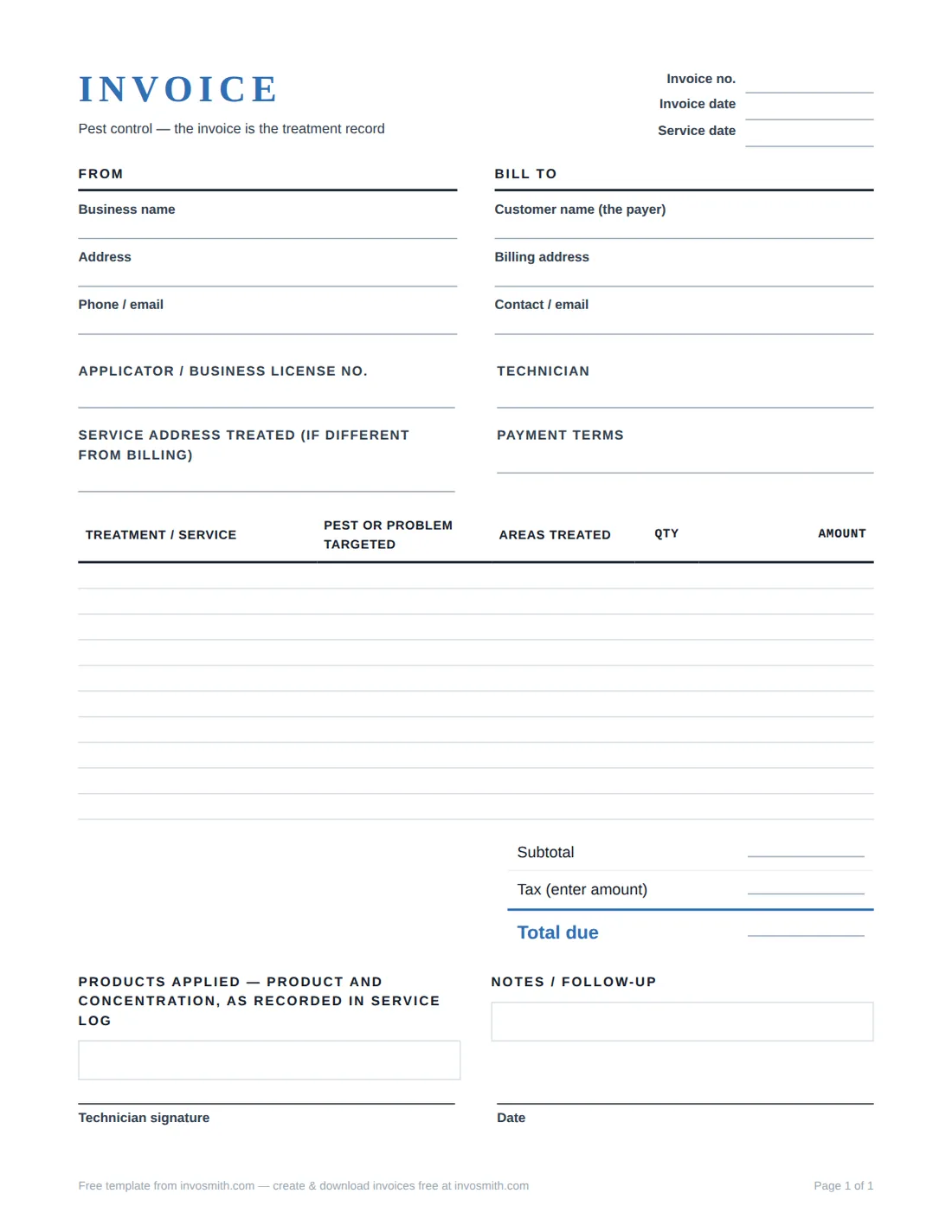
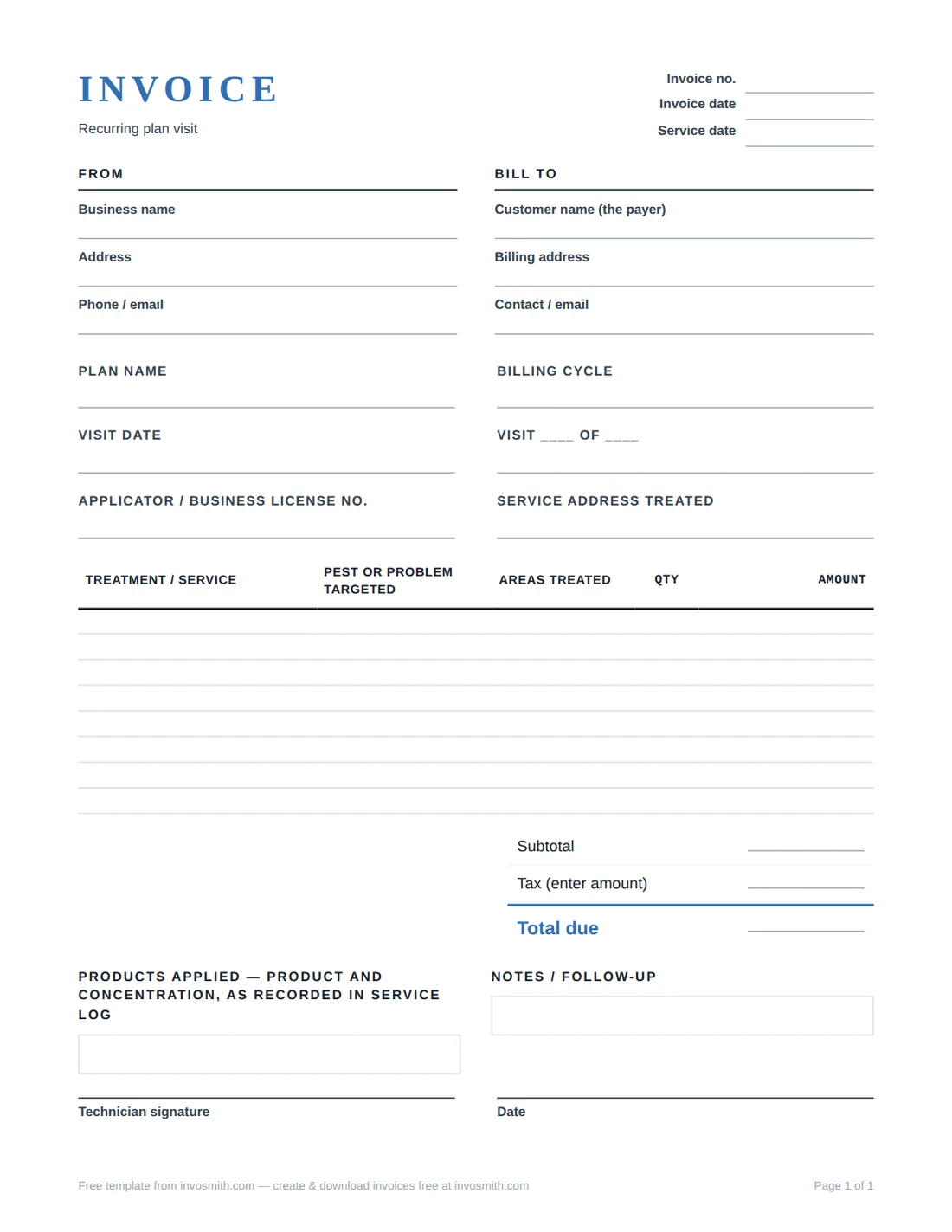
Pest Control Invoice Template (PDF / Word / Excel)General invoice — treatment lines with pest, area and product columns, license number field, products-applied note.
Open this template in the invoice makerFree template
Pest control has a billing problem no other trade quite shares: the customer can't see what they paid for. The termites are gone, which looks exactly like the termites were never there. So a pest control invoice has to do two jobs at once — collect the payment, and stand as the treatment record that says what was treated, where, and with what. This free pest control invoice template is built for both: line items that name the pest, the areas covered and the product applied, plus a plan reference block for quarterly and monthly service, because recurring plans are how this trade actually bills. Download it as PDF, Word or Excel below. No sign-up, no watermark.
Every download is free - no email, no sign-up, no watermark.
Two builds: a general version for one-off jobs and initial treatments, and a recurring-plan version with a visit-of-plan field for quarterly and monthly service billing.
Every field below is either a payment field or a proof field, and the proof fields are what make this invoice different from a generic one:
A quarterly plan visit to a single-family home — general treatment, rodent station service, and a follow-up on earlier exclusion work:
Read what the lines are doing. The general treatment names its areas, so "did you do the inside?" is answered before it's asked. The rodent line shows four stations at $12 each — a count the customer can check by walking the fence line. The exclusion line references the prior visit's work, which is the plan quietly proving its own continuity: visit 3 checked what visit 2 installed. And the two note lines at the bottom turn the invoice into the treatment record — which visit of which plan, and what went into the house. Six months from now, when someone asks what was applied in March, this piece of paper answers.
| Description | Qty | Rate | Amount |
|---|---|---|---|
| General pest treatment — interior and exterior, baseboards, entry points, perimeter | 1 | 145.00 | 145.00 |
| Rodent station service — inspected and re-baited, garage and rear fence line | 4 | 12.00 | 48.00 |
| Crawl-space exclusion follow-up — checked seals installed on prior visit, one re-secured | 1 | 65.00 | 65.00 |
| Subtotal | 258.00 | ||
| Tax — enter the amount that applies to you, if any | — | ||
| Total due | 258.00 | ||
| Plan: Quarterly General Pest — Visit 3 of 4 — service date March 12 | |||
| Products applied: [product, concentration] — as recorded in service log |
The customer says nothing changed. This is the trade's defining dispute — the treatment worked, so there's nothing to see, or the pests were gone before you arrived, and either way the customer is staring at a bill for an invisible result. The treatment detail lines are the answer. An invoice that says "General pest treatment — interior and exterior, baseboards, entry points, perimeter" plus a products-applied note describes work that visibly happened, whatever the pests did afterward. You billed for the treatment performed, and the invoice proves the treatment, line by line. A one-line "Pest service — $145" has no defense to offer.
Billing a quarterly or monthly plan. The invoice's job is to tie itself to the plan: plan name, visit date, visit-of-plan. Bill per visit as visits happen, and each invoice reads "Quarterly General Pest — Visit 3 of 4," so the customer's four invoices a year tell one continuous story instead of arriving as four unexplained charges. If you bill the cycle up front instead, invoice the cycle once and record each visit against it — but per-visit billing with a plan reference is the layout that generates the fewest phone calls.
The re-treatment visit. The customer calls two weeks after a treatment: the ants are back. If your service terms cover re-treatment, do the visit and put it on an invoice anyway — as a $0.00 line: "Re-treatment — ants, kitchen perimeter, covered under quarterly plan — 0.00." Nobody pays anything, but the visit enters the record: the date, the product, the reason. When the account is reviewed later — by the customer, a landlord, or you — the record shows every visit, including the free ones. Work that isn't on an invoice didn't happen, as far as paper is concerned.
The one-off job for a non-plan customer. A single wasp nest removal or a pre-listing inspection treatment bills like any trade job — but keep the treatment-record habit anyway. An exterminator invoice that names the pest, the location and the product is the version of you the customer remembers when they're ready for a plan; the products-applied note is your quiet proof of professionalism on a job you may never repeat.
The landlord–tenant triangle. The tenant reports the problem, the landlord pays the bill. Bill the landlord, name the unit's address on every line-relevant field, and keep the treatment detail complete — the payer wasn't on site, so the invoice is the only account of the visit they will ever get. The more the lines say, the fewer questions the landlord asks the tenant, and the tenant asks you.
One document can carry both jobs. A pest control service report records what was found and done; an invoice collects payment. Put the treatment detail — pests targeted, areas treated, products applied — on the invoice itself, and it serves as both: the customer files one piece of paper, and your billing record and your service record can never disagree with each other.
Reference the plan on every invoice: plan name, visit date, and which visit this is ("Visit 3 of 4"). Bill per visit as each visit happens. The plan reference is what makes a recurring charge legible — the customer sees the visit, the plan it belongs to, and where in the cycle it falls, all without calling you.
Your treatment lines answer for you. An invoice that names the areas treated, the stations serviced with counts, and the products applied describes verifiable work — the customer can walk the fence line and count four stations. This is why the detail belongs on the invoice at billing time, not reconstructed later: the record you need in a dispute is the one you wrote before there was one.
Yes — at $0.00, with the reason on the line: "Re-treatment — ants, kitchen perimeter, covered under quarterly plan — 0.00." The customer pays nothing, but the visit, the date and the product enter the account record. A complete visit history, including the free visits, is what the record is for.
The template gives you a single tax amount field you fill in yourself. Whether and how tax applies to pest control work varies by state and by how you sell — enter the amount that applies to your situation, or leave the field blank if none does.