Snow Removal Estimate Template (PDF / Word)Trigger depth, scope, pricing model and valid-until field.
Open this template in the invoice makerFree template
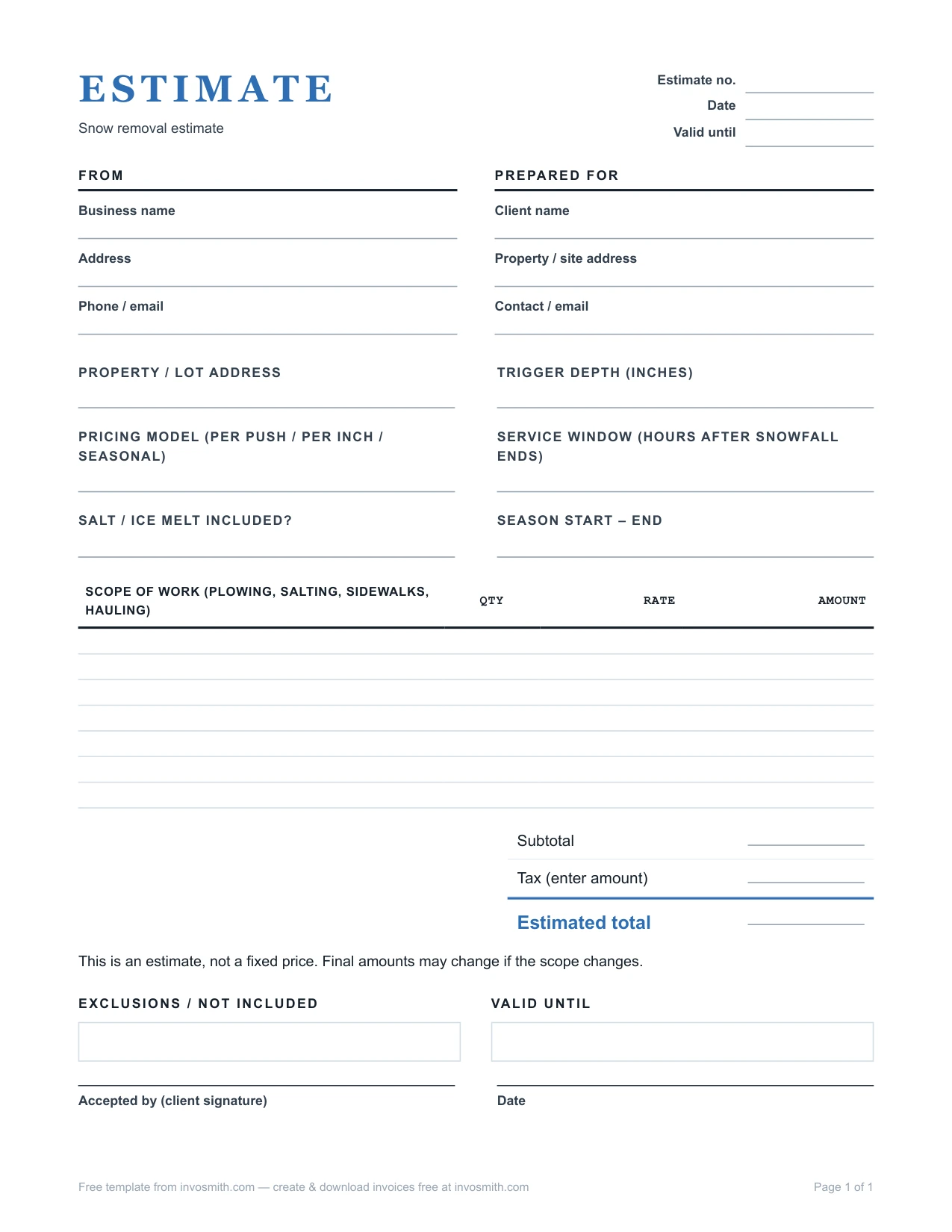
A snow removal estimate records the proposed scope and price structure before the season begins. This free PDF or Word template gives you space to describe the property, surfaces, trigger or dispatch approach, pricing model and any stated inclusions or exclusions. A separate event log records each visit, measured depth, dispatch count and de-icer used.
Every download is free - no email, no sign-up, no watermark.
You can also make it in the free estimate generator and download a PDF without signing up.
The header is standard — your business, the client, the property address, an estimate number and date.
Use these as drafting prompts, then replace every bracketed field with the service you can actually deliver. Liability terms belong in the signed agreement and should be adapted to the law and insurance terms that apply to the job.
A per-push estimate for a small commercial lot, priced in October:
Every price is attached to a definition: the plowing line carries the trigger, the sidewalk line names its surfaces, the salt line settles the material question before the first storm. Nothing here predicts how many visits the winter will bring — it can't. What it does is make every future visit pre-priced: when the season ends at 14 pushes and 9 salt runs, each invoice will point back to this sheet.
| Description | Qty | Rate | Amount |
|---|---|---|---|
| Lot plowing — main lot + both entrance aprons, 2" trigger, per push | 1 | 145.00 | 145.00 |
| Sidewalks & entryways — front walk, ADA ramp, rear exit, per push | 1 | 60.00 | 60.00 |
| Ice control — salt application, lot and walks, material included, per application | 1 | 85.00 | 85.00 |
| Estimated total per service visit | 290.00 | ||
| Tax — enter the amount that applies to you, if any | — | ||
| Estimate valid until: October 15 · Season slots are limited |
This worked example uses 14 plowing-and-sidewalk dispatches and 9 de-icing applications. It is arithmetic, not a forecast: a real estimate should not promise how many events a season will produce.
The downloadable event log gives the contractor and property contact one row per visit, so a seasonal review can be rebuilt from dates, measured depth, dispatches and material usage instead of memory.
| Seasonal line | Calculation | Amount |
|---|---|---|
| Lot plowing and named sidewalks | 14 × (145.00 + 60.00) | 2870.00 |
| De-icing applications | 9 × 85.00 | 765.00 |
| Worked seasonal service total | 3635.00 | |
| Tax — enter the amount that applies to you, if any | — |
what actually exists in this industry isn't a formula — it's four pricing structures. The numbers inside them are yours: they come from your market, your equipment, your route density and your snowfall history. What the estimate has to do is name the structure and define its edges.
Per-push. A set price each time you clear the property, triggered by the depth on the estimate. The client's cost tracks the winter — heavy year costs more, light year costs less. the definition that matters is what counts as one push during a long storm (a visit each time accumulation re-reaches the trigger is the common rule — write yours down). Per-event. One price per storm, however many visits the storm takes. Clients like the predictability per storm; you carry the risk of a two-day system. The definition that matters is when one event ends and the next begins — a stated gap of hours without snowfall is the usual line. Per-inch tiers. Stepped prices by accumulation band — one price for trigger-to-6", a higher price for 6–12", higher again above that. This is how per-visit pricing absorbs heavy storms without renegotiation. The definition that matters is the measurement source; name the official station or measurement method on the estimate so the tier is a fact, not a debate. Seasonal flat. One price for the whole season, paid monthly or up front, whatever the sky does. You're trading storm-by-storm revenue for guaranteed cash flow; the client is buying budget certainty. Definitions that matter: the season's start and end dates, whether there's a cap on events, and what falls outside the flat rate (hauling and relocation usually do). Multi-year seasonal deals are how contractors and clients both smooth out freak winters — but that lives in the agreement, not the estimate.
Dense commercial routes lean per-push or tiered; HOAs and budget-bound property managers lean seasonal; per-event fits markets with well-separated storms. The estimate's job is the same in all four: name the model, define its trigger and boundaries, and put your number next to it.
"It was only an inch — why was there a charge?" Because the trigger was 1", and the estimate said so. If the client wants a higher trigger to save money, that's an October conversation that produces a revised snow clearing estimate — not a December standoff over an invoice.
The surfaces grew. By February, "the lot" quietly includes the back stairs, the loading dock and the walk to the shed. The listed-surfaces line is your answer: new surface, new line, revised pricing — handled in one email that points at the estimate.
The client sat on the estimate until November. And now the route is full. This is why the valid-until date is real: honor it. Re-quote late signers at your late price — the original sheet said what would happen.
A monster storm blew past everything. Per-inch tiers absorb most of it. For per-push and seasonal models, the top band — say, accumulation above a stated depth, or municipal emergency declarations — is worth a line on the estimate marking it as quoted separately.
Hauling the pile. Mid-winter, the snow pile has eaten six parking spaces and the property manager wants it gone. If the estimate priced relocation and hauling — even as "quoted per occurrence" — this is a work order.
Five things: the trigger depth that starts service, the surfaces listed by name, the pricing model (per-push, per-event, per-inch tiers or seasonal), ice control priced as its own line, and a valid-until date. Everything else is standard estimate furniture; those five are what winter disputes are made of.
No. The estimate is the offer — scope, model, prices, validity window. Once the client accepts, a signed agreement follows that carries the season's legal terms: liability, slip-and-fall responsibility, payment schedule, cancellation. The estimate wins the work and feeds the agreement; it doesn't replace it.
Use a period you can actually honor for both price and route capacity. Put an exact expiry date on the estimate, state that availability is confirmed only when the work is accepted, and issue a fresh estimate if the date passes.
Yes, always. They're different services with different triggers — ice happens without snowfall — and different costs, because material is a real per-application expense. A separate per-application price with material terms stated keeps a freeze-thaw February from becoming a month of free salt.
Offer the one your cash flow and your market support, or both on the same estimate as alternatives. Per-push tracks the actual winter and suits clients who accept variable costs; seasonal flat trades upside in a heavy year for guaranteed monthly revenue and suits budget-bound clients. Whichever they pick, the trigger and surface definitions stay identical — only the money model changes.