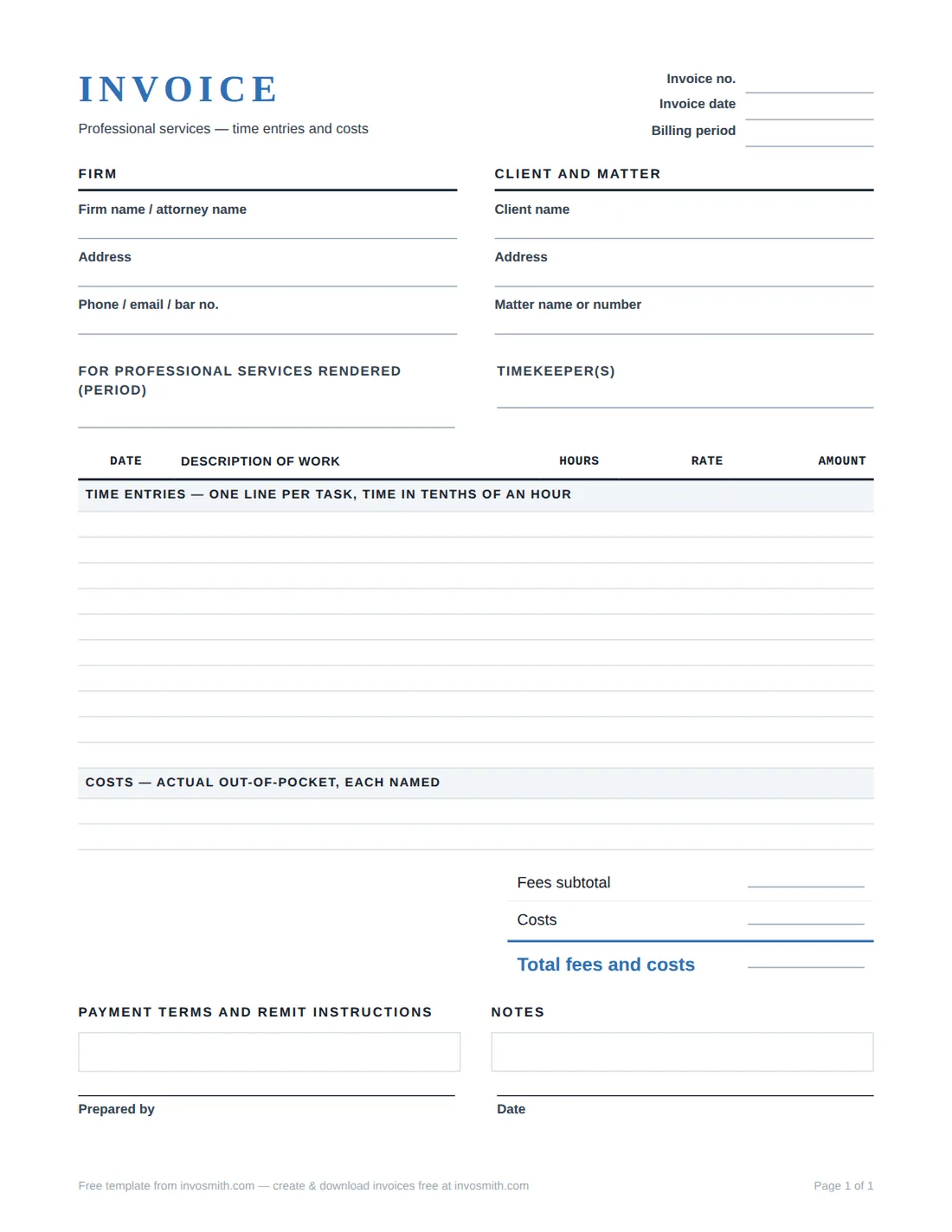
Attorney Invoice Template (PDF / Word / Excel)Standard hourly — itemized time entries in tenths, a separate costs section, matter and invoice numbers.
Open this template in the invoice makerFree template
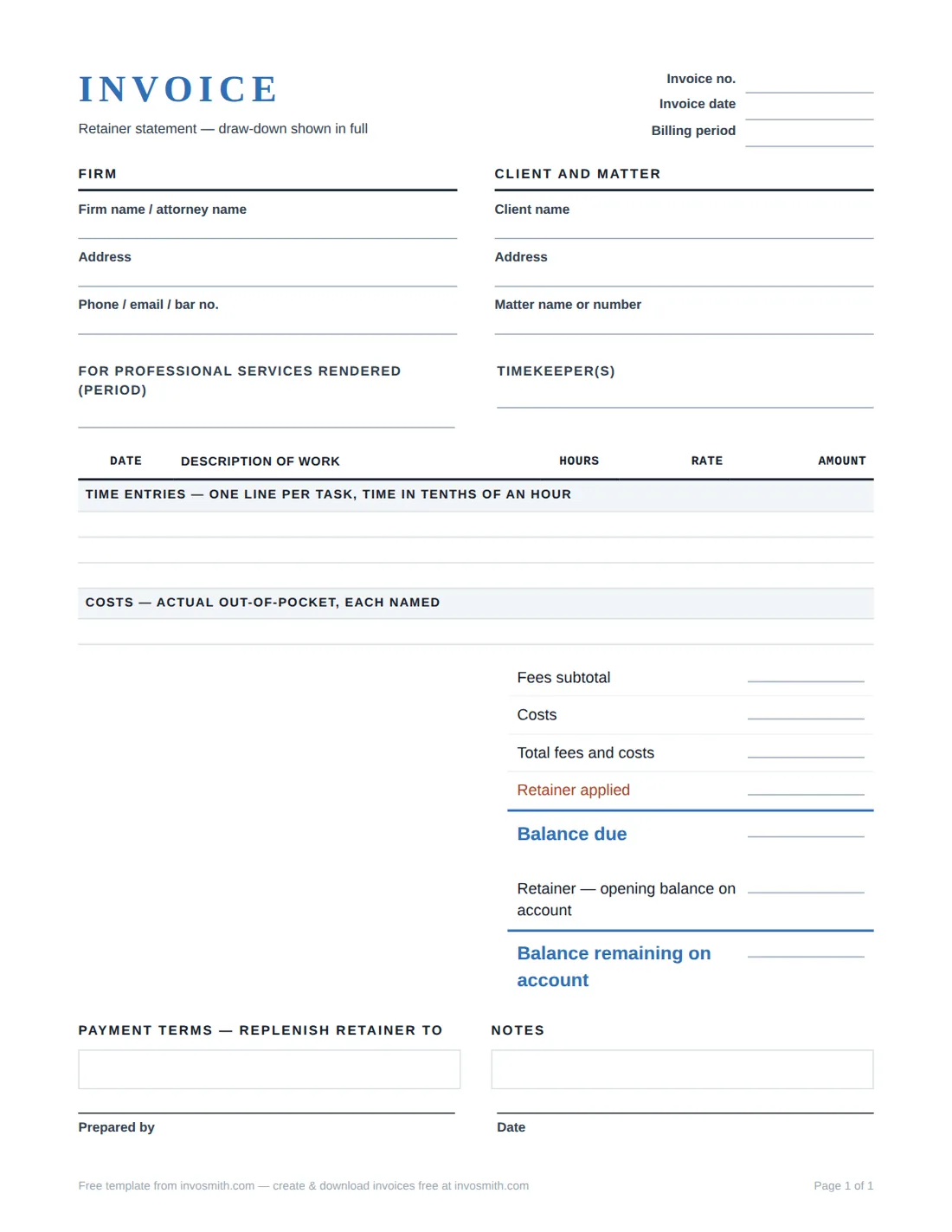
A legal invoice lives or dies on its time entries. Each line has to stand on its own — the date the work happened, a task description specific enough to justify itself, the hours in tenths, the rate, the amount — because the client reading it wasn't in the room when the work was done. This free attorney invoice template is built around that discipline, plus the second thing every hourly bill owes the client: a retainer section that states what was on account, what this bill draws down, and what remains. Vague block entries are what clients dispute and fee complaints cite; specific entries defend themselves. Download it as PDF, Word or Excel below. No sign-up, no watermark.
Every download is free - no email, no sign-up, no watermark.
This legal invoice template comes in two builds — a standard hourly invoice, and a retainer-statement version that adds the on-account summary block for matters billed against a deposit.
Everything on the page exists to make the bill reviewable — by the client now, and by anyone else later:
How you hold client funds is governed by your bar's rules — the invoice's job is only to report the draw-down.
A month of work on a settlement matter, billed against a $1,500.00 retainer at $250.00 per hour:
Read what the entries are doing. Each one answers the client's only real question — what did I get for this money — without a phone call: a specific document drafted, a specific call with a named purpose, a specific set of discovery reviewed. Each is timed in tenths, so 0.3 means eighteen minutes, not "a while." The costs sit apart from the fees, at the actual out-of-pocket amount. And the retainer block does the full accounting out loud: $1,500.00 was on hand, $593.00 came out, $907.00 remains. A balance due of $0.00 with a visible draw-down is a bill nobody has to question.
Notice what the invoice doesn't do: it doesn't bundle three days of work into "legal services," and it doesn't make the client subtract anything themselves.
| Date | Description | Hours | Rate | Amount |
|---|---|---|---|---|
| Jul 28 | Draft and revise settlement demand letter | 1.2 | 250.00 | 300.00 |
| Jul 29 | Telephone conference with opposing counsel re: scheduling | 0.3 | 250.00 | 75.00 |
| Jul 30 | Review discovery responses, second set | 0.8 | 250.00 | 200.00 |
| Fees subtotal | 2.3 | 575.00 | ||
| Costs — certified copies | 18.00 | |||
| Total fees and costs | 593.00 | |||
| Retainer applied | −593.00 | |||
| Balance due | $0.00 |
| Retainer summary | |
|---|---|
| Opening balance | 1,500.00 |
| Applied to this invoice | −593.00 |
| Balance remaining on account | 907.00 |
The client disputes a block entry. "Legal services — $2,400" is indefensible not because the work wasn't done, but because the entry can't prove it was. Block billing — folding a day or a week of distinct tasks into one line — is the single most-cited defect in fee disputes, and the cure costs nothing: record time as the tasks happen, one line per task, in tenths. An entry that names the document, the call, or the filing carries its own justification onto the page.
The retainer runs low mid-matter. The invoice is where the client learns this — which is exactly why the retainer block shows the remaining balance every single bill. When the balance remaining approaches the cost of the next phase, the invoice can carry one plain line ("Please replenish the retainer to $1,500.00 per our engagement agreement") and the request lands as arithmetic, not as a surprise. A client who watched the balance step down bill by bill replenishes without friction; a client who last saw the number at signing does not.
Costs the client didn't expect. Advanced costs — a filing fee, a process server, a transcript — belong in their own section at actual amounts, ideally traceable to the engagement letter's cost provisions. A lawyer invoice that buries a $400 filing fee inside a fee line has converted a reimbursement into a credibility problem. Named separately, the same $400 reads as what it is: money you fronted for the client's case.
Two timekeepers on one matter. When an associate and a partner both bill, every entry carries its timekeeper's initials and rate, and the rates match the engagement letter. What clients challenge is not the associate's lower rate — it's discovering two rates on a bill that never disclosed there would be two people.
The flat-fee matter. No time table at all: one line stating the agreed fee and referencing the scope ("Flat fee — uncontested dissolution, per engagement agreement dated June 2"). Listing hours under a flat fee invites the client to re-price a fee that was never hourly.
The best time to make a bill reviewable is while the work is still clear. Build the invoice from dated records, then make the period and balance arithmetic visible before the client has to ask for it.
When time is short, do not reduce the invoice to one unexplained total. These five checks preserve the record the client needs to review the bill and the firm needs to explain it later.
No. An engagement letter or retainer agreement records the scope, fee arrangement and other terms you agreed before or during the matter. The invoice records work performed, costs incurred and any retainer amount applied for a billing period. Keep the invoice consistent with the agreement, but do not treat the invoice as a replacement for it.
Detailed enough that each entry justifies itself without a conversation — a specific verb and a specific object: "Draft and revise settlement demand letter," not "legal work." The test is whether the client, reading the line cold, can see what they bought. Entries that pass that test rarely get disputed; block entries that fail it are what fee complaints cite.
Because 0.1 hour — six minutes — is the profession's standard increment, fine enough that short tasks bill close to their true length. A 0.3 entry is eighteen minutes; a 1.2 entry is an hour and twelve. Billing in tenths keeps the arithmetic honest in both directions: the client isn't paying an hour for a six-minute call, and you aren't donating the eighteen-minute ones.
Three numbers, every bill: the balance on account at the start of the period, the amount applied to this invoice, and the balance remaining. That's the entire draw-down story, and showing all three every month is what keeps a replenishment request from arriving as a surprise. The invoice's only job here is to report that movement — three numbers, every bill, no mystery.
Same invoice, separate sections. Fees are your time at your rate; costs are money you advanced — filing fees, certified copies, service of process — billed at actual amounts. Each gets its own subtotal before the combined total, so the client can review the lawyering and the out-of-pocket spending as the different things they are.
No. This template helps you present a reviewable record of work, costs and any retainer draw-down, but local professional, tax, trust-account, confidentiality and fee rules can change what you need to include or retain. Check your firm procedures and consult a qualified local professional when the requirement matters.
One line: the agreed fee, with a reference to the scope in the engagement agreement — no hourly table, because listing hours invites re-pricing a fee that was never hourly. Costs still get their own section at actual amounts. (Contingency matters are different paper entirely — a settlement disbursement statement, not an hourly invoice.)