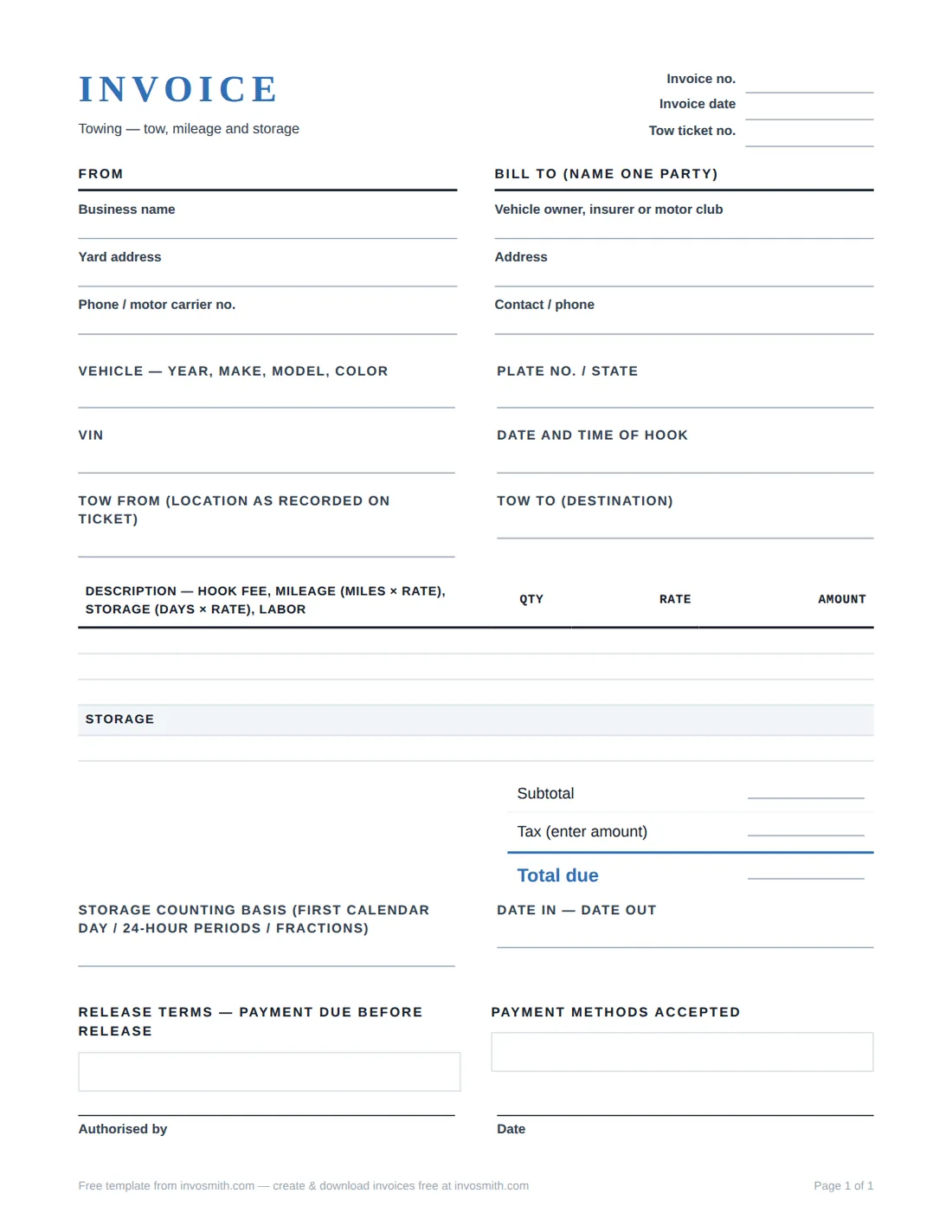
Towing Invoice Template (PDF / Word / Excel)Tow & storage invoice — tow ticket reference, vehicle block, tow from/to, hook fee, per-mile line, storage-by-day line and release notes.
Open this template in the invoice makerFree template
In towing, the paperwork was born at the hook: it's the tow ticket. A towing invoice doesn't reconstruct the job from memory — its whole job is to mirror the tow ticket so exactly that anyone holding both documents sees the same story twice. This free towing invoice template gives every fact on the ticket its own labeled place: the ticket number, the vehicle's year, make and plate, where it was towed from and where it went, the hook fee, the per-mile line, and storage billed by the day. That matters more in towing than almost anywhere else, because on an impound job the person reading your invoice is paying it before they get their vehicle back — and reading it angrily. A clear, itemized invoice is how that conversation stays short. Download it as PDF, Word or Excel below. No sign-up, no watermark.
Every download is free - no email, no sign-up, no watermark.
These towing invoice forms come in two builds — a full tow-and-storage invoice and a lighter roadside-call version for jobs where nothing gets stored.
Everything on this list traces back to one document — the tow ticket your driver wrote at the scene. If a field below isn't on the ticket, it doesn't belong on the invoice either:
An impound tow with three days of storage, billed to the vehicle owner at release:
Read what the lines are doing. Every line cites the tow ticket and shows its own arithmetic: the hook fee names the route and the vehicle, the mileage line multiplies in plain sight, the storage line prints its dates so the day count can be checked against a calendar. The owner standing at the counter can check this invoice line by line without asking you a single question — and at an impound counter, every question you don't get asked is a dispute that never starts. Notice also what the invoice doesn't do: it doesn't editorialize about why the vehicle was towed. The ticket number carries that story; the invoice just prices it.
| Description | Qty | Rate | Amount |
|---|---|---|---|
| Hook fee — tow from Ashland Ave & 47th St to yard, ticket #T-2277, 2016 Ford F-150 | 1 | 125.00 | 125.00 |
| Mileage — 14 mi × 6.00/mi, per ticket #T-2277 | 14 | 6.00 | 84.00 |
| Storage — 3 days × 45.00/day, in 07/12 out 07/15 | 3 | 45.00 | 135.00 |
| Subtotal | 344.00 | ||
| Tax — enter the amount that applies to you, if any | — | ||
| Total due before release — Subtotal + tax | 344.00 |
The owner disputes the charges at the release counter. This is the defining scene of impound billing: payment happens before release, so the argument happens in front of you, not over email. The invoice is your script. When the hook fee, the mileage math, and the storage dates are each their own line tied to ticket #T-2277, you're not defending a number — you're pointing at three small facts the owner can check one at a time. Most disputes deflate at the storage line the moment the in/out dates are printed on it. The invoices that turn into shouting matches are the ones that read "Towing & storage — $344."
Storage days keep accruing while the invoice sits. Storage is the only line on a tow truck invoice that changes with the calendar, so date the line explicitly: "Storage — 3 days × 45.00/day, in 07/12 out 07/15" or "through 07/15, accruing daily." If the vehicle is still in the yard when you issue the invoice, say "to date" and re-issue at release with the final count. How days are counted — and how long a yard may hold and charge — varies by state and by contract, so keep the invoice to your posted rate and your counting basis, and let the ticket and your storage terms carry the rest.
The job was called in by a motor club or an insurance company. Then that's who you bill — not the driver you unhooked on the shoulder. Put the club's or carrier's name in the bill-to block, print their claim number, PO number, or dispatch/job number on its own reference line, and bill at the contracted rate, not your retail rate. Clubs pay against their own reference numbers; an invoice without the claim number joins a queue, an invoice with it joins a file.
Cash at the counter. A lot of release-day payments are cash or card on the spot. The invoice still gets issued exactly the same — itemized, ticket-referenced — and then marked paid with the date, amount, and method. That paid copy is what the owner drives away with, and it's the record both sides keep if anyone revisits the charges later.
The roadside call with no storage. A jump-start, lockout, or winch-out doesn't need the storage section staring at the customer — that's what the roadside variant above is for. One service line at your call-out rate, a mileage line if the job included a tow, ticket number on top. Same discipline, smaller page.
The tow ticket is the field record — written at the hook, it captures the vehicle, the locations, the times, and the miles. The invoice is the bill built from it: same facts, plus your rates, line amounts, tax, and total. Nothing appears on the invoice that isn't on the ticket; the invoice adds prices, not facts. Print the ticket number on the invoice so the two documents stay joined.
By the day, with the math and the dates showing: days in the yard times your daily rate, with the date in and the date out printed on the line — "Storage — 3 days × 45.00/day, in 07/12 out 07/15." If the vehicle hasn't been released yet, bill "to date" and re-issue with the final count at release. How days are counted varies by state and by contract, so state your counting basis on the invoice instead of leaving the reader to guess.
Yes to both, and they can be the same piece of paper. Issue the itemized invoice as usual, then mark it paid with the date, the amount, and "cash" as the method — that paid copy serves as the towing receipt the owner keeps. For the mechanics of documenting cash payments cleanly, the same practice as a cash receipt applies: amount, date, method, and both parties named.
Bill the club or carrier directly — they ordered the job, so they own the bill. Put their name in the bill-to block, print their claim number or dispatch number on its own reference line, and bill the contracted rate from your agreement with them. Their payables system matches on that reference number; include it and the invoice files itself.
It varies — some states tax towing services, some tax storage, some tax neither, and contracts with clubs and carriers can change what's billable. That's why the template's tax line is a single amount field you fill in yourself: enter the amount that applies to your situation, or leave it blank. The template never calculates or suggests a rate.