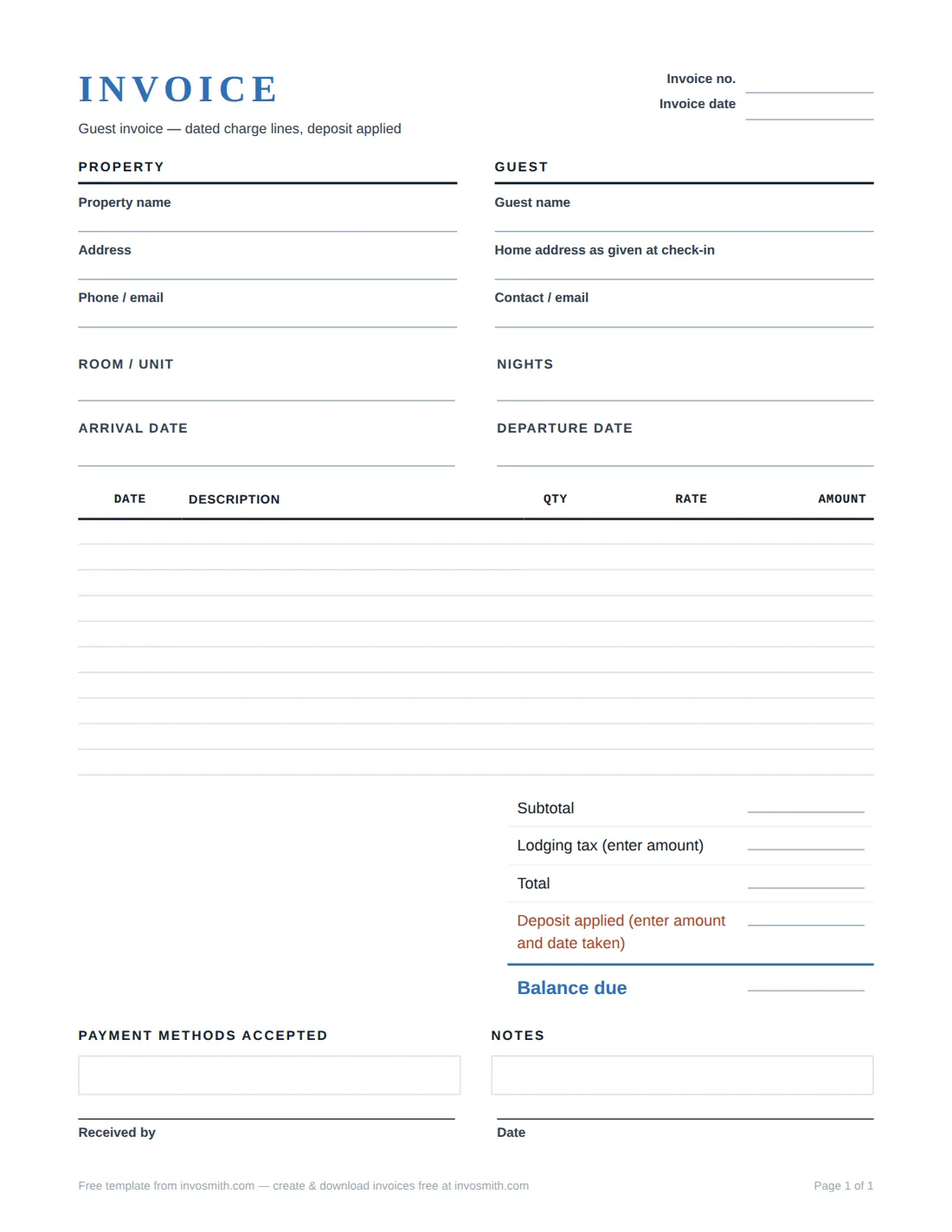
Hotel Invoice Template (PDF / Word / Excel)Guest invoice — date-stamped charge lines, room and incidentals, an entered lodging tax line, deposit applied, balance due.
Open this template in the invoice makerFree template
Nobody disputes the room. What guests dispute is everything that landed on the folio after check-in — the minibar they don't remember, the parking they thought was included, the late checkout nobody wrote down. A hotel invoice is the folio turned into a bill, and its whole job is to make every one of those lines recognizable: this free hotel invoice template date-stamps each charge, shows lodging tax as its own entered line, and applies the deposit so the balance due is the number the guest actually owes. Built for independent hotels, motels, guesthouses and B&B hosts billing guests or corporate accounts. Download it as PDF, Word or Excel below. No sign-up, no watermark.
Every download is free - no email, no sign-up, no watermark.
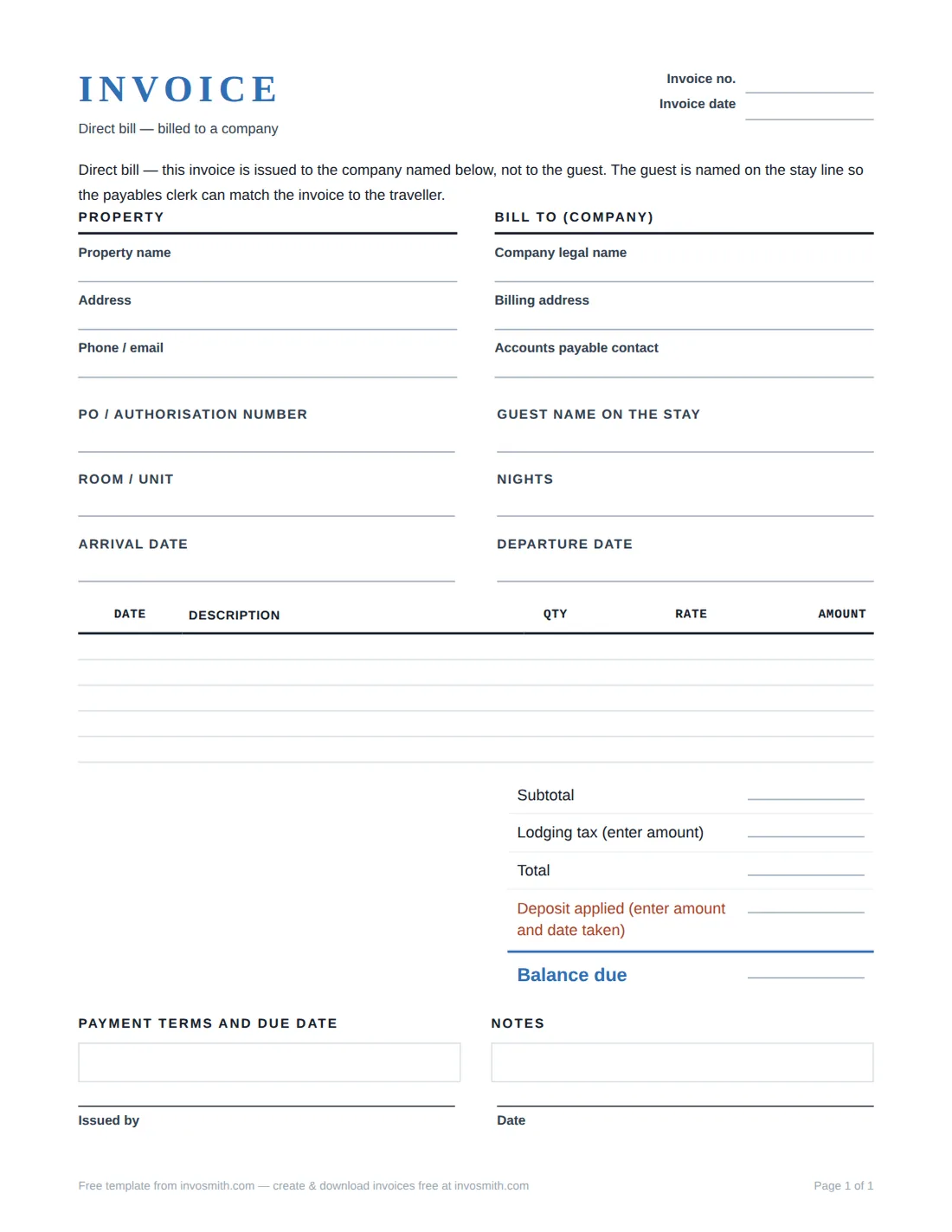
Two builds: the standard guest invoice, and a direct-bill version for invoicing a company instead of the guest. The same layout works as a motel invoice template — nightly lines, dated incidentals, one entered tax line, deposit applied.
Every field earns its place by answering a question the guest — or a company's payables clerk — will actually ask:
A three-night stay with parking and one minibar charge, deposit taken at booking:
Read the two columns doing the real work. The date column is the anti-chargeback field: the minibar line doesn't say "Minibar — 16.50," it says _Aug 2_, sparkling water and nuts — a charge with a date and a description is a charge the guest remembers, and a charge the guest remembers is a charge nobody phones their card issuer about. And the tax line is entered, not computed: lodging tax is set by the city and the county, it differs from one property's address to the next, and the template's job is to record the amount you enter, not to work it out. In this example the Tax (if applicable) line is left blank. The deposit sits below the total, dated to the day it was taken, so the balance due — $357.50 — is the only number the guest has to act on.
| Date | Description | Qty | Rate | Amount |
|---|---|---|---|---|
| Aug 1–4 | Room 204 — 3 nights, R. Almeida | 3 | 129.00 | 387.00 |
| Aug 1–4 | Self parking — 3 nights | 3 | 18.00 | 54.00 |
| Aug 2 | Minibar — sparkling water, mixed nuts | 1 | 16.50 | 16.50 |
| Subtotal | 457.50 | |||
| Tax (if applicable) | — | |||
| Total | 457.50 | |||
| Deposit applied — taken at booking, Jul 12 | −100.00 | |||
| Balance due at checkout | 357.50 |
A charge the guest doesn't recognize gets resolved by its date and its description, not by argument. Here's the call every small operator eventually gets: a guest — or their card issuer — questions a $16.50 charge from a stay three weeks ago. If the invoice line reads "Incidentals — 16.50," you have nothing; the conversation becomes your word against a memory, and card issuers side with memories. If the line reads "Aug 2 — Minibar — sparkling water, mixed nuts," the dispute usually ends on the phone: the guest hears the date and the items, places the evening, and drops it. When it doesn't end there, the same line is what you send the card issuer — a dated, itemized charge on a numbered invoice tied to a named guest and a signed registration card.
This is why the template puts a date column on every charge line, not just the room. The habit that makes it work is a front-desk habit, not a paperwork one: post charges to the folio the day they happen, with the specific description, while the detail is still knowable. A minibar restock sheet from that morning tells you it was the water and the nuts; three weeks later it tells you nothing. The invoice can only be as specific as the folio behind it — date-stamp the folio and the invoice defends itself.
The folio is the running record; the invoice is the bill. A folio accumulates charges during the stay — room nights, parking, minibar — and changes daily. The invoice is the folio made final at checkout: the same lines, with the tax amount entered, the deposit applied, and a balance due, under an invoice number everyone can reference afterward.
Use the direct bill version of the template. The bill-to becomes the company's legal name and billing address, the invoice carries the PO or authorization number the company gave you when the stay was arranged, and the guest's name stays on the stay line so payables can match the invoice to the traveler. Send it at checkout, per stay, with the payment terms the account agreed to.
The lodging or occupancy tax amount that applies where your property sits — entered by you, as an amount. These taxes are set city by city and county by county, often stacked, and they change; that's why the template gives you a field to fill rather than working anything out. Check your local lodging tax with your city or county before you set the amount, and recheck whenever they revise it.
As its own negative line after the total, labeled with when it was taken — "Deposit applied — taken at booking" — so the balance due below it is what the guest still owes. Never net it silently into the room line: a guest who can't see their deposit assumes it was forgotten.
Pull the invoice by its number and read them the line: the date, the description, the amount. Most disputes end when the guest hears "August 2, minibar, sparkling water and nuts" — the date places the charge in their memory. If it goes to their card issuer, that same date-stamped line on a numbered invoice, tied to the registered guest and the stay dates, is exactly the documentation the issuer asks you for.