Brightline Supply Co. → Harbor Cafe Group
| Item C-220 · 100 × $8.00 | $800.00 |
| Total | $800.00 |
|---|
Short answer
Both correct an invoice that has already been sent. A debit note increases what the customer owes; a credit note reduces it. The seller usually issues both, while a buyer may send a debit note to request a credit.In the United States the pair is called a debit memo and a credit memo. One invoice, INV-2041 for $800.00, shows both below.
WORKED EXAMPLE
INV-2041 is the original invoice for 100 Item C-220 units at $8.00 each: $800.00. The original invoice stays unchanged while the correction note records what changed.
Pick the tab that matches your case. Each note cites INV-2041 by number, so a reader can trace it back to the sale.
Brightline Supply Co. → Harbor Cafe Group
| Item C-220 · 100 × $8.00 | $800.00 |
| Total | $800.00 |
|---|
Price should have been higher: debit note DN-0007 shows 100 × ($8.40 − $8.00) = $40.00 added to INV-2041.
Ref INV-2041 · Agreed price was $8.40; billed at $8.00
| Description | Qty | Unit price | Amount |
|---|---|---|---|
| Price difference | 100 | $0.40 | $40.00 |
Customer now owes$840.00
10 units came back damaged: credit note CN-0012 shows 10 × $8.00 = $80.00 taken off INV-2041.
Ref INV-2041 · 10 units returned damaged
| Description | Qty | Unit price | Amount |
|---|---|---|---|
| Returned units | 10 | $8.00 | $80.00 |
Customer now owes$720.00
The debit note adds $40.00 to the original $800.00 balance, so the customer now owes $840.00. The credit note subtracts $80.00 for 10 returned units, so the customer now owes $720.00.
The two notes point in opposite directions. DN-0007 raises the balance and CN-0012 lowers it, yet neither one rewrites INV-2041. Each note carries its own number, a date, the reason in one line and the amount of the change.
Keeping the original intact leaves a clear trail of what was billed, what changed and why.
Each correction here is shown on its own against the original invoice, which is why the credit is $80.00. The reconciliation section puts both on one invoice, where the returned units are credited at $8.40.
TEMPLATES
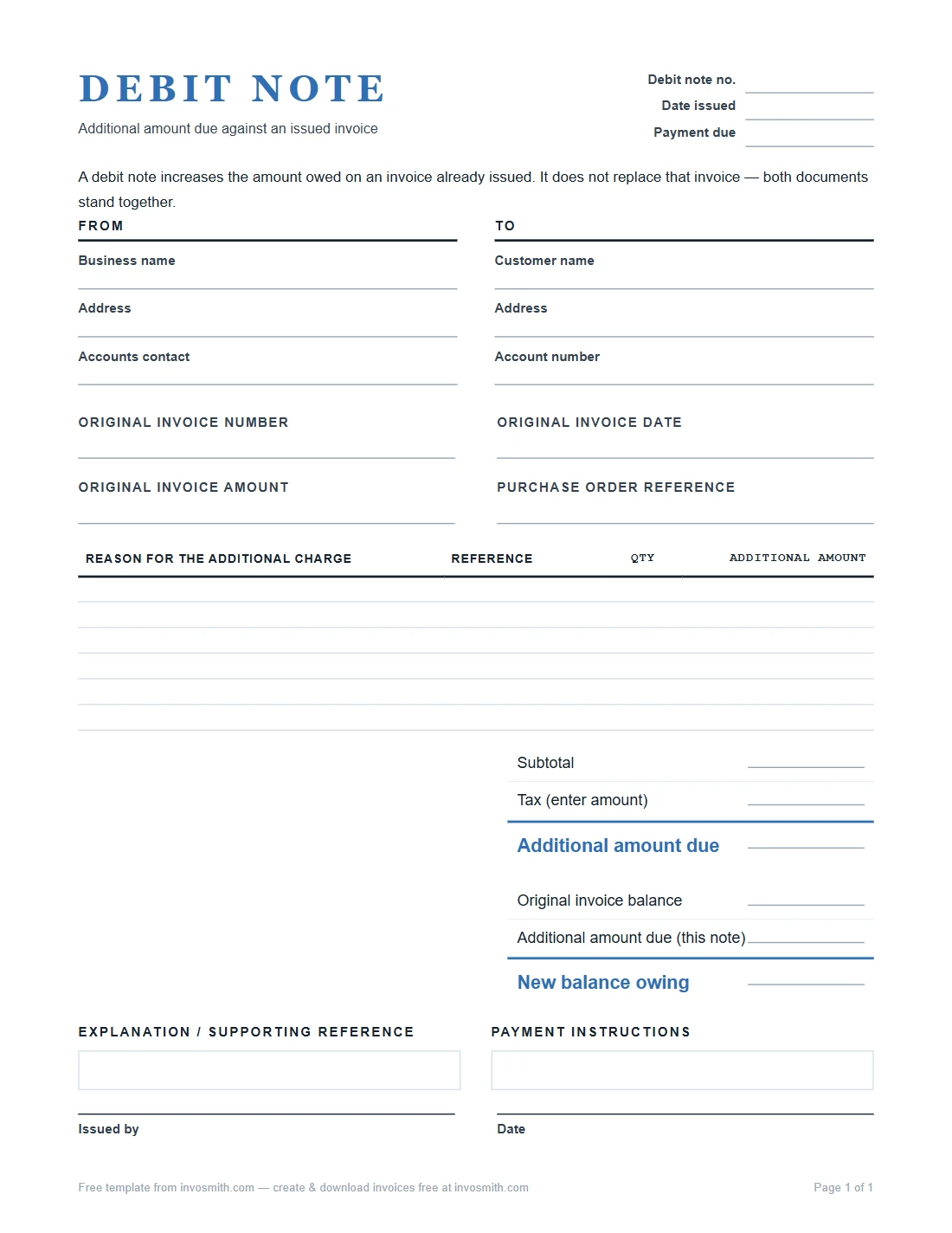
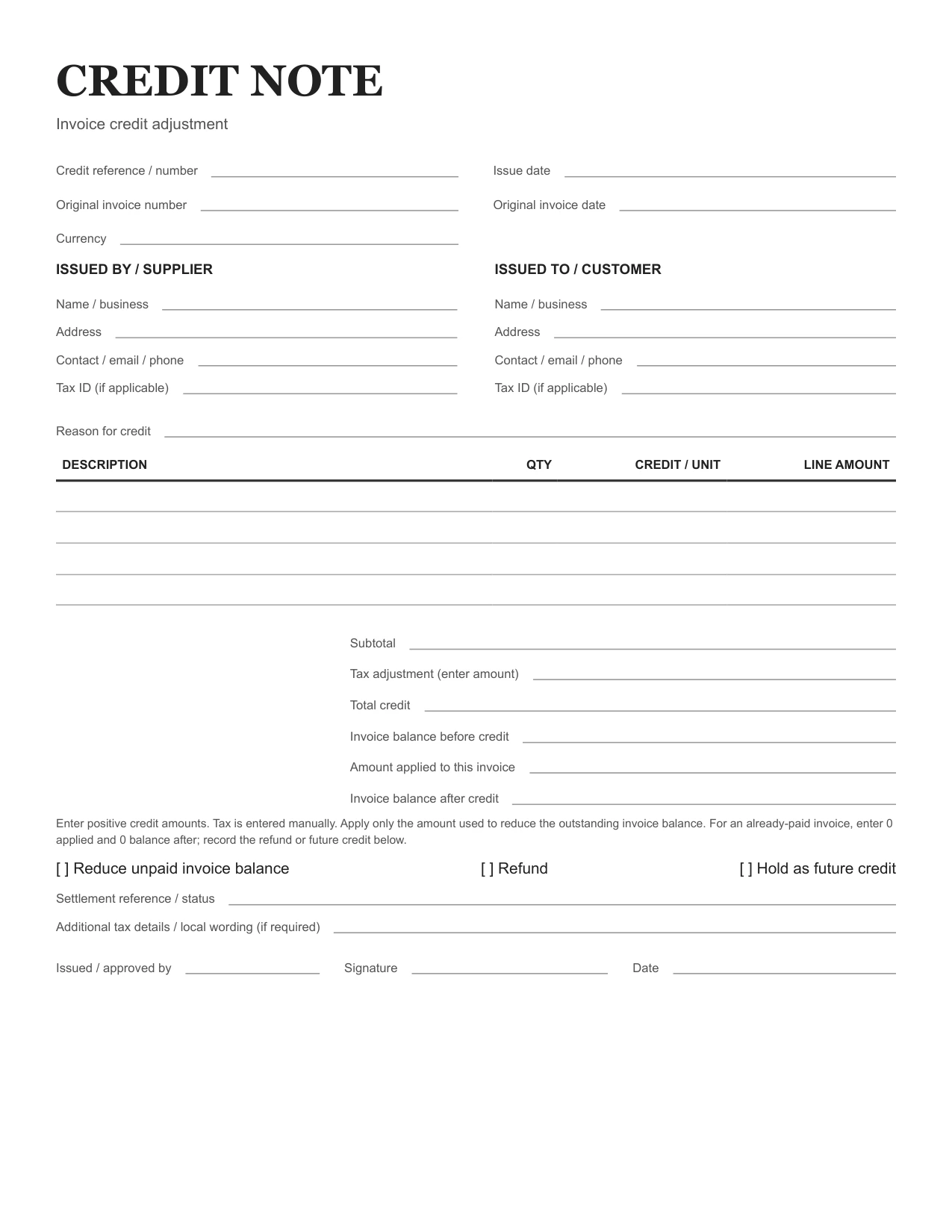
Both templates reference an original invoice and share one layout, so a correction looks the same whichever way it points. Pick the note that matches your correction, then fill in the note number, the original invoice, the reason and the line amounts.
SIDE BY SIDE
The table compares the two notes on six points a bookkeeper checks first. Read it as a quick reference before the longer sections on situations, entries and reconciliation.
| Question | Debit note | Credit note |
|---|---|---|
| Effect on invoice | Increases what the customer owes | Reduces what the customer owes |
| Usually issued by | The seller; a buyer may send a debit note to request a credit | The seller |
| Common trigger | Undercharged price, missed freight, or extra units | Returned, damaged, or discounted goods; overcharge |
| Original invoice | References the invoice being corrected | References the invoice being corrected |
| US name | Debit memo | Credit memo |
| Cash movement | When the customer pays the added amount | Only if the invoice was already paid and you then send a refund |
A debit note is not an invoice. It cites the original invoice and carries only the difference, such as the $40.00 on DN-0007.
Cash is the row people mix up most. The customer pays a debit note on the invoice terms, but a credit note turns into money only when a refund follows.
A credit note is not a refund either, as the refund section explains. In US practice the credit note template includes a version headed CREDIT MEMO.
WHICH NOTE
Eight common corrections applied to INV-2041 and its $8.00 unit price.
One rule sorts nearly every case. If the amount grows, issue a debit note; if it shrinks, issue a credit note. A new sale gets a new invoice, not a note.
| What happened | Which note | What to record |
|---|---|---|
| Price was billed at $8.00 instead of $8.40 | Debit note | 100 × $0.40 = +$40.00 |
| Freight was left off the invoice | Debit note | Freight omitted from INV-2041 |
| 100 units were billed but 105 shipped | Debit note | 5 × $8.00 = +$40.00 |
| 10 damaged units came back | Credit note | 10 × $8.00 = −$80.00 |
| A 5% volume discount was agreed after the sale | Credit note | 100 × $0.40 = −$40.00 |
| Price was billed at $8.00 instead of $7.50 | Credit note | 100 × $0.50 = −$50.00 |
| 95 units arrived after 100 were billed | Credit note | 5 × $8.00 = −$40.00 |
| The same order was invoiced twice | Credit note for the duplicate | Reference INV-2041 and the duplicate amount |
Each amount is the difference per unit multiplied by the units affected. A $0.40 price gap on 100 units gives $40.00, and a $0.50 gap gives $50.00. The 5% discount works out as 5% of $8.00, which is $0.40 a unit.
Two rows depend on proof of quantity: the short delivery of 5 units and the 10 damaged units. A signed delivery note is the document that backs both. To see the first row filled in, open the price-difference sample on the debit note page.
WHO ISSUES IT
The seller usually issues both in US practice. In the buyer-issued convention, the buyer sends a debit note to claim a credit and the seller answers with a credit note.
| Convention | Who writes the debit note | What it does |
|---|---|---|
| Seller-issued | Seller | Bills the customer for an extra amount |
| Buyer-issued | Buyer | Requests a credit for a deduction such as returned goods |
When a note arrives, read the sender first and then ask whether it is a request or an agreed adjustment. A seller’s note is a bill. A buyer’s note is a claim that waits for an answer.
Regions differ on which convention is normal, so the sender line matters more than the title.
In some workflows, a buyer sends a debit note to request a supplier credit; see what a debit memo means.
A request names the amount it asks for and waits for a reply. An agreed adjustment states a figure both sides have already accepted, such as DN-0007 for $40.00.
BOOKKEEPING
The seller records the change in receivables and the buyer records the matching change in payables. The two sets of books move together, in opposite directions, so both sides can reconcile to the same figure. Every note therefore lands in four accounts, two for each party.
A debit note for $40.00 raises what the customer owes. The seller books extra revenue and the buyer books extra cost. DN-0007 is the example: 100 units at a corrected $8.40 instead of $8.00.
| Entry | Debit | Credit |
|---|---|---|
| Seller · Accounts receivable | $40.00 | — |
| Seller · Sales revenue | — | $40.00 |
| Buyer · Purchases or inventory | $40.00 | — |
| Buyer · Accounts payable | — | $40.00 |
A credit note for $80.00 does the reverse. Receivables fall for the seller, who books the sales return, and payables fall for the buyer. CN-0012 is the example: 10 units at $8.00 come back damaged.
| Entry | Debit | Credit |
|---|---|---|
| Seller · Sales returns (or revenue) | $80.00 | — |
| Seller · Accounts receivable | — | $80.00 |
| Buyer · Accounts payable | $80.00 | — |
| Buyer · Purchase returns (or inventory) | — | $80.00 |
The direction flips between the two tables, but the pairing never does. Whatever the seller adds to receivables, the buyer adds to payables.
Returns have their own accounts so that sales returns stay visible instead of vanishing into revenue. If you do not track returns separately, the entry falls back to revenue, as the brackets show. Put the note number in each entry’s memo field so the entry traces to the document.
RECONCILIATION
When one invoice has more than one note, add debit notes and subtract credit notes from the original invoice balance. Work through it one document at a time, and carry the running balance forward each time.
| Step | Document | Change | Running balance |
|---|---|---|---|
| 1 | INV-2041: 100 × $8.00 | +$800.00 | $800.00 |
| 2 | DN-0007: price corrected to $8.40 | +$40.00 | $840.00 |
| 3 | CN-0012: 10 returned units at $8.40 | −$84.00 | $756.00 |
The returned units are credited at the corrected $8.40 unit price, so 10 units reduce the balance by $84.00. INV-2041 ends at $756.00 after one of each note.
The $84.00 differs from the $80.00 in the single-note example for one reason. The price correction came first, so each returned unit is worth $8.40 and not $8.00.
Write the running balance on each document, so a reader who finds CN-0012 alone can see the balance before and after it.
Say the customer paid $800.00 before either note. The net balance of $756.00 leaves $44.00 to refund or to apply to the next invoice.
To summarise the account, list all three documents on a billing statement. To check payments against what is still open, keep a payment history per customer.
PARTIAL PAYMENT EXAMPLE
Sometimes a customer has already paid part of an invoice when you issue a credit note. Work out what is still owed before you decide how to settle it. This example uses invoice INV-2058 for $600.00, a payment of $250.00 and credit note CN-0019 for $45.00.
Example figures
| Line | Amount | Still owed |
|---|---|---|
| Invoice INV-2058 | $600.00 | $600.00 |
| Paid so far | −$250.00 | $350.00 |
| Credit note CN-0019 | −$45.00 | $305.00 |
The customer still owes $305.00: $600.00 − $250.00 − $45.00. Show that balance on the credit note, next to the invoice number it adjusts. Any later payment then reduces that same $305.00 balance.
For an overpayment, see the refund versus credit section.
REFUNDS
A credit note lowers what a customer owes. Money moves only when a separate refund is paid, and the table shows when that happens.
| Situation | What changes | Does cash move |
|---|---|---|
| Invoice not yet paid | The credit note lowers the amount due | No |
| Invoice paid, credit kept for later | The credit offsets the next invoice | No |
| Invoice paid, customer asks for money back | A refund is paid and recorded on its own | Yes, when the refund is paid |
Take INV-2041 paid in full at $800.00, then CN-0012 for $80.00. The customer can set the $80.00 against the next invoice or ask for it back. The credit stays on the account until one of those two things happens.
For the first choice, start a new invoice with the Invoice maker. For the second, hand over a payment receipt when the refund is paid.
FAQ
Only for a separate sale. For a correction to an invoice already sent, a note that references it keeps both records matched and the balance traceable. A new invoice for the same goods would count them twice. A debit note adds only the missing amount, here $40.00 on INV-2041.
Usually the seller in US practice. Some workflows let a buyer request a credit instead, as the issuers section explains.
No. A credit note lowers what is owed, and cash moves only when a refund is paid. The refund section above shows when. Until then the credit simply sits against the customer’s account.
Yes. Add the debit notes, subtract the credit notes, and the result is the balance. INV-2041 above ends at $756.00 after one of each. The running balance table above shows each step. A third note changes nothing about the method: keep adding and subtracting in date order.
This comparison explains how each note changes the invoice balance; it does not calculate a tax amount. The figures on this page are made-up examples shown without tax, so the arithmetic stays visible. Each note still cites the invoice it corrects.
Issue a note in the opposite direction that cites it. A $40 debit note sent by mistake is cancelled by a $40 credit note, and both stay on file. Do not edit or delete the original note. Cancelling a $40.00 debit note this way returns INV-2041 to its starting balance of $800.00. Keep both documents in the account record so the correction can be traced.
Browse the free templates for invoices, receipts and correction notes.