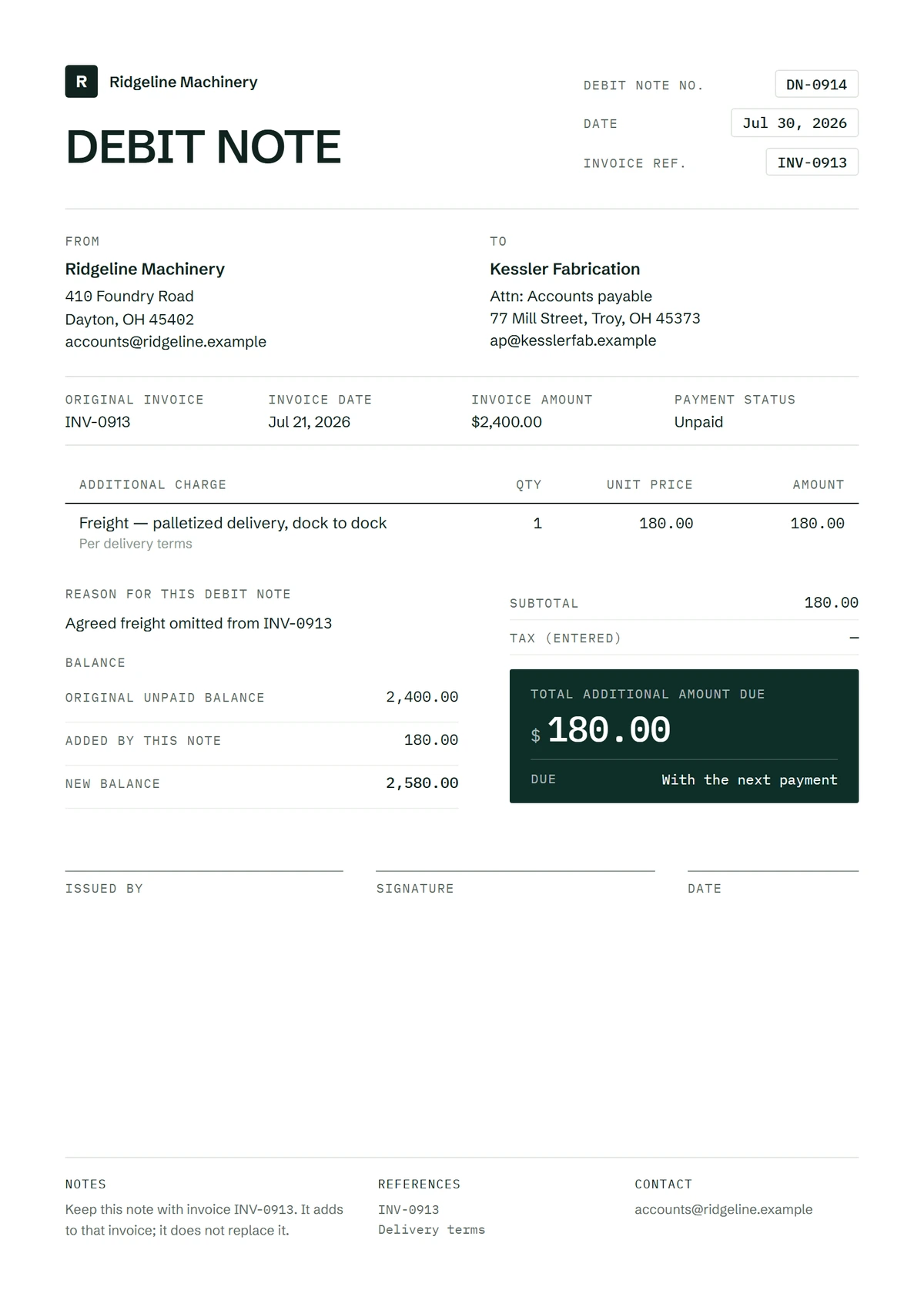
Freight sample (DN-0914)
Seller adds $180.00 omitted freight; new balance $2,580.00.
DEBIT MEMO GUIDE
A debit memo can record a bank charge, a buyer’s request for supplier credit, or a seller’s additional amount linked to an invoice.
If the memo is on your bank statement, the bank has already taken the money and you record it in your books. If a supplier sent it, it is an extra bill against an earlier invoice. If you are writing one as a buyer, it is a request that your supplier reduce what you owe.
A debit memo is also called a debit note or a debit memorandum. “Memo” is the usual US term, while “note” is common in other regions.
MEANING
A debit memo is a document or entry that adjusts a balance by a stated amount, and the party that issues it decides which way the balance moves. The table sets the three uses side by side with one amount each.
| Who issues it | What it does | Example amount | Who records what |
|---|---|---|---|
| Bank, to the account holder | Takes money out of the account for a fee or similar charge | $25.00 wire fee | Holder: debit Bank Fees Expense $25.00, credit Cash $25.00 |
| Buyer, to the supplier | Asks the supplier to reduce an invoice, usually after a return or overcharge | $50.00 for 4 damaged units | Buyer, once the supplier agrees: debit Accounts Payable $50.00, credit Inventory $50.00 |
| Seller, to the customer | Adds an amount to an earlier invoice | $50.00 price difference on a $500.00 invoice | Seller: debit Accounts Receivable $50.00, credit Sales Revenue $50.00 |
In all three cases the memo points to an earlier transaction and leaves it in place. The amounts on this page exclude sales tax so the arithmetic stays visible.
HOW TO READ
Four checks work on any debit memo, whoever sent it. Run them in order, and stop at the first step you cannot answer.
Identify who issued it.
Find the earlier transaction.
Read the reason and amount.
Check the adjusted balance.
FOR BANK CUSTOMERS
A bank debit memo is an entry the bank posts to your account to reduce its balance, most often for a fee such as a wire, a returned item or an order of checks. You did not write it, and no invoice came before it.
Yes: record it in your books. Until you do, your book balance is higher than your bank balance for a reason that is not a timing difference. The reconciliation below runs end to end.
| Step | Amount |
|---|---|
| Balance on the bank statement | $5,175.00 |
| Less: outstanding check not yet cleared | −$1,000.00 |
| Adjusted bank balance | $4,175.00 |
| Balance in your books before the memo | $4,200.00 |
| Less: bank debit memo, wire fee | −$25.00 |
| Adjusted book balance | $4,175.00 |
Both sides land on $4,175.00, so the reconciliation closes. The outstanding check is a timing item: the bank will take it later, so it adjusts the bank side. The debit memo is different. The bank has already taken the money, so it adjusts your books.
The entry in your books is a debit to Bank Fees Expense for $25.00 and a credit to Cash for $25.00. Cash is an asset, so a credit lowers it.
Check the date, the description line and the amount before you post. A fee you agreed to in your account terms goes to expense. An entry you cannot explain goes to the bank first.
Your bank's own description line is the authority on what a specific entry is. AccountingTools lists service charges, bounced-check fees and check-printing charges as typical bank debit memos.
STATEMENT EXAMPLE
Here is how the $25.00 wire fee from the reconciliation above looks on a bank statement. Match each note to your own statement.
Operating account ····4821Note 4
Nov 1 · Opening balance · $3,940.00
Nov 3 · Deposit · +$1,400.00
Nov 5 · Check 1038 · −$650.00
Nov 8 · Card settlement · +$820.00
Nov 12 · DEBIT MEMO — OUTGOING WIRE FEE · −$25.00Note 1Note 2Note 3Note 5
Nov 14 · Utilities autopay · −$310.00
Nov 30 · Ending balance · $5,175.00
FOR ACCOUNTS PAYABLE
A buyer-issued debit memo is a document in which the buyer tells the supplier that it is reducing the amount payable on a stated invoice and asks for a matching credit. It is used after a return, a short shipment, a damaged delivery or a price that does not match the order.
For an accepted return or allowance, the buyer debits Accounts Payable and credits Inventory or the related purchase account. Until the supplier agrees, treat the debit memo as a request. The supplier then issues a credit memo to confirm the reduction.
A worked case: the buyer received invoice INV-1007 for 40 units at $12.50, a total of $500.00. Four units arrived damaged and were returned. The reduction is 4 × $12.50 = $50.00.
| Before | Debit memo | After | |
|---|---|---|---|
| Invoice INV-1007 payable | $500.00 | −$50.00 | $450.00 |
| Inventory carried | $500.00 | −$50.00 | $450.00 |
A supplier can act on a debit memo only if it can match the memo to its own records. These seven elements make it matchable.
| Element | What to write | Why the supplier needs it |
|---|---|---|
| Memo number and date | DM-0007, 12 Nov 2026 | One reference for replies |
| Buyer and supplier names and addresses | As on the invoice | Routes it to the right account |
| Original invoice number and date | INV-1007, 3 Nov 2026 | Finds the invoice being adjusted |
| Purchase order or delivery reference | PO-2291 | Ties it to what was ordered and received |
| Reason in one sentence | 4 units damaged on arrival, returned 10 Nov | Shows which team handles it |
| Itemised amount | 4 × $12.50 = $50.00 | Shows how the figure was reached |
| Requested action and revised payable | Please issue a credit memo for $50.00; payable becomes $450.00 | Makes the request explicit |
Attach the delivery note or return slip if you have one. If you paid the invoice in full before the return, say whether you want a credit against the next invoice or a refund.
Back the memo with a purchase order for PO-2291 and a delivery note for the damaged units. The supplier answers on a credit note.
FOR SELLERS
A seller-issued debit memo is a document that increases the amount a customer owes on an earlier invoice, without replacing that invoice. It is used when the invoice was too low: an omitted charge, a unit price later agreed to be higher, or a short-billed quantity.
The seller records the extra amount as a debit to Accounts Receivable and a credit to Sales Revenue. Invoice INV-1007 billed 40 units at the earlier agreed price of $12.50, or $500.00. The later agreed price is $13.75.
The memo carries only the $50.00 difference. If the customer has already paid $500.00, the open balance after the memo is $50.00. The full calculation is in the example below.
Not every underbilling needs a debit memo. Choose the document by what you are correcting. The table below lists four common situations and the document each one calls for.
| Situation | Use | Reason |
|---|---|---|
| The amount completes an existing invoice (price, quantity, an omitted line) and the customer matches payables by invoice number | Debit memo | It stays linked to INV-1007 and shows the change as a difference |
| The amount is for new goods, new work or a new period | New invoice | It is a new sale and gets its own number and due date |
| The customer's system accepts invoices only | New invoice that cites INV-1007 | A memo may be rejected on intake |
| The original invoice has not been sent yet | Edit or reissue the invoice | Nothing has to be reconciled yet |
A debit memo for underbilling is uncommon; some finance teams prefer a corrected or supplementary invoice, as AccountingTools explains. The working rule: if the customer must match the extra amount to an invoice it already holds, use a debit memo; if it is a fresh charge, invoice it.
For the first case, fill in the debit memo template. For the second, start from the Invoice maker and cite INV-1007 on the new invoice.
EXAMPLE
A seller billed 40 units at the earlier agreed price of $12.50 each. The later agreed price is $13.75 each, so the seller records only the $1.25-per-unit difference on debit memo DM-0012.
| Calculation | Amount |
|---|---|
| Original invoice INV-1007: 40 × $12.50 | $500.00 |
| Agreed amount: 40 × $13.75 | $550.00 |
| Debit memo DM-0012: 40 × ($13.75 − $12.50) | $50.00 |
| Total after the debit memo: $500.00 + $50.00 | $550.00 |
This is a made-up example, and every figure on the page is invented for illustration. If the customer has already paid $500.00, $50.00 stays open until the memo is settled.
To check what a customer has paid against what is still open, keep a payment history per customer. Three filled debit note samples (freight, price and short-bill) are on the debit note template page.
Freight sample (DN-0914)
Seller adds $180.00 omitted freight; new balance $2,580.00.
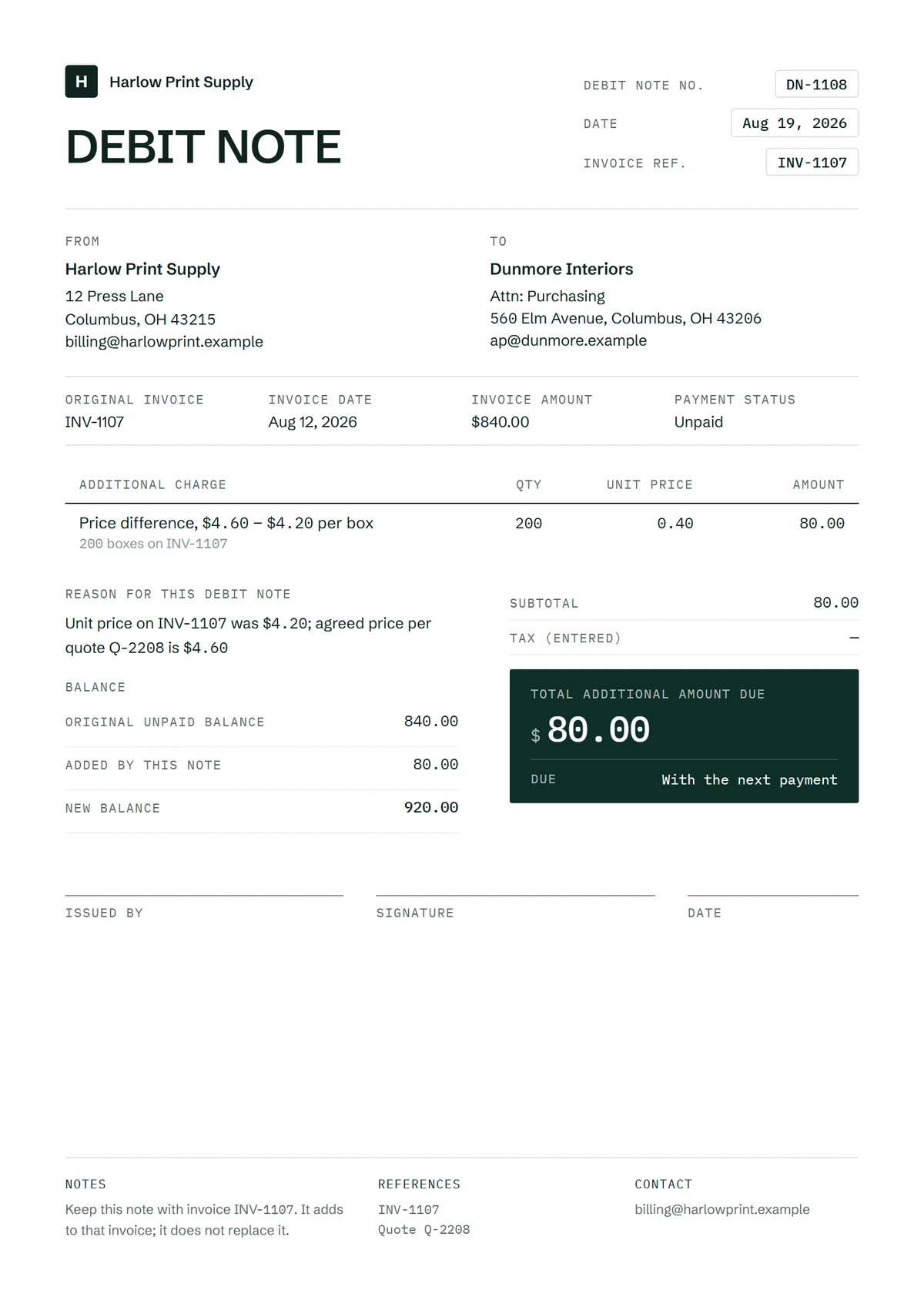
Price adjustment sample (DN-1108)
200 boxes × $0.40 = $80.00; new balance $920.00.
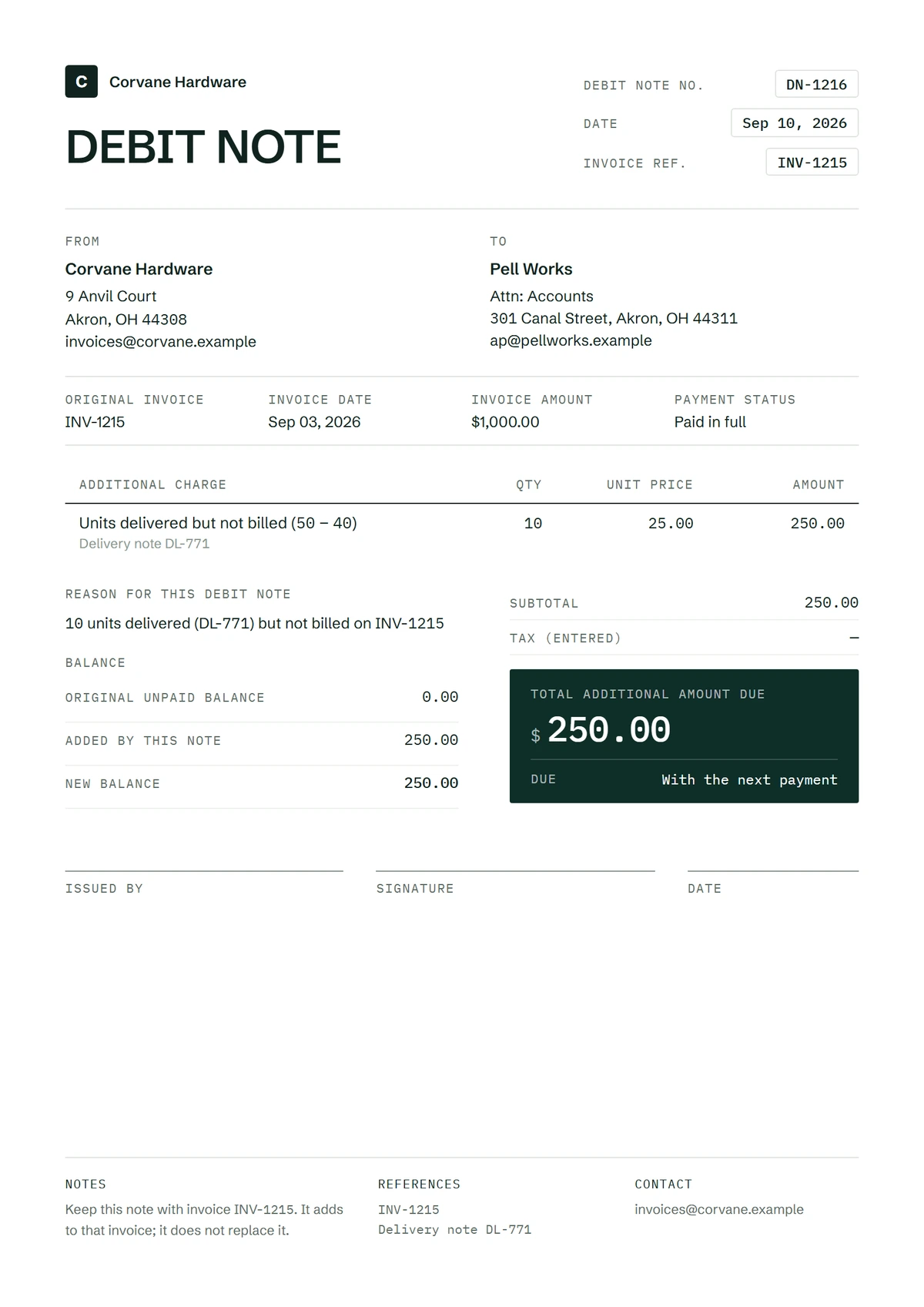
Short-billed quantity sample (DN-1216)
10 units × $25.00 = $250.00 on a paid invoice; new balance $250.00.
COMPARISON
A debit memo adds an amount to a balance and a credit memo takes an amount off it, but which party sends each depends on whose books you are reading. For a seller correcting its own invoice, the debit memo raises what the customer owes and the credit memo lowers it. For a buyer, the debit memo asks the supplier for a lower payable and the supplier’s credit memo grants it.
| Debit memo | Credit memo | |
|---|---|---|
| Effect on the invoice balance (seller view) | Increases it | Decreases it |
| Typical trigger | Underbilling, omitted charge, price difference | Return, overbilling, discount agreed after billing |
| Usual issuer | Seller (to add), buyer (to request a reduction), bank (to charge) | Seller (to reduce), bank (to credit an account) |
| Seller's entry | Debit Accounts Receivable, credit Sales Revenue | Debit Sales Returns or Revenue, credit Accounts Receivable |
| Buyer's entry on receiving it | Debit expense or Inventory, credit Accounts Payable | Debit Accounts Payable, credit expense or Inventory |
| Example (INV-1007) | $500.00 + $50.00 = $550.00 | $500.00 − $50.00 = $450.00 |
When a buyer sends a debit memo, the supplier’s usual reply is a credit memo for the same amount. Read the issuer line first, because the same word on two documents can point in opposite directions.
An invoice bills the original sale, a debit memo adjusts one that already exists, and a billing statement lists invoices, payments and adjustments across a period. A billing statement template pulls all three onto one page.
A debit memo adds to an existing balance; a credit memo reduces it. On INV-1007, $500.00 + $50.00 = $550.00, while $500.00 − $50.00 = $450.00. See debit note vs credit note for the full comparison.
For UK VAT, HMRC says a debit note might be issued instead of a supplementary invoice when the amount due increases (VATREC13010).
TEMPLATE
Use the debit note template as a fillable debit memo: identify the issuer and recipient, link the memo to the original invoice, state the reason, and show each adjustment line. The same fields work for a seller’s additional-charge use; a buyer request should say that credit is requested rather than presenting the amount as a new charge. Open the debit note template to fill it online or download a copy.
| Template field | What to enter |
|---|---|
| Memo number and date | A unique reference for this memo and its issue date. |
| From and to | The buyer or seller issuing it, and the supplier or customer receiving it. |
| Original invoice | Invoice number and date the memo relates to. |
| Reason | The omitted charge, price change, return or other adjustment. |
| Adjustment lines | Description, quantity, unit amount and line total. |
| New balance | Original invoice amount plus an added charge, or the requested reduced payable. |
Fill the six fields in order and the memo is ready to send, with a buyer’s version worded as a request.
HOW TO
Reference the original invoice or order number and date.
State the reason for the adjustment in one clear line.
Show the quantity multiplied by the unit difference.
Say whether it is a request or an agreed adjustment.
Write the revised balance.
Number the memo and keep a copy with the account record.
FAQ
For a seller billing an extra amount against an earlier invoice, the terms are often used for the same kind of document. “Debit memo” is common in the United States; “debit note” is common in other regions. The layout and the fields are the same in both.
It records an amount the bank took from the account outside a check or card payment, such as a service or wire fee. The money has already left, so you record it in your books. Check the date and description line against your bank feed first.
For an invoice adjustment, include the original invoice number and date so the other party can match the memo to the transaction. A bank debit memo has no invoice number.
Both can, and so can a bank. A seller issues one to add to an invoice, a buyer issues one to ask for a reduction, and a bank posts one to charge an account. Read the issuer line before you act on it.
No. The invoice stays as issued and the memo sits beside it. Together they give the new balance: $500.00 + $50.00 = $550.00 for a seller's debit memo, or $500.00 − $50.00 = $450.00 when a buyer's request is granted.
A seller's debit memo is a bill for an extra amount, so you pay it on the terms printed on it once it matches the invoice and your agreement. A buyer's debit memo is a request, and nothing changes until the supplier replies with a credit memo. If the figures do not match your invoice, ask the sender for the source document before paying.
Tax invoice requirements differ by country. See the country notes on the debit note template before you issue one. A debit memo adjusts an invoice that exists and does not stand in for it.
Yes. Issue a credit memo for the same amount that cites the debit memo's number, so both stay on the record and net to zero. Neither document is deleted, so an auditor can follow the correction from start to finish.
Fill it online or download a PDF, Word or Excel copy.